The Smith Manoeuvre – A Wealth Strategy (Part 2)
As a recap, the Smith Manoeuvre is a wealth strategy that converts a non tax deductible Canadian mortgage into a tax deductible investment loan. As promised from Part 1 of this series, I will be going into more detail regarding the Smith Manoeuvre(SM) and some common questions that people have. I am by no means an expert in the SM where I’m not even using it myself. I do, however, plan on implementing this technique in the near future and I’m usually pretty analytical when it comes to big financial decisions.
One popular question I often read about is how a person is supposed to pay for both the mortgage AND the HELOC at the same time?
- This is a probably among the biggest concerns as the borrower will be responsible for BOTH payments while implementing the SM. This includes your primary mortgage (principle + interest) along with your HELOC (interest only). Seems a bit steep hey? Say you get a $100k HELOC @ 6% (prime), that’s an extra $500/month on top of your existing mortgage payment.
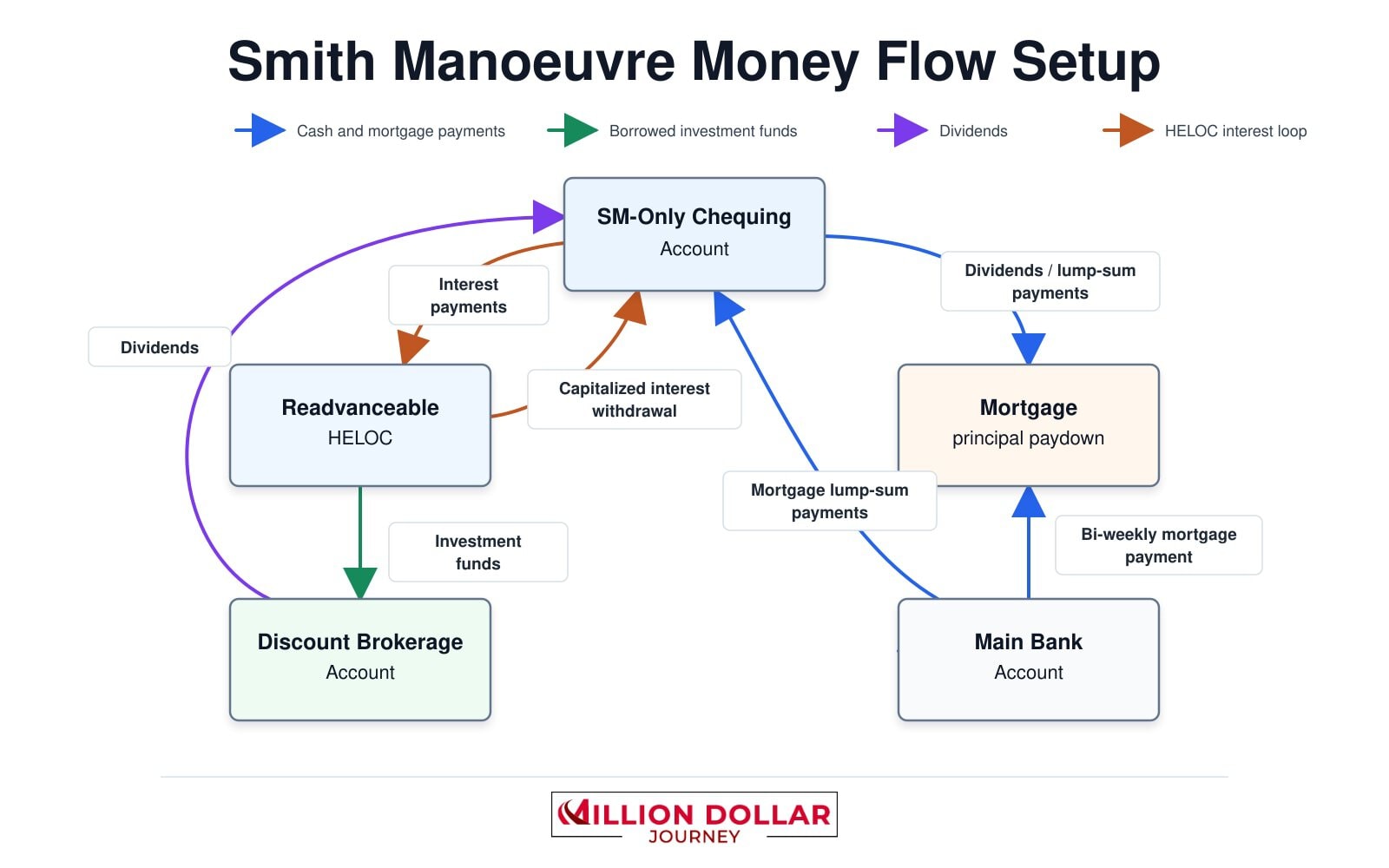
- I’ve actually emailed Fraser Smith about this issue and he said to “capitalize the interest” on the HELOC. Scratching your head yet? Capitalizing the interest simply means to withdraw the monthly interest due from the HELOC account and redeposit the amount as a payment. Apparently, most credit unions will allow this but some banks will not. You’ll have to check your specific lender for the details.
- If you capitalize the interest, you will never make the extra interest payments out of your own pocket while your primary mortgage exists.
- You will only start paying the HELOC interest out of pocket/cashflow when the primary non-deductible mortgage is paid off. So as you can see, using the Smith Manoeuvre, you will always have a payment. It never goes away. However, the payments are now tax deductible.
Another popular question is why would you need 25% 20% down to start the Smith Manoeuvre?
- The reason is that most of the re-advancable mortgages out there REQUIRE 25% 20% down. The mortgages that do NOT require 25% 20% down will charge an extra CMHC fee. The Canadian government has introduced legislation that will reduce the 25% down payment requirement to 20%.
What are some investment options for the Smith Manoeuvre?
- As you already know, I’m just some obsessive compulsive personal finance guy who is NOT a financial planner. So take my advice at your own risk. However, with that said, when I start using the Smith Manoeuvre I plan on using the money to purchase steadily growing dividend paying stocks/mutual funds/ETFs.
Why dividend stocks do you ask?
- I believe that investing in mostly Canadian dividend paying stocks/mutual funds/ETFs is the most efficient way to implement the SM. The reason being is that Canadian dividends of strong companies (like the big banks) have a history of increasing dividends that can be used to pay down the non-deductible mortgage. Why not just buy interest bearing bonds or GICs? Publicly traded companies that pay dividends in Canada are eligible for the enhanced dividend tax credit which results in a substantial tax break for dividends compared to interest bearing income.
- To summarize, the strong dividend company (if history is any guide), will increase their dividend on a regular basis AND you will receive a tax credit for any dividend income that you receive. Putting the dividend income and the annual tax refund towards the non-deductible mortgage will make the conversion from bad (non-deductible) to good (deductible) debt even quicker.
So that’s my strategy for my next home. Sell off my non-registered portfolio, put >20% down, obtain a re-advanceable mortgage, take the HELOC money and invest in dividend paying stocks (mostly Canadian).
If you are currently using the Smith Manoeuvre, I would appreciate any comments that you may have regarding your experiences and if my strategy is sound.
Other articles related to The Smith Manoeuvre Strategy:
- How to keep your investment loan tax deductible.
- Manulife One Mortgage Review
- Smith Manoeuvre Spreadsheet / Calculator
- Anti-Smith Manoeuvre?
- Smith Manoeuvre Strategy – The Rempel Maximum
- Re-Advancable Mortgage Comparison
- Using the Smith Manoeuvre – My Scenario


422 Comments, Comment or Ping
2. Q Cash
Frugal
I never used the smith manouver (didn’t hear about it until after I had paid off the mortgage on my principle residence.) but in theory I think it makes good sense.
I admit I haven’t read it all the way through, but in your situation (considering your age and future plans), wouldn’t you be better off paying down your mortgage faster and taking the interest savings and reinvesting them directly to generate cash flow.
From my limited understanding of the smith manouver, it does not generate any extra income, in fact it may cost more cash flow.
Just my thoughts.
Q
Dec 15th, 2006 @ 11:22 am
3. FrugalTrader
Hey QCash!
That is a very interesting point of view!
I would need a spreadsheet to calculate the difference between using the SM or just paying down the mortgage. Actually, I believe that http://www.smithman.net has some scenarios that does the calculations for us.
From my point of view though, why not pay down the mortgage faster using the Smith Manoeuvre and use the portfolio to invest in dividends which give you more cashflow? Using the tax refund at the end of the year towards the mortgage should help speed the process. The SM does not cost you any cashflow as you can “capitalize” the interest meaning you can use the loan for pay for the loan interest payments.
FrugalTrader
Dec 15th, 2006 @ 12:44 pm
4. Q Cash
FT
Like I said, I am not too familiar with the whole concept of the smith manouver but I will check out the site. Thx.
As for the smithman and your scenario, if you can do both, that is fabulous, but be careful with “capitalizing” the interest, because now you are paying more interest on the loan (yes it is deductible but only at 45% rate).
You are on the right track, regardless of how you structure it for tax purposes.
I did get one good piece of advice early on though, don’t just invest in something because of the tax-break, make sure it is a sound investment first and foremost. If you are using the “extra” equity room through the smithman to buy dividend paying blue chip stocks, I doubt you will go too far wrong. But also keep in mind that dividends as a percentage of capital invested are not that high.
The fastest, easiest and most tax efficient way to increase your net worth is to eliminate your non-deductable liabilities.
Q
Dec 15th, 2006 @ 1:59 pm
5. Q Cash
BTW
I have added your blog to my daily read, so I wish you all the best.
You asked earlier what other saving strategies I used, well, we are definitely in agreement with the used car approach (although deep down I still want one of those pontiac solstices :-)
My wife is a fan of garage saling and it is her summer hobby. Every Saturday morning she gets up at some ridiculous hour to go scavenge through other people’s junk. But she has managed to get tonnes and tonnes of kids stuff dirt cheap (books, toys, big plastic things that clutter up our back deck) but at a hugely reduced cost.
I also set up an ING account with a direct deposit on the same day as my paycheque to save towards a rainy day.
I use Microsoft Money to track investments and cash flow and spending. I am entirely too obsessive about it, but it keeps me happy knowing how much of our monthly grocery budget we have spent so far each month.
Q
Dec 15th, 2006 @ 2:04 pm
6. FrugalTrader
Again, great advice QCash.
That is the reason why I like the SM so much, b/c it quickly pays down the largest non-ded debt that most people have, their principle mortgage! Yes, i do plan on purchasing mostly dividend paying stocks with the HELOC and perhaps a small portion to trade/play with. As with any leverage there is a risk involved with the strategy but can be minimized with a well thought out portfolio.
I am the same way with MSMONEY, i keep track of every single expense that we have. My wife calls me obsessive compulsive. :)
So how do you split up your savings? A portion goes to your ING the rest go to investment accounts like RRSP and non-reg investment accounts?
FT
Dec 15th, 2006 @ 2:39 pm
7. Ed Rempel
Hi, Frugal,
Great summary of the SM. We are the main Smith Manoeuvre advisors in the Toronto area and have implemented it for more than 100 families, including many variations and enhancement strategies.
You summary is quite good. A couple of tips:
1. You can do it with as little as 10% down, as there are a couple of sources for 90% readvanceable mortgages.
2. No institution will capitalize the interest, but you can do it yourself with one simple transaction a month. This way, the SM uses none of your cash flow. The reason for this is that any of your cashflow used for debt should pay non-deductible debt.
3. After the mortgage is gone, the most effective strategy is to keep the investment credit line for ever. Once you are retired, there you will be very thankful for both this tax deduction and for having a large non-RRSP portfolio. For our retired clients with large RRSP’s and a large non-RRSP portfolio, tax planning is full of options. This is in contrast to those with only RRSP’s and pensions, who have no cash available they can take without paying full tax.
4. You’re right that the only real risk is the investments. Your dividend stock idea is sound, as long as you diversify enough. We tend to use tax-efficient mutual funds with what we call “all-star fund managers” (the Wayne Gretzky’s of the the investment world). We get good diverification, a long track record, stats to measure risk, and many have been 100% tax-efficient.
Good luck and I hope you find this helpful.
Ed
Dec 17th, 2006 @ 12:55 am
8. FrugalTrader
Hey Ed!
Thanks for the tips!
So when you say that I can capitalize the interest myself, does that mean to withdraw the amount needed from the HELOC then redeposit it?
Also, when you get 90% readvancable mortgages, CMHC fees apply yes?
FT
Dec 17th, 2006 @ 11:56 am
9. Q Cash
FT
A couple of comments about the SM. I did a little (very little) reading about it and it seems to me that while the idea is sound, I am concerned that it still involves leveraging your personal residence to make investments.
Taking what you posted in your Net worth post, wouldn’t it make more sense to flip your 38K in non-registered portfolio into the SM and then just keep paying down the non-interest bearing debt?
Also, you have a rental property. How much is that leveraged for currently? (if you don’t mind me asking). If you have room on the property, you probably can use that extra equity to leverage some investments, if you feel comfortable doing it.
Also, I remain skeptical of “capitalizing” the interest. You pay 500 in interest, you get a deduction of 500, but at 46% tax bracket you see a net cash flow of -270 (500 interest out – 230 tax reduction in). Plus the 500 is now adding extra interest costs.
I think you have to look at as “I have a mortgage of 75% of my house value and the payment will be X for the next 25 years” part of that X will be deductible, part will not.
I am probably more conservative in that I don’t believe in leveraging my principle residence to invest.
Just some added extra thoughts. Not to disuade you from investing using the SM, but just make sure you plan it out and look at the real cost/benefits.
Q
Dec 17th, 2006 @ 10:08 pm
10. FrugalTrader
Q Cash,
I am aware of the risks of leverage and leveraging my personal residence to make investments. My rationale is that I will be investing for the long term, probably buying stock and never selling them, just collect dividends.
The loan to value on my rental is approximately 75% right now, as I just purchased the property about a year ago. So, it’s not enough to get a HELOC out of that without paying CMHC fees.
When you capitalize the interest, you use the HELOC to pay the interest costs. For example, if you owe $500/month in interest, you simply withdraw the $500 out of your heloc and redesposit it. $0 out of your cashflow.
Yes, the risks involved can be substantial if you are not careful. I will have to take the time to review the risks carefully before I dive in.
Thanks again for your thoughts.
FT
Dec 18th, 2006 @ 8:54 am
11. Neil F
This is an interesting blog. I use leveraging to make my mortgage interest deductible. Obviously, I think it is a good strategy, but I am already into the fray for a few years now, and the project is providing handsome rewards given the large returns in the equity markets the past few years, and incredibly low interest rates. It makes it look like a no brainer, but it was far from a no brainer when I dove in. You can’t predict what the markets are going to do (otherwise, you would be on a beach in Bermuda talking about your first 100 million rather than blogging about when your first 1 million will be). If it was a sure thing that the markets were going to go up, everyone would be levaraging. But as one poster indicated above, levaraging is risky business that cuts both ways. Optimists see handsome returns and large retirement portfolios. Pessimists see losses and cash calls. If you undertook this maneuver with a lump sum investment from a HELOC in January 1973, you would be wishing you never heard of the Smith Maneuver.
” I will have to take the time to review the risks carefully before I dive in.”
I think these words are very appropriate in this dicussion. The risk is a bear market at the beginning of your journey that could take two decades to recover from, all the while you are paying interest on a loan with only a fraction of the funds to show for what you borrowed. That’s a tough pill to swallow, and therefore, this strategy is really not for the faint of heart, and is far from a sure thing.
NF
Dec 19th, 2006 @ 11:50 pm
12. FrugalTrader
Hey NF!
Thanks for your comments. Yes, I think the only way to go when leveraging to invest for the long term is to purchase recession “resistant” stocks like the big blue chips that have a good dividend track record.
My problem is that i’m an eternal optimist. :)
What investment strategy would you follow if you were to start today?
FT
Dec 20th, 2006 @ 7:06 am
13. Neil F
If I were to start today, I would have the same portfolio I have now which is diversified globally and in market cap. When I started, I crossed my fingers, and hoped that if the US or Canada (or both!) tanked, EAFE and fixed income positions would limit the losses. Diversification is your only protection, but nothing is guaranteed since the only thing certain about the stock market is its unpredictability.
NF
Dec 20th, 2006 @ 9:14 pm
14. FrugalTrader
Neil,
Do you purchase your own stocks? Or do you own mutual funds? Or Both?
I like strong dividend paying companies because even if the markets tank, there’s a very high probability that you’ll still receive your dividend payment. According to historical data that is. With the dividends typically growing on an annual basis, it’s only a matter of time before your dividends received exceed the required interest payment on the loan. That is provided that prime doesn’t go through the roof and even if that does happen, you are hedged as the interest is tax deductible.
FT
Dec 21st, 2006 @ 7:13 am
15. Neil F
I am a do-it-yourself investor using a discount brokerage. While I have dabbled in individual stocks in the past, I generally did not guess very well, and gave up that exciting game for a boring portfolio of diversified low cost ETF’s.
Dec 22nd, 2006 @ 1:47 am
16. FrugalTrader
Hi Neil,
Do you focus primarily on income producing ETF’s? Which ETF’s are your favorite?
FT
Dec 22nd, 2006 @ 7:00 am
17. QuickQuestion
Very nice job on the article. You state (and I’ve seen it stated in other sites) that the strategy should be to pay off the non-deductable mortgage with cash or other non-RSP investments first and then re-borrow to fund the SM.
What if the non-deductable mortgage is less interest than the credit line minus the tax deduction? Eg. non-deductable mortgage at 4%, Line of Credit at 6% and 30% tax bracket = 4.2%. In this case, does it still make sense to sell a non-RSP investment to pay off the non-deductable mortgage and then reborrow to pay re-buy the non-rsp investment?
Dec 24th, 2006 @ 4:59 am
18. FrugalTrader
Hey QuickQuestion!
Great question.
That is an interesting point as it seems that it wouldn’t make much sense. In your case, I would think that taking your money and just paying down your mortgage would be best. However, you also have to consider how long your 4% non ded rate is going to last. You probably obtained that rate around 3 years ago, when you renew, do you think you’ll get the same rate? Rates are around 5% for 5 year fixed today.
FT
Dec 24th, 2006 @ 8:46 am
19. Ed Rempel
Hi, FT, Q & Neil,
I’ve just been reading all the comments. FT, yes, I think you have the capitalizing right. You pay the interest from your chequing and then take the money out of the credit line to reimburse yourself for paying the interest. And yes, there are of course CMHC fees involved if you go to 90%.
The tax rule is that, if the interest is tax deductible, then the interest on the interest is also tax deductible, which is why capitalizing is useful. Why use your cash to pay tax-deductible interest when you also have non-deductible interest to pay (such as your mortgage).
You all mentioned reviewing the risks carefully before diving in. The strategy and tax rules are simple and work. The only real risk is with the investments. If you invest effectively, can tolerate the risk and will stay invested for the long term, then the SM is very profitable.
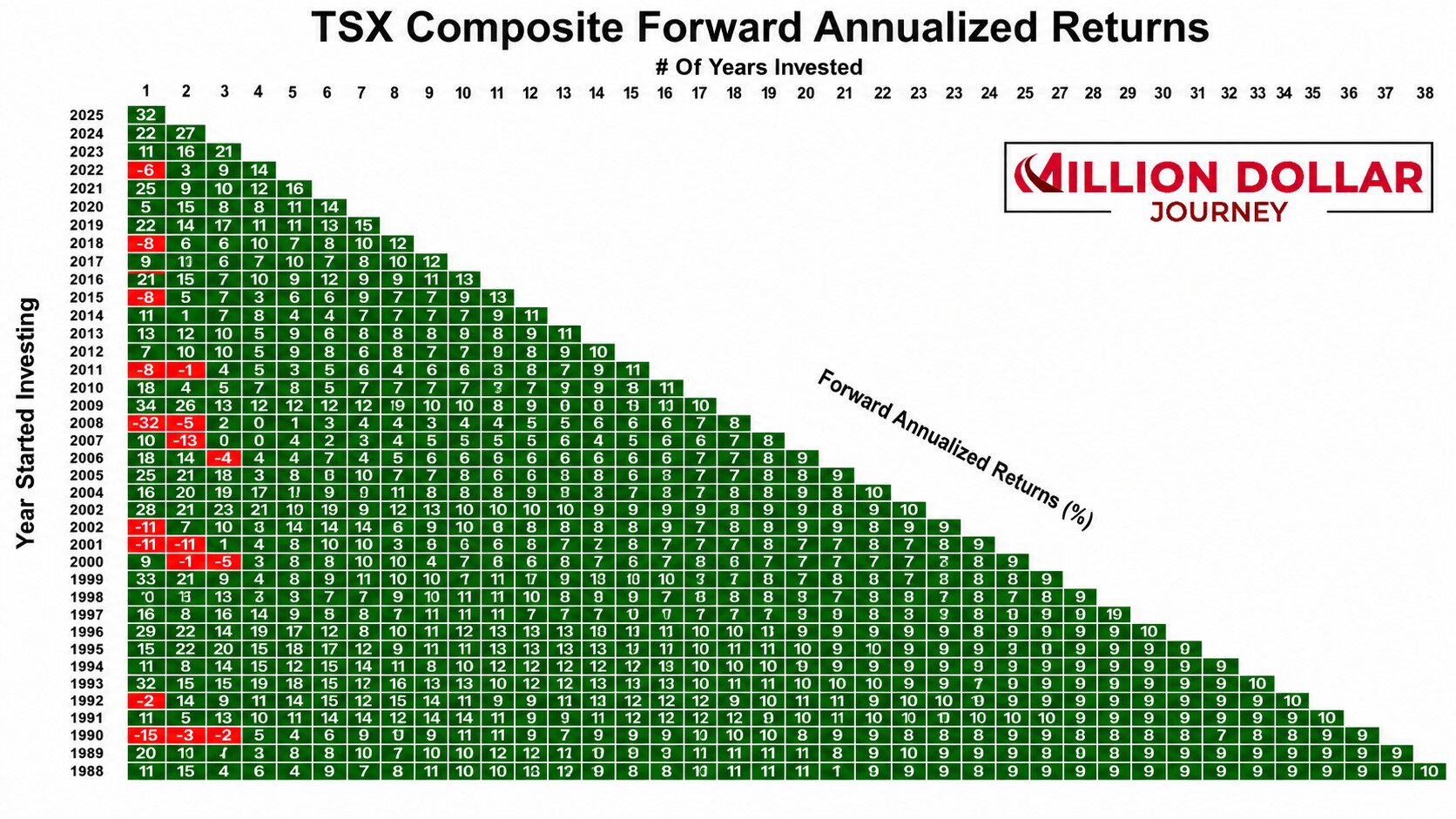
Neil, you have exaggerated the risks of the stock market, like most people do. The figures often shown about the markets being down for 20 years always exclude dividends. The longest period the markets have been down since the 1930’s has been 6 years, when you take the total return. This was from 1973 and from 2000, which were the 2 largest bear markets in the last 60 years.
FT, your dividend strategy is sound, but dividend stocks have had a perfect storm lately. Long term, you should only expect 8-10% from dividend stocks, since they are very mature companies.
We tend to use equity mutual funds managed by managers with long term records of beating the indexes at low risks than the markets. There are managers with 15-30 year records of beating the markets by wide margins with returns of 15-19%after all fees) and lower standard deviations.
The advantages of mutual funds are that many come in tax-efficient corporate structures, so that they have never paid a distribution. With dividend stocks or fixed income investments, you lose much of the gain to annual tax on the investments. The risk is measureable when there is a long term track record and mutual funds offer all kinds of risk stats (such as standard deviation, alpha, beta, etc., and correlation between investments). The risk stats vary in different markets, but if you look at them in the worst times (such as 2000-2), you can be relatively confident that that is about as bad as it will ever get.
The main risk that you do-it-yourselfers face is trying to time markets or trade. Several studies show that the average investor only makes 1/3 of the investments they own, because they tend to always buy high (something currently “doing well”) and sell low (something currently “not doing well”). It is always tempting to sell when your dividend stock or ETF struggles and to buy something that has just had a few good years.
This is actually your main risk, since studies consistently show that the average investor loses most of their return by trading, because trading consistently means selling low and buying high. Your best strategy is to research your investments well and then hold them forever, especially if they go through a few bad years. Only own investments that you would be comfortable owning all the way through bear markets.
Hope you find this helpful.
Ed
Dec 30th, 2006 @ 6:15 pm
20. FrugalTrader
Great comment Ed, thank you for your insights.
FT
Dec 30th, 2006 @ 11:31 pm
21. ezboy
Ed,
Where do you buy these mutual funds with 15%-19% return after fees? I’ve been looking for them. I searched through MorningStar.ca, the best funds with over ten years track record are mostly Canadian dividend funds managed by the banks. They only made between 13% to 14% for the last ten years.
FT,
Your article is marvelous.
There is only one thing I can add. Going through all the comment, I realize that a lot of people have the perception that the Smith Manoeuvre is pretty risky. It is not. It is much less risky than the original purchase of the primary residence.
Let’s thing about it. For the original home purchase, if you had put a 30% down, you had 3.3 times leverage on that investment. If you had put only 10% down, that was a 10 times leverage. And, the worse part, the whole quarter million to half million investment was made in a single shot, at one particular market price.
On the other hand, when you employ the Smith Manoeuvre, you are only taking out the portion of your home equity which you already paid off. Technically, you are not leveraging at all. On top of that, you can take out a fixed dollar amount every month from your HELOC to invest on your favourite stock or mutual fund. You get the advantage of dollar cost averaging. That is, it really doesn’t matter whether the market goes up or down in the short or medium term. If the price goes down, you accumulate more shares, if the price goes up, you accumulate less shares.
As long as your stock or mutual fund grows faster than your interest cost in the long run, you are ahead on the investment. You don’t even have to play the risky game of market timing like the purchase of your residential investment.
Let’s look at some hard number. Between 1978 and 2005, the average price of Vancouver’s detached house rose from 77,778 to 658,910, the volatility was 21.72%, annualized price increase was 8.24%. In that same period, the TSX Composite Total Return Index rose from 1,436 to 26,619, the volatility was 16.31%, average yearly gain was 12.58%, annualized gain was 11.42%. In that 27 years, the average detached house price in Vancouver rose 3.18% less than the TSX Composite Total Return Index per year, but the volatility (aka risk) was 5.41% higher.
So, if you were in Vancouver, the SM approach for investing is less risky than the detached house investment.
Let’s look at the investment return. In that 27 years, your average HELOC interest rate would be 10.84%. If you were in the 30% tax bracket, that would reduce your effective interest cost to 7.4%. Your investment funded by the home equity would have made a 4.02% annual return. That only beat inflation by a little, but that is extra return in addition to the price gain of your primary residence. And you did not invest any extra money out of your pocket. Thanks to Fraser Smith.
Best wishes on your million dollar journey.
EZ
Jan 16th, 2007 @ 3:50 am
22. FrugalTrader
Good comment EZ. I like how you backed up your opinion by cold hard numbers.
FT
Jan 16th, 2007 @ 7:34 am
23. L-Shaped Tetris Block
I’m planning to implement the Smith Manoeuvre on a 65% mortgage totalling $215,000 (huge down payment) new condo unit here in Toronto.
Can anyone recommend a financial consultant who can take me through this? I don’t really feel like calling up the 60 or so qualified individuals listed at http://www.smithman.net :/
Jan 24th, 2007 @ 11:29 pm
24. Fred Snodgrass
FT,
I went to a Smith Manoeuvre presentation in Calgary in the fall and implemented it the next day. It was easy for me to implement as I have a Manulife One mortgage, so setting up a sub-account to track the interest in my “Investment Line of Credit” involved a simple phone call. The monthly interest for my Investment Line of Credit is automatically added to my main Manulife One balance, but I simply reverse this transaction manually each month.
For the investing end of the equation, I’ve set up an account with Shareowner and I transfer the “paid down” portion for that month into my Shareowner account every month, and have that amount equally invested in 15 securities.
Anyway, this all may sound complicated, but it really is very easy and straightforward.
Jan 29th, 2007 @ 3:53 pm
25. FrugalTrader
Hey Fred,
Thanks for your explanation. What is your investment strategy?
FT
Jan 29th, 2007 @ 5:11 pm
26. Splash
I would first off like to commend you on the excellent post FT. I have been researching the SM for a few months now and am seriously considering it with my next home purchase.
I agree mostly with what everyone has stated in the comments, however I feel that one incredibly important point is being missed.
Ezboy stated “As long as your stock or mutual fund grows faster than your interest cost in the long run, you are ahead on the investment.” While this is true, no one has mentioned the compounding interest benefits associated with converting your home equity using the SM.
The tax benefits alone make this procedure intriguing, but who wouldn’t want to convert what is essentially stagnant home equity (not quite, I know) to an investment that includes compounding interest. If left for a long enough time, this compounded interest will greatly increase the SM’s benefits.
Great blog, I plan on following it often myself. Keep up the good work.
Jan 30th, 2007 @ 10:34 am
27. FrugalTrader
Hey Splash,
Thanks for your comments.
There are some arguments that the risks involved outweigh the benefits. My counter argument is if you’re planning on living in the home for the long term, and investing for the long term (investing in strong dividend paying co’s), why would a down market in real estate or stock market bother you? Just keep collecting those increasing dividends (which are resilient to market down turns), and the market will turn around eventually.
FT
Jan 30th, 2007 @ 11:05 am
28. Ed Rempel
Hey, Ezboy,
Great analysis about risks and returns.
Risks:
I didn’t realize Vancouver real estate was that risky. Here in Toronto, the way I look at it is that the largest ever decline from top to bottom in the TSX was 43% and the largest ever in Toronto real estate was 28%. So, real estate is 2/3 as risky as the stock market.
Meanwhile, real estate (Toronto Real Estate Board) since 1977 is up 6.0%, GIC’s 7.7%, TSX 12.3% and S&P500 12.6%. The cumulative return on GIC’s is double that of real estate for the last 30 years (most people are shocked by this) and stocks have 6 times the growth of real estate.
So, stocks have 6 times the growth and while real estate is 2/3 as risky – and yet we Canadians tend to believe leveraging into a house is very safe, while leveraging into stocks is scary. This is one of many financial “conventional wisdoms” that are not supported by the facts.
Returns:
The fund managers I referred to with returns of 15-19% for periods of 15-30 years result from studying the fund manager in whatever fund he has been in – not the fund. Most of these have either been contracted with different funds over that time or were only available outside of Canada until more recently. However, they have owned their own investment firm continuously for the entire period. The trick is to study the fund managers, not the funds.
Just to be clear, I’m not saying they will continue to make 15%+ returns, only that if you hire Gretzky, you should get much higher returns than average (market). Returns will probably be generally lower going forward, since we are in a low inflation environment.
By the way, none of the funds with more than 15% return for the last 10 years on Morningstar are bank dividend funds. Most of those are hedge funds or sector funds. And only one of them has had the same manager for that period. Again, you need to study the manager and his management firm – not the fund.
Ed
Jan 30th, 2007 @ 11:11 pm
29. Ed Rempel
Tetris,
If you need help setting up the SM, we are the main SM advisors in the GTA with over 150 families doing the SM monthly. We are only looking for serious clients, though, so we will want you to attend one of our unique seminars before we would meet. It is not a waste of time, since we address the main issues (mainly emotional & investment). 2/3 of our seminar is not in the SM book.
If you are a do-it-yourselfer, we can still help you get the right mortgage. We know the pros and cons of every SM mortgage and have contacts with the banks (some of the big 5) with the best SM mortgages.
Click on my name if you want any more info.
Ed
Jan 30th, 2007 @ 11:29 pm
30. Shaun
My main concern: The SM, while creating a tax deduction out of your mortgage, creates a situation where the resulting investment portfolio return is constrained by taxation issues (capital gains). As I see it using the SM, you either invest aggressively and pay the capital gains, thereby losing precious investment funds, or use special classes of mutual funds to avoid the taxes until withdrawal time. Either way, the portfolio you are building is either losing opportunity for compound interest because of the gains tax, or because of the reduced return of these special funds (Ed’s comment aside!).
Now, I wonder if the best approach is to ensure that your RRSP is maxed, and build your investment portfolio tax sheltered?
* RRSP Example:
For example, say I have $50k of RRSP room, and I borrow from the house for it, and deposit it to my RRSP. The taxman @ 40% returns $20k now, so I have 70k to invest. Compounding that over 10 years at 15%, I have $283k, with interest costs on the borrowed $50k @ 6% = $30k. Net pre-tax on my borrowed money: 253k.
* SM Example:
I SM $50k from my mortgage. Annual interest on the 50k @ 6% is 3k. This is tax deductible tho, so assuming the same 40% tax rate above, gives me a return of 1.2k. If I add that annually, and assuming I can compound at 15%, my portfolio is: $230k. But that assumes NO capital gains. So, if we assume 1.2k paid in capital gains, the portfolio goes to $202k, or if we assume we are in the special mutual funds with no capital gains, but a return of 10% we get $151k (that includes the 1.2k added annually).
* Now, the SM has the advantage of the tax deduction annually, whereas the RRSP does not. So, what happens if we extend this out to 20 years?
The RRSP portfolio assuming 15% growth: $1,146,000, minus $160,000 of interest = $986,000
The SM portfolio, adding the tax deduction of $1.2k annually, no capital gains and 10% growth, minus $64,000 of interest (the non-refunded portion): $348,000
Conclusion:
1) I believe for Canadians with maxed out RRSP’s and home equity, the SM is a good approach for tax savings; for everyone else no!
2) The hype is due in part the profits of interested parties: lenders win, and financial advisors win: they have a shot at a piece of your pie because of the complexity
3) I am going to focus on maxing my RRSP’s every year, so I can compound my way to retirement!
Ed, prove me wrong, and you might just have another client!
Jan 31st, 2007 @ 12:32 am
31. FrugalTrader
Shaun:
Valid points, but you neglect to point out the effects of taxation @ RETIREMENT. With an RRSP, your portfolio is taxable as INCOME upon withdrawal. Your SM account though will face the preferential tax treatments of capital gains and dividends (my article on investment taxes).
You also give the RRSP an annual return of 15% and the SM an annual return of 10%. Is this realistic? If you earned $150 in capital gains in a taxable account, only $75 is taxable, which would probably leave you with around $120 after taxes. So 12% would be a fair annual return for the SM assuming 15% for RRSP.
On top of that, I believe that an efficient way to invest the SM money is through the purchase of dividend paying co’s (Canadian preferably). Buy strong dividend paying companies, never sell, collect increasing dividends/year. In certain tax brackets and provinces, you can pay as little as 0% on dividend income (article to follow). Does your analysis change then? So with this scenario, you get TAX FREE SM growth, a tax deduction / year, AND reduced taxation at retirement. I will bet that this scenario will beat the RRSP every time(providing that you invest in the same vehicles in the RRSP).
I’m not saying that the RRSP is a bad way to go. I think it would be prudent to build BOTH your RRSP and SM. Both have their advantages.
ED:
Thanks for your insights. However, I’m not sure that I agree with your statement that you’re “leveraging real estate”. I would agree with that statement IF you used the HELOC money to buy rental property, not stocks.
FT
Jan 31st, 2007 @ 7:01 am
32. Shaun
Your point on dividend investments is interesting (no pun intended), but I would re-enforce what Ed says: They are investments that are not growth stocks. They are mature companies that produce dividends, not spectacular growth. That’s okay, but you are not going to get a high average returns using that strategy. I would even say you are not going to get what the SM advisors talk about. (Which by the way, after meeting a SM advisor last week, he would talk about 7-8% returns). Also the special tax treatment only applies to Canadian dividend investments as well. So, my original point still stands: The SM creates a portfolio that is constrained by tax issues (not that you get deal with them, but they are constraints).
Think of it this way, the SM gives you a tax incentive as long as you hold the loan, the RSP gives you a tax incentive upfront, and as long as you hold the RSP. The magic of compound interest is going to work better for the RSP sheltered investments. So the question becomes, who has the better retirement?
Using the hypothetical results in my previous post, let’s assume my wife and I are looking for an after tax retirement income of $66,000. What would we each need to withdraw to make that happen?
SM – Withdraw $40k
In Ontario the marginal tax rate for $40k is 22%.
Not sure how to correctly calculate the gain taxes on a partial withdrawal from the investment portfolio. Let’s assume the withdrawal is fully taxed as a gain:
Gains Taxes due: 40k/2 * .22 = $4400
Loan interest: $3000
Interest refund: $660 (your marginal tax rate is now 22%)
Total interest/taxes paid: $6700
Household income after taxes: $33,300 x 2 = $66k
RSP – Withdraw $46k
In Ontario the marginal tax rate for $46k is 22%.
Income Taxes due: $10000
Loan interest due: $3k
Total interest/taxes paid: $13000
Income after taxes: $33k x 2 = $66k
So, how many years can we each withdraw from our portfolio at that rate?
SM: 348k/40k = 9 years
RRSP: 986k/46k = 21 years
This makes the assumption that when we retire after 20 years, we STOPPED investing. If we continued to invest (of course!) the larger RRSP portfolio does way better.
Consider this: financial advisors that are selling the SM almost always have a conflict of interest: they stand to make good money on your SM. Have you tried to find an advisor that will help you just set it up for just a fee or hourly rate? They are a far and few between. Sounds like Ed does; kudos to him. But all and all, the people marketing and selling this idea to the public are the same ones who stand to profit. If it was just good for you, and nobody else, would be seeing all the hype? I suggest not.
The taxman always gets paid, and the advisors and investment community in generally only get paid by us! I would say look very carefully and run your numbers on this approach before going for it; they are playing with your retirement!
Jan 31st, 2007 @ 10:24 am
33. FrugalTrader
Shaun,
Another great comment, thanks for sharing.
Say that your numbers are correct. Perhaps the SM is NOT a method to REPLACE your RRSP, but to supplement it. Why not invest in both your RRSP AND the Smith Manoeuvre? Not just one or the other? You have a maximum contribution limit / year on your RRSP, and if you capitalize the interest on the SM (see article), you’ll never have to pay for it out of pocket. So it will be kinda like what i’m doing now, maxing out my RRSP, and putting any excess into my non-reg account. Except with the SM, instead of putting the money into my non-reg account, i’d pay down the non-ded mortgage and re-borrow to invest from the HELOC.
A more fair comparison would be SM vs traditional non-reg portfolio/paying down mortgage.
Another point about dividend paying stocks, as long as the dividends keep increasing, the stock price will follow. I doubt that we’ll see growth over the next 5 years as we did see during the last 5 years but they are stable and give you a guaranteed return (providing that you don’t sell on a down turn). If you buy the strong dividend paying stock on a DIP, you will get strong returns.
FT
Jan 31st, 2007 @ 11:01 am
34. Shaun
FrugalTrader,
> Perhaps that SM is NOT a method to REPLACE your RRSP, but to supplement it.
Agreed, but my review finds that there is a serious disadvantage to use it if you have any RRSP room. And since the deduction limits are going up, and currently lots of Canadians have siginificant unused contributions, I wonder who the SM is really for? Smith in the book even suggests you might want dump your RRSPs! I have no idea how that could be justified.
> Say that your numbers are correct
I, like you, am not financial person, so I fully expect the back of the napkin calculation has holes. And the assumptions in the calculations are mine, but I tried to favour the SM where possible. The calc was meant to show big picture: that said, am looking forward to someone taking it further and finding any fatal flaws.
Thanks for the great blog and discussion!
Jan 31st, 2007 @ 11:23 am
35. Shaun
FrugalTrader,
BTW – didn’t me to ignore your other points: I would love to see someone run some scenarios and numbers to see how this compares!
But for me, I know now, that I won’t be using the SM. I am currently 40 years old, married with two kids. We have a house valued at $700,000 and a mortgage of $150,000. From here, I am going to borrow against my HLOC to top up my RRSP deduction limit, and make my maximum RRSP contribution annually, while I pay off my house. Very conservatively at retirement in 20 years, I will have in excess of $2,000,000 in my RSP, and a paid up house worth about $1,200,000 million (assuming 3% annual growth in it’s current value). I think that will keep us happy until death. :-)
I really have no significant experience in dividend paying stocks, but if you have a system that works, just use those numbers in your calculations. The major issue for me has been finding enough growth in the Canadian markets. My portfolio is usually 80% us, 20% cdn; therefore, with my approach, I see no disadvantage to continue investing in my sheltered RSP. I will say the major disadvantage to investing in the US markets within my RSP, is by law, the account can’t hold US cash, so I am always getting dinged on the conversion. There also has been reduced earnings due to the currency fluctuations in the past few years.
Jan 31st, 2007 @ 11:42 am
36. Chris
Shaun, you may want to try using an Excel spreadsheet that someone at Red Flag Deals developed to do an analysis of different SM scenarios. I’ve found it quite helpful.
http://home.cogeco.ca/~pgannon/investment/Readvanceable_Mortgage.xls
Jan 31st, 2007 @ 11:49 am
37. FrugalTrader
Shaun: Congrats on building up your nest egg! Regardless of if you use the SM or not, you will come out just fine in the end. With regards to your USD conversion problem. Apparently, TD bank will allow you to sell your US stock and transfer the money to a USD money market fund, thus avoiding FX fees. I believe it’s called wash trading. Here is the link on Canadian Capitalist for more info.
Chris: Thanks for posting the spreadsheet.
Jan 31st, 2007 @ 11:56 am
38. ezboy
Shaun,
It is true that RSP is the one of the most tax efficienct investment strategy available to Canadians. However, it cannot be used as part of the SM. The evil Tax Act doesn’t allow a taxpayer to deduct interest expense for RSP. This evil details will significantly hurt the return on investment for the RSP strategy.
EZ
Feb 4th, 2007 @ 12:07 am
39. Ezboy
Ed,
Thanks for the insight on how to pick the high return mutual fund. It is a very smart idea to choose the jockey rather than the horse.
Yes, the Vancouver real estate market was pretty volatile in the last three decades. The figures I used was the detached home, the figures for attached home and condos was less volatile. And, with less appreciation of value, it was about 5.8% per year over the last two decade.
EZ
Feb 4th, 2007 @ 12:25 am
40. CK
Hi all,
Thanks for the analysis! This discussion has been more interesting and useful (backed up with cold hard numbers) than the one on Canadian Capitalist.
Ed, your initial calculation that real estate is only up an average of 6.0% since 1977 omitted the fact that, as an investment alone, real estate can generate rental income. The interest portion of the mortgage on a rental property is also tax-deductible. This is nothing significant to disprove your position, but unless you also happen to be a real estate agent, I see some self-serving interest for such omission. Nothing major.
My questions to all:
1. What are the mechanics of “capitalizing the interest”? I guess it means that, for every month, you first make your mortgage payment, draw out sufficient money from the HELOC to make the interest payment for the HELOC, then draw the remaining available credit from the HELOC towards the investment?
2. I am already locked for a mortgage for the next 5 years (just signed the papers today). Is it possible to utilize SM at this stage, if so, what are my options and their relative merits and drawbacks?
3. Does a significant change in income level affect how SM should be implemented?
4. I’m fairly green to mutual funds. What are some good reads, especially ones with Canadian interest?
Thanks all!
Feb 4th, 2007 @ 2:26 am
41. FrugalTrader
Ezboy: Yes, although the SM offers a tax refund, it is NOT a replacement for the RRSP. If you work out the numbers, the RRSP will out perform the SM in the long run.
CK:
1. You are right with the mechanics of capitalizing the interest. Simply withdraw the interest payment required for your heloc FROM your heloc, and redeposit.
2. You can utilize the SM with your new mortgage, IF you have substantial equity in your home (>>25%). The only disadvantage now is that you wont’ be able to get an increasing credit limit on your heloc as you pay it down. If you want to do the SM at this stage, pay down your mortgage as much as you can, or as much as your terms will let you, and obtain a new HELOC. You “could” pay down your mortgage every year, and re-apply to get your HELOC limit increased, but I believe that this will require a new application every time. Another alternative is to take the penalty and move to another mortgage, which is undesirable. If your mortgage is already with RBC, perhaps they’ll switch you to the homeline mortgage for no penalty?
3. Can you clarify this question? Did you mean that if you’re income increased, who should claim the tax deduction?
4. IF you like mutual funds, go to http://www.morningstar.ca, they have a great rating system and screener available.
Hope this helps, FT
Feb 4th, 2007 @ 9:14 am
42. Ezboy
FT,
When I think about it, Shaun’s point on using the HELOC loan for RSP may be a good strategy too. If there is contribution room, the RSP contribution will produce tax refund too.
Yes, you are right, I am going to do the number crunching to see how thing will work out if RSP is used instead of the interest deductable non-registered account. :)
Again, you guys are great.
EZ
Feb 4th, 2007 @ 11:27 am
43. CK
Thanks for the answers. It is a little unfortunate (for us) that we have decided to give SM the green light the night we signed our mortgage (i.e., last night), thus limiting our options on HELOC. Our mortgage is with TD, and I don’t think they have a mortgage product similar to ManulifeOne or RBC’s Homeline.
As it currently stands, we are only borrowing about 65% for the mortgage, leaving us with roughly 10% available credit if we apply for HELOC now. I’m not sure if TD’s HELOC automatically adjusts the available credit every month. If they don’t, how often do we draw money out from the HELOC depends on the hassle required to ask credit increase.
Since it’s RRSP season, we’ll probably wait a month or two before jumping into the market. On the bright side, if we zealously pay off our mortgage for the next quarter, including the capital originally set aside for investment and tax refund (but excluding the RRSP amount), we probably have another 10-15% credit available. It may be better to get our HELOC then.
I was more concerned about reduction of household income than a huge raise. This reduces the amount available for mortgage payment, slowing the process of mortgage-to-HELOC conversion.
On an unrelated note, the math we did to arrive at the decision to go ahead with SM is different from what I’ve read so far.
CK
Feb 4th, 2007 @ 5:23 pm
44. FrugalTrader
CK,
I think that if you max out your RRSP, and use any available money to pay off your mortgage, you’ll come out just fine. After you pay off the mortgage, THEN start investing in non-registered securities. Perhaps if you account for the risk of the SM, you may come out ahead by doing things the old fashioned way.
FT
Feb 4th, 2007 @ 8:00 pm
45. Ed Rempel
CK,
TD Bank has a readvanceable mortgage that works better for the SM than Manulife or Royal. They just call it a HELOC, from which you can lock in a portion. They don’t have a variable rate on the mortgage within the HELOC (which saves you the most money), but they might well backdate your request to change to a HELOC. Manulife and Royal are actually more awkward for the SM than some of the other banks.
If they won’t backdate a change, I believe TD will convert your mortgage to a HELOC without charging a penalty. Let me know if you have trouble with this, because I have a good contact at TD (the one mentioned in the SM book).
If nothing else, I’ve done the calculation many times and I think you will find the SM benefit over 5 years will be significantly more than your penalty.
By the way, did you take a 5-year fixed? I saw a study going back to 1950 that shows that 5 1-year mortgages or variable mortgages would have saved you money 100% of the time over 5-year fixed?
Ed
Feb 4th, 2007 @ 10:37 pm
46. Chris
Ed,
I’m curious as to why you call Manulife One “awkward” for the SM? I’ve been using M1 for over a year and the SM for four months. All I had to do was call them up and ask them to set up a sub-account, which I called “Investment Line of Credit”. When I transfer money into my investments, I credit my main M1 account with invested amount from my subaccount. At the end of the month M1 takes the interest from my main account, but I reverse the transaction online.
Anyway, it takes me all of 30 seconds online to manage this whole process monthly, so I’m not quite sure why you’d call it awkward…..
Chris
Feb 4th, 2007 @ 10:57 pm
47. Ed Rempel
EZ,
I have a better suggestion for you. RRSP and SM are not either/or. If you decide on RRSP, add it to your mortgage – don’t use the HELOC. Even if your mortgage is not due, several banks allow multiple fixed mortgages within the same readvanceable. The mortgage will be a lower rate than the HELOC, and this will allow you to also do the SM.
As for your calculation comparing the SM & RRSP, I think you will find the best choice is based on optomizing your tax brackets each year. The SM doesn’t use any of your cash flow, so there is no reason not to do both. In all likelihood, you will both fully convert your mortgage and max your RRSP during your work life. Just figure out how much of each will maximize your tax refunds over your work life based on your tax brackets.
The actual difference may vary depending on your circumstances and assumptions. RRSP gives you a bigger refund sooner, but is only a tax deferral. The SM can give you refunds possibly all your life, depending on how tax-efficient your investments are.
If you want to have a clear benefit, combining the SM with additional leverage can make it clearly better than RRSP’s. For example, the “Rempel Maximum”, where you calculate the maximum additional leverage on which you can make the payments completely from your readvancing mortgage payments. With an enhancement like this, the SM will clearly be better than RRSP’s. However, you can still do both, since the SM requires none of your cash flow.
FT,
Since when have you been concerned about the risks of the SM? I thought you were very confident in your dividend strategy. The risks of the SM are really only in the investments. And the break even point is quite low.
Based on studies by Talbot Stevens, the breakeven point for leverage in general is 2/3 of the loan interest rate over 5 years, or 1/2 the interest rate over 15 years. So, if your HELOC is at prime, you only need to make 4% over 5 years or 3% over 15 years to break even. This is because of the different tax treatments and because the investment growth is compound growth while the loan interest is simple interest.
While I prefer a different investment strategy than you, your dividend strategy should also work just fine.
I was just surprised to see you comment on the risks of the SM, FT.
Ed
Ed
Feb 4th, 2007 @ 11:10 pm
48. Ed Rempel
Chris,
Are you investing every month in the SM, or just periodically? The reason I find it more awkward, is that you need to call them to increase the subaccount limit and because you can’t do an automatic monthly investment directly from the subaccount.
If you are maxing the SM and readvancing to the limit every month, you would need to phone in and do several manual transfers every month.
At a couple of the big banks, this can be comletely automated, except for capitalizing the interest. The credit line limit increases automatically with each mortgage payment and you can invest monthly directly from the credit line.
I also found Manulife to not be competitive on the mortgage rates. We can get prime -.85% on an open readvanceable mortgage.
Ed
Feb 4th, 2007 @ 11:20 pm
49. Chris
Ed,
Are you sure you have your information correct? The subaccount’s limit does not have to be “increased”. Provided the combined value of your M1 main account and subaccount do not exceed 75% of the appraised value of your house, there is no need to call.
My transfers are done monthly and automatically between my M1 account and my investment account (i.e. at the beginning of each month $1500 is removed from my M1 account and invested in 15 stocks with my Shareowners account – I then increase my Investment Line of Credit by $1500 by using it to credit my main M1 account). There is no phone call, one of the transactions is done automatically, and the other is done manually online, taking all of 30 seconds. Again, I’m not sure why you’d call this “awkward” and I don’t really get what you mean about about a subaccount “limit”.
With respect to mortgage rates, you are correct – M1 tends not to be as competitive. However, I can live with that given that everything that I deposit into that account is automatically applied to the mortgage, rather than me having to manually make the “extra” payments at a traditional bank myself, and being limited in my pre-payment options (which was the case with my old RBC mortgage). Given that our expenses vary on a monthly basis (CPP limits reached, insurance due, etc), it was a pain in the rear to have to do this manually every month and ONLY on the payment date. That’s my definition of awkward.
Anyway, I think you may want to revisit the Manulife One product – based on the inaccuracies of your previous post I get the impression that you may not completely understand it.
Chris
Feb 4th, 2007 @ 11:51 pm
50. FrugalTrader
ED,
I suggested NOT to do the SM in CK’s case just purely because of the penalties involved with changing his mortgage around. Also, the SM is NOT for everyone. It may be fine for guys like you and me who are comfortable with investing, but not everyone can sleep at night when their portfolio is down 20% or more because of leverage.
Also, out of the mortgages that i mentioned (RBC homeline, Scotia Step, and M1), Scotia banks STEP mortgage is the only mortgage that requires that you physically re-sign paperwork to increase your credit limit on your HELOC.
FT
Feb 5th, 2007 @ 7:25 am
51. Ezboy
Ed,
Thanks for the suggestion on the Rempel’s maximum. I just finished the spreadsheet and confirmed that the Rempel’s maximum make a big difference on the investment return. It beats all other strategies I came across.:)
The only setback I found so far is that I may have to sell a tiny portion (about 0.2% of a $200K portfolio for 17 months) of the investment in some odd years to cover for cash defficiency. Also, there are years which I might have a bigger credit line loan than my investment portfolio’s market value.
Nevertheless, the strategy yields almost twice the return of the other strategies in a 25 year investment span. I apply the Rempel’s Maximum to a Vancouver detached house purchased at the average price in 1981, and invest the loan money on a TSX Composite index fund. After 25 years, in 2006, the Rempel’s Maximum strategy produces an annual yield of 2.81% after tax and inflation while my next best strategy yields only 1.74%. The conventional mortgage yields only 1.34%.
WORD OF CAUTION: If you are an investor who is considering the Rempel’s Maximum, make sure you fully understand the math behind it. In some odd years or poor implementation, it may not look pretty on paper.
Feb 8th, 2007 @ 4:53 pm
52. FrugalTrader
Ezboy or Ed: Can you guys explain the Rempel Maximum in more detail? Perhaps include an example?
FT
Feb 8th, 2007 @ 5:46 pm
53. CK
Ed,
Thanks for the tip. We have already set up another meeting with TD on Saturday, and I’ll ask the FSR if we can switch to the HELOC without penalty.
With just the HELOC, I wonder though, for taxation purposes, how do you differentiate the tax-deductible debt from the non-tax-deductible part?
FT,
I have to clarify that we are comfortable with investment in general. Due to the small capital we (individually) had in the past, we have only held a small number of stocks at any time. We are just not familiar with mutual funds.
CK
Feb 8th, 2007 @ 7:03 pm
54. Ed Rempel
Chris & FT,
I have a diffferent outlook on the Manulife One, that I thought I should clarify. I’ve never actually used one for a client that still has a mortgage, but have one myself, since my situation is quite different. In my case, readvancing does require a phone call.
For clients with a significant mortgage, I’ve found the higher rates and high monthly fee ($14/mo.) cost far more than any benefits from the way the chequing reduces mortgage interest. Perhaps if you had a huge balance in your chequing, but then why not just transfer some to an ING savings and use a normal SM mortgage?
Also, it takes disciplined not to keep using the available credit and never get the mortgage paid.
While it does readvance for people with a mortgage, it involves 2 manual transactions (transfering from credit line to cover the automatic investment and capitalizing the interest), it requiress care to make sure the tracking of money from the credit line all going to investments is maintained for tax purposes.
The only place I’ve used it is for clients like myself with no mortgage. In this case, the subaccount is more than the total owing, so in essence it is a secured credit line, but I get daily interest on my chequing account. As an advisor, I also don’t pay the $14/month fee.
Here is the truly awkward part. There is a bit of credit left, which I use to compound the interest. In order to do this when the subaccount is higher than the total owing, it requires a phone call and they actually have to cancel the subaccount completely and create a new one at the higher amount.
The costs are also very high to have your home reappraised every few years to use the increase, so we usually get a free 2nd securd credit line from a bank instead.
In short, I find it non-competitive and risky, in that it requires discipline to pay down the mortgage and to maintain the tracking required for tax purposes with the SM. It can work for people without a mortgage, but then capitalizing the interest is very awkward.
Ed
Feb 10th, 2007 @ 12:05 am
55. Ed Rempel
FT & EZ,
The Rempel Maximum is an enhancement to the SM that is the maximum possible benefit of the SM, without using any of your cash flow. The benefit is usually triple the Plane Jane SM (but depends on the situation). It is for people that believe in leverage and are comfortable with their investments, even when they get to be large amounts.
It involves the maximum leverage that can be financed from the SM. For example, if you are paying down $500/month principal on your mortgage, instead of investing the $500, you multiple by 12 and divide it by the loan interest rate (say 6%) to get the maximum loan you can finance from the $500/month (in this case $100,000).
In short, instead of investing $500/month, you would borrow $100,000, but the payments are all made from within the SM, by readvancing the principal portion of the mortgage payment. So, you have a $100,000 investment on which you never have to make any payments from your cash flow.
The $100,000 will grow much faster than the $500/month would grow. And while the $500/month will increase as you pay increasing amounts down on your mortgage, you can use this to increase the loan every year or 2, still without ever using any of your cash to make any payments.
The investment loan could be from using your secured credit line within your readvanceable mortgage (if you have enough equity), or it could be a separate investment loan (or some combination of the 2).
EZ, I don’t know how you did your calculations, since you mentioned requiring the use of a bit of cash flow in some years. Also, my simulations get rates of return about 5% (about 4.5% after tax if you assume total liquidation after 25 years, which we wouldn’t actually do), which is slightly higher than the Plane Jane Smith Manoeuvre, but on a much higher dollar amount. These rates of return are quite good, considering that they are on a large loan, that they are after all loan interest payments, & that none of this is from your cash flow.
The projected benefit of this is surpisingly high. For the SM, it is typically about double the starting mortgage over 25 years. The projected benefit of the Rempel Maximum is typically about triple that number, or about 6 times the starting mortgage.
Ed
Feb 10th, 2007 @ 1:44 am
56. Chris
Ed,
I find your post confusing, in that you say “I’ve never actually used one for a client that still has a mortgage, but have one myself, since my situation is quite different. In my case, readvancing does require a phone call.”
and then you say:
“The only place I’ve used it is for clients like myself with no mortgage. In this case, the subaccount is more than the total owing, so in essence it is a secured credit line, but I get daily interest on my chequing account.”
So, you say that you’ve never used one…..and then you use examples of where you’ve used one?!?
In how many situations do you (a) have clients without a mortgage and (b) why would you ever recommend a situation where clients who DON’T have a mortgage but adopt M1?”
Additionally, you state that “the costs are also very high to have your home reappraised every few years to use the increase”.
I ask you, what costs? I’ve had my home reappraised twice, and since the reappraised value was well over the M1 minimum amount, there was no fee. And “every few years” happens how often?
Again, and sorry for being skeptical, but I find your scenarios to be terribly uncommon and confusing.
Regards,
CF
Feb 10th, 2007 @ 2:10 am
57. FrugalTrader
Ed,
I understand the Rempel Maximum now, it is mainly for people who have close to 25% equity in their home and are looking to invest the maximum amount right away instead of waiting until they pay off the mortgage. How would the rempel max work if someone already had a LOT of equity in their home? Or someone who has their mortgage paid off? Also, is it difficult to get ANOTHER LOC in ADDITION to your HELOC?
FT
Feb 10th, 2007 @ 2:42 pm
58. Chris
Ed,
One other thing that I want to point out (and sorry of I sound like I’m picking on you – I don’t mean to sound that way – I’m just looking for some clarification on your opposition to M1). Anyway, you also stated:
“In short, I find it non-competitive and risky, in that it requires discipline to pay down the mortgage and to maintain the tracking required for tax purposes with the SM.”
The discipline part I understand, and that’s certainly why M1 isn’t for everyone (although I wonder if this means Australians are most disciplined than we are, as I read over 70% of mortgages in Australia are similar to M1), but the part about “maintaining the tracking required for tax purposes” makes no sense – the subaccount tracks that. At the end of the month my M1 statement shows both the interest for the “main account” (i.e. the mortgage) and the interest for the subaccount (i.e. the investment line of credit). And not only does it show it on a monthly basis, but it shows it on a cumulative basis as well. So I don’t have to do any tracking – M1 does it for me.
I’m starting to wonder if you and I are even talking about the same Manulife One product!
Regards,
CF
Feb 11th, 2007 @ 10:55 pm
59. Ed Rempel
Hi, Chris,
Manulife One obviously works well in your case. I’ve just found there are better choices out there for the average person. Where I have used it is for the odd cient with no mortgage. Let me give you an example.
Let’s take a client with no mortgage and money in savings that wants to do leverage. If the credit limit is $300,000, we can invest the full $300,000. But since he has $20,000 in savings, the Manulife One balance is $280,000, but the subaccount is $300,000. The advantage here is that his chequing account is getting about 4% daily interest.
Now the home rises in value. Every 2-3 years, we like to get the house reappraised to increase the value. If the limit is now $350,000, we can either invest the extra $50,000, or we can keep it to use to capitalize the interest on the leverage account. Now if I want to increase the subaccount from $300,000 to $320,000 to capitalize $20,000 of interst, it requires a phone call to Manulife and they actually need to collapse the subaccount and create a new one with the higher balance. We would like to capitalize this interest monthly, but it is too difficult. We just do this once each year.
Does that clarify the situation, Chris? Yes, this is an unusual situation and I’ve done hardly any of them.
So, you say Manulife reappraised your home and increased the total limit without charging you legal fees? I’m impressed. I was not able to get them to absorb the fees, even for my own Manulife One mortgage. What’s your secret, Chris?
So, I just get a 2nd HELOC put on after the Manulife One. Some banks will do that for free, if you use it.
Yes, we are talking about the same Manulife One. I understand why you like it. I realize the subaccount tracks your tax-deductible interest, but that is only as long as you make sure that you match transfers from the subaccount to automatic investment purchases. We tend to work with some bank HELOCs, where the investment purchase is directly from the credit line.
You are doing it yourself, Chris, so you can make sure it works. I am working with clients and have to hope they follow my instructions and make sure they transfer the $100 every month, for example, from the subaccount to the main account, when the investment purchase of $100 is made from the main account.
I’m not suggesting you change it, Chris, since you seem to know what you are doing. I just find I can get mortgages with more competitive mortgage rates and less risk that the client will screw up the tracking or their tax deductions.
Ed
Feb 11th, 2007 @ 11:39 pm
60. Ed Rempel
FT,
The Rempel Maximum would work exactly the same for someone with a lot of equity in their home. We still calculate the maximum possible leverage without using any additional cash flow. If there is a lot of equity, then all or most of that leverage can be within the HELOC, instead of from a separate investment loan.
If there is no mortgage, then we are only talking about simple leverage. Just like the Smith Manoeuvre where we readvance the principal portion of each mortgage payment, with the Rempel Maximum, we use that principal to pay the interest on an investment loan. Once the mortgage is paid off, then the client just makes the payments from their cash flow. The payments are less than their mortgage payments were and is fully deductible. This is simple leverage, though, not really the Rempel Maximum, since there is no mortgage principal to readvance.
In answer to your question about getting a 2nd HELOC, the banks are usually eager to add a 2nd, as long as it is a reasonable size (say over $50,000) and is going to be used. Fewer of them are willing to absorb all legal and appraisal costs to do this, but some still do.
Ed
Feb 12th, 2007 @ 12:12 am
61. Chris
Ed,
Thanks for clarifying – it all makes sense to me now. With respect to “my secret”, if I remember correctly, provided the re-appraised value results in an increased valuation greater than a certain threshold (I think $20K is the magic number), then M1 bears all of the costs. In my case we went from $425K to $580K (thanks to the crazy real estate market out here), so they didn’t charge me anything. I imagine in most situations, an increase of $20K every couple of years is not realistic.
Again, thanks for taking the time to clarify the points I wasn’t understanding.
Regards,
CF
Feb 12th, 2007 @ 11:42 am
62. John
I haven’t read all the posts above (too long). But here is my understanding to SM.
It is something like these. Every time you pay your mortgage, you are paying interest + principal. The bank doesn’t like to keep your principal, cos it doesn’t create value. So they lend it to you again by putting it into HELOC account. You then use this money to invest. Assume that you make a profit X for the year and pay interest Y for the HELOC, then you deduct Y from X and pay tax for the net profit (X-Y). The deduction has nothing to do with either your interest part of mortgage or your personal income, if X > Y (it has no meaning to do SM if X Y.
Please correct me if I am wrong.
Feb 26th, 2007 @ 1:16 pm
63. John
If the above understanding is correct, the essence of SM is that you invest with a loan secured by your home property. The only benefit of SM is that it allowes you to invest without putting extra cash.
So you must be very careful to ensure that you can earn enough money to cover the interest paid. X must > Y.
Feb 26th, 2007 @ 1:19 pm
64. FrugalTrader
John,
Yes, you are essentially correct in your thinking. Except for the fact that you don’t subtract your interest from your gains, you subtract your interest from your overall income for that year. As long as there is a “potential” of income from your investments, the HELOC interest is tax deductible.
If you still have a mortgage on your home and you have a re-advancable mortage, the HELOC is maintained with NO CASH OUT OF POCKET. You simply withdraw the required money from your HELOC and make your HELOC payment by redepositing it.
Feb 26th, 2007 @ 5:47 pm
65. John
FrugalTrader,
Thanks for the reply! Actually your answer is another way of what I said.
Say your annual income is A, tax rate is 40%, your HELOC investment profit is X, interest is Y. Your overall income is A+X, then you deduct Y. The tax you pay is: (A+X-Y)*40% = A*40%+(X-Y)*40%. If you don’t do SM, your tax is: A*40%. The difference is (X-Y)*40% (the 50% tax exempt rule for capital gain may be applied). If X>Y, you win and pay more tax (no impact to your income A).
If X less than Y, you lose and pay less tax, but that’s definitely not what you want from SM.
So SM is still a way to invest with loan. There is no tax benefit of doing that. The tax rule makers are not stupid. I never doubt that.
Of course, SM still has the advantage of NO CASH OUT OF POCKET.
Feb 27th, 2007 @ 10:49 am
66. Sandor
I wish to address Shaun’ comments in posting #30:
“Conclusion:
1) I believe for Canadians with maxed out RRSP’s and home equity, the SM is a good approach for tax savings; for everyone else no!
2) The hype is due in part the profits of interested parties: lenders win, and financial advisors win: they have a shot at a piece of your pie because of the complexity
3) I am going to focus on maxing my RRSP’s every year, so I can compound my way to retirement!”
1) The numbers would prove to the contrary. Whether you have an RRSP or not, the large non-registered investment can only benefit you.
2) They don’t take a piece of your pie at all. They create the pie for you in the first place and as long as you make a lot of money by “doing the right thing,” without any sacrifice, why should you begrudge if the advisor is paid for his work and skills?
3) You would be better off by paying off your house and amass a non-registered portfolio, because a) that is always at the ready in case you need cash for unexpected expenses and b) in your retirement the taxes will be less, since you already paid the income tax when you earned the income, unlike in the case of he RRSP.
By the way, the capital gains tax can also be avoided with a bit of planning.
Sandor
Mar 1st, 2007 @ 12:57 am
67. Ezboy
John: “So you must be very careful to ensure that you can earn enough money to cover the interest paid. X must > Y.”
John, you are correct that one must try his/her best to make ensure that the rate of return on the investment (X) is greater that the cost of fund (Y). However, even if the return on investment is slightly lower than the interest cost, it will still be financially beneficial.
Let me explain it with an example. Let’s say you are in the 40% marginal tax bracket. Your investment interest cost is $1000 for the year. On your investment, you earn $800 as capital gain. Since capital gain is only 50% taxable, so only $400 is taxable. Therefore, for tax purpose, you pay $400 x 40% = $160 for the capital gain, and the after tax gain will be $800 – $160 = $640 .
On the interest cost part, the entire $1000 is tax dedeuctable, so it reduces your income by $1000. This translates to $1000 x 40% = $400 tax saving. When you add together the after tax gain of $640 and $400, you get a total of $1040. This is $40 more than your interest cost.
So, despite your investment earn $200 less than the interest cost, you still make a small after tax profit of $40.
EZ
Mar 3rd, 2007 @ 10:52 am
68. Ed Rempel
Hi, All,
John, your post a while back about is not correct: “The deduction has nothing to do with either your interest part of mortgage or your personal income, if X > Y (it has no meaning to do SM if X Y.”
You actually only need to make 2/3 of the interest rate over 5 years to be profitable, or 1/2 the interest rate over 15 years. There are several reasons for this:
1. Capital gains are only 50% taxed, while the interest is fully deductible (as EZ mentioned).
2. With a tax-efficient investment, you can defer the capital gains for many years, but still claim the interest deduction each year. You should be able to get a refund for all or nearly all of the first 20-30 years with the SM (or until you start taking income from the investments).
3. The interest expense is the same number every year, while the growth of the investment is compounding. The investment growth is an exponential growth, because of the magic of compounding.
Ed
Mar 6th, 2007 @ 12:55 am
69. bert
Does anyone know or deal with CIBC and employ the SM along with a HELOC? I’m considering M1, but struggling with the .9% difference in rates.Seems silly to me to give up a better rate for the convenience of one blanket account
Mar 6th, 2007 @ 1:23 am
70. FrugalTrader
Bert:
CIBC does not have a re-advancable mortgage product. They offer a plane jane heloc that you can get up to 75% LTV. As I mentioned in my M1 post, the M1 is definitely not a money saver, you PAY for the convenience.
FT
Mar 6th, 2007 @ 8:21 am
71. John
Hi ED & EZ:
Thanks for the comments! But I still have some questions.
“Capital gains are only 50% taxed, while the interest is fully deductible (as EZ mentioned).” But deduct from where? By my understanding, if you have loss or expense from investment, you can only deduct it from investment gain, either backward or forward, but not from any other income sources. For example, if I loss in stock, I can only claim the loss first and deduct it from future gain in stock. I can’t deduct it from my permanent job income.
So is the rule different in SM? Did anybody confirm it with an experienced accountant or CRA agent?
Thanks,
John
Mar 6th, 2007 @ 10:43 am
72. John
BTW, it is not uncommon to get different answers to the same question from different accountants, or even CRA agents.
Mar 6th, 2007 @ 10:50 am
73. FrugalTrader
John:
If you have an investment loan, according to CRA, you may deduct the interest against your income IF you have an expectation of income from your investments. According to the finance department(2003), they require an expectation of “profit”. So, according to Tim Cestnick (a tax pro), CRA will not enforce the finance departments decision to only allow tax deductions IF the investments are profitable.
In Quebec however, you can only deduct the investment loan interest against your investment income.
Mar 6th, 2007 @ 10:55 am
74. John
Sounds great! Then my concerns have been addressed.
Having revised my previous formular, the profitable condition should be: X > 0.75 * Y (X is investment gain, Y is interest). By considering a real world case, here is a more detailed formular: P > 0.75*L*R/(L-L*R-F), where P means profit rate, L means loan, R means interest rate of loan, F means management or commission fee. Since L,R,F are known, you can calculate the P, which is the minumum rate of gain you must achieve.
Thanks,
John
Mar 6th, 2007 @ 3:10 pm
75. Ed Rempel
Hi, John & FT,
You guys are confusing capital losses with interest costs. A capital loss can only be netted against capital gains. You cannot claim a capital loss against other income on your return.
However, interest from the SM is claimed as a “carrying charge”, or investment expense, which can be claimed against other income (except in Quebec).
Your formula may be approximately right for year 1, John, if you sell the investment every year on December 31. However, if you keep it and it is tax-efficient, the tax on the gain can be deferred almost indefinitely. Also, your formula understates the gain, since the investment profit compounds on itself, this profit will be higher every year, and far higher after 20 years of compounding.
Ed
Mar 6th, 2007 @ 5:54 pm
76. John
ED,
I think you are right. Capital loss is different than interest cost (investment expense). So are these fees treated as investment expense and can be claimed against other income?
trading commission fee
annual/monthly account management fee
real time quote fee
money transfer fee (bank broker)
financial advisor’s consulting fee
…
As you said, my formular is only for sell-off-in-the-year and doesn’t consider compound. Also, L and R are variable from year to year. So it is just a rough calculation. Putting it simply, as long as the average capital gain every year >= interest cost, SM definitely wins.
So I think the focus should be changed to another topic: what kind of investment should I look for to secure the capital gain? If I choose mutual fund, any recommendation?
Thanks,
John
Mar 7th, 2007 @ 11:57 am
77. Ed Rempel
Hi, John,
All of those fees would be considered “carrying charges”, except for the trading commission. That is part of the capital gain calculation (adds to the cost of reduces the proceeds of sale).
The breakeven on leverage, in general, based on studies by Talbot Stevens, is 2/3 or the interest rate after 5 years, or 1/2 the interest rate after 15 years. For example, if you borrow at 6%, your investments will need to make only 3%/year over 15 years for you to break even after tax (surprising, but true).
The specific investments need to be chosen very wisely. They should be less risk than your RRSPs or other non-leverage investments, but tax-efficient. We prefer not to publish our favourites, but we focus on finding the world’s best fund managers available to us (we call them “All-Star fund managers”).
The 2 big risks in the SM are choosing bad investments and being a bad investor. The 2nd one may sound funny, but most investors consistently buy high (something “doing well”) and sell low (when it is “not doing well”). Many studies have shown investor behaviour consistently wipes out most of investment gains.
To avoid these to risks, it is best to hire professional fund managers (use top mutual funds) & work with a trusted advisor. If you own mutual funds, you are already paying for comprehensive financial advice in your MER, so why not get the professional advice you are paying for?
Ed
Mar 9th, 2007 @ 1:10 am
78. Maura
I found this sight last night and had to finish reading every post before going to bed. Very infomative and I love the back up with numbers (the way my head works). I do have one question on EZboy’s post (#67). It looks like your calculation shows an 80% ROR. Am I reading it wrong?
Mar 19th, 2007 @ 6:02 pm
79. Ezboy
Maura: “… I do have one question on EZboy’s post (#67). It looks like your calculation shows an 80% ROR. Am I reading it wrong?”
The calculation did not make an explicit assumption on investment return. The $1,000 is the total interest cost for the year, not the investment loan amount. Let’s say you can borrow money from the HELOC at 6%, $1,000 interest cost would mean an investment loan of $1,000 / 6% = $16,666. For the $16,666 to yield a $800 capital gain, that is about 4.8% ROR. Therefore, you can still make a few bucks even if the investment return is somewhat lower than the interest cost.
On top of that, since a person normally won’t realize the capital gain every year, the capital gain tax is deffered. On the other hand, the interest cost is carrying charges, so it can be claimed as tax deduction every year. If you hold the investment for a long time and take inflation into account, the tax defferal will make a big difference.
EZ
Mar 21st, 2007 @ 12:52 am
80. Warren
Hey guys, great discussion. I’ve been considering SM since I heard about it last year, just not in a position to buy another residence just yet in this market.
I have a minor question around the CRA and documentation. It looks like everybody is using a major bank mortgage product and doing all of the transactions like capitalization of interest and even the investments themselves online. What does CRA require in the event of (gasp!) an audit. Since you are saving a lot of tax dollars I imagine they are taking a close look at taxpayers using the SM. Is anybody out there using multiple institutions for all of the transactions?
Thanks. -Warren
Mar 27th, 2007 @ 9:02 pm
81. FrugalTrader
Warren,
As long as you can keep a paper trail of your transactions, you will be alright according to CRA.
FT
Mar 28th, 2007 @ 8:49 am
82. cihanlee
Great comments, here is my 2 cents,
As FT, was saying if you use the funds to invest in the major banks in Canada or the blue chip stocks in the long term, there is very little risk considering the Bank of Canada acts as the ‘lender of last resort’ meaning if any MAJOR bank in Canada gets into financial difficulty (which I think is very unlikely given the circumstances) the Bank of Canada will be there to get them refinanced. As a result, the price of the stock will not be affected in a major way.
Mar 29th, 2007 @ 1:07 pm
83. Brad Ormsby
FrugalTrader:
Thanks for this discussion about the SM. I read it and used it when making my decision about starting the SM. Mind you, I also read Fraser’s book 3x and have the SM Calculator software too. My RBC Dominion Securities advisor is online with me doing this. We see no more risk in this than having an RRSP exposed to the stock market via mutual funds. I have 19 years until retirement, plenty of time to help eliminate the odd correction. My mortgage will not last 12 years. In the end, the SM is going to be one of three income streams for us into retirement. Pension from work & RRSP being the others. I don’t count on seeing a dime from CPP.
Apr 6th, 2007 @ 9:25 am
84. David
While surfin the ‘net this weekend, I stumbled across yet another commentator of the Smith Manoeuvre:
http://www.thefinancialblogger.com/?cat=11
The FinancialBlogger.com is a webpage that was created by M35, a company owned by Mikael Heroux and Pierre Cantin. Both have graduated in finance and are now working in two separate fields. While Pierre is working in the investment field, Mikael has more specialised in the debt sector as well as the area of personal finances.
Apr 30th, 2007 @ 12:16 pm
85. JCK
Why not just switch your mortgage to a HELOC and start paying interest only right away? Why bother going through all that extra time of making principal and interest payments on the mortgage. From my understanding of the SM, you are paying down your mortgage until it is fully a HELOC. Makes more sense to me to just get a HELOC to begin with and save that extra money that was going towards the mortgage.
May 3rd, 2007 @ 12:25 pm
86. FrugalTrader
JCK: There is only one problem with your assumption, interest paid on a principle residence (unless it’s a 2 apt), is NOT tax-deductible. That is why you would use the HELOC portion to invest in equities, so that you can start using your interest payments as a tax deduction.
May 3rd, 2007 @ 12:29 pm
87. JCK
FrugalTrader:
I understand that the interest paid on the principal residence is not tax-deductible. That is why you use your net worth to take out an investment loan. Granted, you will pay slightly higher interest, generally about 6.75% on an investment loan these days, but you will still get a nice tax write off. Also, for people who already have more than 25% equity in their homes, they can use a portion of the HELOC to pay to cover their existing mortgage, and use the rest as an investment portion.
Example: Home value $400K
Balance remaining on mortgage: $200K
This example shows 50% equity. On this home, you could take a HELOC of $300K (75%) Pay off the $200K mortgage, and put good chunk into investments as well. Keeping in mind that real estate values pretty much always rise, the home value will increase over time. Although your principal on the HELOC is not getting paid down, the amount of equity in the home is rising and would allow you to take out more later on.
May 3rd, 2007 @ 12:38 pm
88. FrugalTrader
JCK: But if I use a HELOC, like the M1 mortgage, to pay down my non-ded mortgage, I would be paying a higher rate. Where would be the advantage? Why not get a lower rate for the non-ded mortgage, and use the higher prime rate for the heloc? The goal of the SM is to pay off your non-ded debt as fast as possible, not prolong it.
May 3rd, 2007 @ 12:52 pm
89. JCK
To add to my comment above, another advantage to doing a full HELOC is that if you do have more than 25% equity, you can use this to consolidate other higher interest debts. In the above example, you have $100K leftover after paying off the mortgage. Let’s say you have $20K of credit card debt…take that from the $100K, and use the rest as investments. $80K from the HELOC would cost $400/month which at 40% tax would be $4800 (annual interest) x40% = $1920 tax refund. Use that to start paying down the principal on the HELOC, and after 20 years (assuming you don’t borrow any more to invest later) You’ve paid down $38400 of your principal.
Another way you could do this would be a source deduction through CRA. $1920/12 = $160/month. A source deduction for those who don’t know, is where instead of giving you the tax deduction when you file your income taxes, they give you the tax deduction monthly. $400/month off of your cheque each month would get you a return of $160/month, so technically you’d only be paying out $240/month. This is an advantage for people worried about cashflow.
May 3rd, 2007 @ 12:54 pm
90. JCK
“JCK: But if I use a HELOC, like the M1 mortgage, to pay down my non-ded mortgage, I would be paying a higher rate. Where would be the advantage? Why not get a lower rate for the non-ded mortgage, and use the higher prime rate for the heloc? The goal of the SM is to pay off your non-ded debt as fast as possible, not prolong it. ”
Frugal Trader: The advantage of the HELOC being a “higher rate” is that it is simple interest, where as the mortgage is compound. The mortgage rate, although it appears lower, is actually more interest over time.
May 3rd, 2007 @ 12:57 pm
91. FrugalTrader
JCK: That is incorrect, a HELOC is compounded monthly, where a Canadian mortgage is compounded semi annually. If you work it out, with both rates being the same, the HELOC will come out more expensive.
May 3rd, 2007 @ 1:00 pm
92. JCK
FrugalTrader: Actually, you are incorrect. A HELOC is not compounded. It is simple interest.
May 3rd, 2007 @ 1:02 pm
93. falconaire@sympatico.ca: Sandor
Gentlemen, JCK and Frugal,
Inndeed, the mortgage compounding and the M1 are so different, that this difference alone, combined with the tax refunds provided by the SM, is enough to make the strategy work.
The monthly payments on the M1 compared to a mortgage of the same amount will be less, even if the interest rate is a full percent higher on the loan.
JCK, you would do better, if you have read the Book. There is no reason to doubt the efficacy of the SM in light of the many successful and profitable applications.
In fact, I am willing to risk the prediction that in about 5-6 years the frequency of SM will equal, if not surpass, the frequency of traditional mortgages.
Not only is it servicable in the conversion of mortgages, but as I find, it is great to start with it at the time of purchasing the home.
Especially so, since about two weeks ago, when the rules of CMHC requirements were changed to the advantage of home buyers; the advanceable portion now is 80% before insurance is required.
I found this out a week ago, when I menaged to help the buying of a house by one of my clients with the SM, up front, with 20% down payment.
May 3rd, 2007 @ 4:48 pm
94. Chris
“I am willing to risk the prediction that in about 5-6 years the frequency of SM will equal, if not surpass, the frequency of traditional mortgages.”
That’s a bold statement. I’m willing to bet that in 5-6 years, you’d be lucky to find 10% of people who aware of the SM, let alone who are incorporating it.
May 3rd, 2007 @ 4:51 pm
95. falconaire@sympatico.ca: Sandor
Chris,
My claim was not as bold asit seems at the face of it.
The M1 was started in Australia 12 years ago, from nothing. They never advertized it and yet today 54% of all houses are purchased with M1 there. But they don’t have the SM, since that is predicated on the Canadian tax system. I really don’t know if they are in the position to do anyting like it. But we are! The M1 type product combined with the SM are more potent than the M1 alone. Therefore my estimate is not overly bold. It has a very promising future.
May 3rd, 2007 @ 5:04 pm
96. Warren
Hey Falcon,
M1 is the perfect product for a SM type mortgage, but as I understand it, the rate is at a .5% or more premium over using regular HELOCs, thanks to its convenience. If there is some competition and the rates come in line, it would be even better.
May 3rd, 2007 @ 5:13 pm
97. Chris
When I used M1 and told other people about it, I’d say roughly 10% “got it”, but they in no way, shape or form ever considered it for themselves. As I did more research (after the fact – and thanks to this place and Red Flag Deals) I realized that the weakness of the product is going to hinder its growth. Not only are they asking people to forget about the traditional mortgage (and the mortgage their parents had, and their parents had, etc), but you are asking them to pay a higher interest rate for the privilege of a new way of thinking.
With respect to the SM, you are under the assumption that more than 50% of mortgage holders are (a) comfortable with carrying their debt position longer than they originally anticipated, and (b) comfortable with investing in products that they anticipate will return a higher interest rate than their HELOC (minus the tax deduction). That simply won’t happen.
It would be great if your prediction proved to be accurate, but I think you are dreaming.
May 3rd, 2007 @ 5:14 pm
98. falconaire@sympatico.ca: Sandor
Gentlemen,
Warren: I don’t know about other HELOCs, since I always use the Manu One. But I know that it is always prime rate. At the same time, I doubt that other lenders would give a discount from prime. M1 is also notable for the fact that margin calls are excluded by contract. This can be a great advantage. I don’t know wether it is the case with others.
Chris: they in fact pay the same, or less. The 10% who “got it” obviously didn’t get it; the difference in compounding would have enabled them to pay actually less then the nominal interest rate of the mortgage. (Remember again: double compounding versus no compounding! For the last time, I hope.)
About the SM, you still disregard the facts that (a)with it they not only not pay longer, but actually pay only as long as 5-8 years in most cases. Much shorter in fact. At this time their investments are more then their debt and they are free to pay back the loan and go on a vacation with their profits. (Not of course if I can help it. They are better off continually investing. In a few years they will have substatial port folios, while, thanks to inflation, their debt is getting smaller every year in the comparison.
This is a very important and almost always overlooked point: the future walue of $100,000 in 20 years at 3% inflation (which is what we have now, more or less,) is 19,389!!! So paying back the 100G in 20 years wont be a big deal.
(b) The return on the investments are a different matter all together. I have proven it already on the Canadian Capitalist website that even if the investments never make a penny of gains for 20 years, you can still pay off your house in 20, instead of 25 years and still make a small profit at the end. Ed Rempel also explained above in one of his postings that you can make less in the investments then the rate you pay and still break even.
In any case, I must protest of having to go over the same ground with you time and again, because you either don’t read the book and the relevant postings, or if you do, you don’t take them into account in your arguments.
As to the prediction, I admit I may be a bit too optimistic, and also, circumstances may change. But that would only extend the period slightly by one or two years. It is still quite amaizing.
May 3rd, 2007 @ 6:25 pm
99. Chris
Dude, you can save the calculations and you don’t have to lecture me on the benefits of the SM. I use it. But because I am comfortable with leveraged investing doesn’t mean MOST people are. MOST people want to eliminate their debt. Until most people change their thinking about wanting to eliminate their debt, most people won’t use SM.
If you want to know how Canadians feel about mortgage debt, I suggest you read this: http://www.rbc.com/newsroom/20070502ownership.html.
I also don’t need to be lectured on the benefits of M1. I used it. If you like I can email you my M1 interest payments versus my BMO interest payments and you can explain to me how I was actually paying less interest with M1 @ 6% versus BMO @ 5.15% when in fact I was paying more. My BMO mortgage is open so I can put any additional funds I have on it just like I did with M1, and as such I will pay off my mortgage debt faster than I would have with M1. The only difference is it is a manual transaction versus an automatic one, and sorry, the convenience of it happening automatically ain’t worth an extra $2K+ per year in interest.
If you want to quote Ed Rempel, you should know his feelings of M1 versus other competing products and he’ll tell you that M1 isn’t worth it. I know this because it was his advice that I followed when I made the switch.
May 3rd, 2007 @ 6:39 pm
100. JCK
Falconaire:
Regardless of whether or not I have read the book, I know the power of the HELOC strategy that I use for my clients and I will stick to that.
May 3rd, 2007 @ 6:42 pm
101. David
Sandor: Manulife introduced the M1 to Canada in 1999. They currently claim some 30,000 customers. It would seem that they have a long way to go to capture 50% of the Canadian mortgage market. I also note that in the UK, the premium for ‘one’ accounts is not as great as here in Canada. I do not know if the same holds for Australia. As such, if I wish to amortize my mortgage, M1 is more expensive than a traditional mortgage.
JCK: It would appear that your strategy is dependent on a continuing rise in the real estate market. While some parts of the country have seen tremendous growth, other parts have been flat, or declined. Many purchasers, and most lending institutions wish to reduce the exposure, and look to a reduction of the outstanding principal on a loan. If you are offering an interest only proposal to your clients, both you & they must be very comfortable with the liklihood of continued rising RE prices in their market.
May 3rd, 2007 @ 10:54 pm
102. falconaire@sympatico.ca: Sandor
Dude, this is rubbish: “But because I am comfortable with leveraged investing doesn’t mean MOST people are. MOST people want to eliminate their debt. Until most people change their thinking about wanting to eliminate their debt, most people won’t use SM.”
The SM eliminates it faster then the mortgage, no matter what they think of debt. If they don’t like debt, they shouldn’t have gone out on a limb and buy a house on 5% down payment, hoping that “something” surely will happen.
I don’t know if lecturing would do any good to you anyway, since you are not arguing honestly really. The rate on M1 is 6% and contrary to your claim, so is on the BMO. Your claim is simply not true. I know, because I just checked it in the BMO website. You can do that too:
http://www4.bmo.com/personal/rates/0,4481,35649_3507291,00.html?pChannelId=0
So, thanks for all the fish.
May 3rd, 2007 @ 11:57 pm
103. Chris
Uh, who pays the banks posted rates?
May 4th, 2007 @ 2:50 am
104. JCK
David: I don’t know where you are located, but up here in Canada where I am, real estate is doing nothing but going up and will for quite a while. Having said that, your assumption about my strategy relying on the rise in RE is incorrect. If RE does go up, it is a bonus as I stated earlier as it allows you access to more equity in your home even though you aren’t paying down your principal. The advantage to the HELOC strategy that I implement, is that instead of paying down the mortgage, and building up a HELOC, you get the HELOC to start. From what I’ve heard about the SM, the HELOC is compound interest, where as a HELOC by itself and not part of a re-advancable mortgage, it is simple interest. Our strategy works very similar to the SM in that we use a HELOC and the client must be comfortable with leveraging. However, by converting your mortgage to a HELOC entirely, you save on the monthly payments tremendously as you aren’t having to pay any principal. That amount you would have paid to the principal can then be used to leverage an investment loan, or if you have enough equity in the home, you can take a portion from the HELOC to invest.
It’s difficult to explain this stuff just through text and I think the best way to see how they compare would be to actually sit down and work out the numbers for the same situation using both strategies. Obviously everyones situation is different, and the SM is not ideal for everyone. The HELOC strategy is not ideal for everyone and every situation either, so it is quite possible that one would work best in one situation, and one would work best for another.
May 4th, 2007 @ 12:27 pm
105. Cindy W
JCK:
I am not sure I follow your HELOC strategy. Can you provide more concrete example?
From my understanding of your comment, let’s say you have a $300k HELOC with a monthly interest-only payment of $800 vs. a monthly interest+principal payment of $1000 for a mortgage, SM or not. What do you do with the extra $200 you claimed you “saved”?
Assuming you invest the $200 in the same manner as you would with SM, what are the differences between SM strategy and HELOC strategy at the end of SM (i.e. when the full mortgage is converted to be tax-deductible)?
CW
May 4th, 2007 @ 4:16 pm
106. JCK
Cindy W: You have it correct. Although a $300K HELOC would be $1500, whereas a $300K mortgage would be approx. $1700/month.
What you can do with that $200 of savings depends on your net worth. What is the value of the house? Do you have any other assets? Any other debt? Etc. With my firm, regulations allow us to leverage up to 40% of our clients net worth. With that $200/month, you can afford to borrow an investment loan of approx. $40K. This would be interest only at 6%, and would be simple interest as well, just like the HELOC. Interest payments on an investment loan are tax deductible. $200/month over a year is $2400. Assuming the max. of 40% tax bracket and you get $960 tax return. This can then be re-invested, or put against the principal amount owing on the HELOC.
I am not totally familiar with the SM, but my understanding of it is that as you pay down the principal of the mortgage, your HELOC grows by that same amount. Let me ask you this though, how much principal are you really paying down on your mortgage? How long would it take you to amount to $40K in your HELOC to put into investments? Let’s say 5 years…I don’t really know if that is accurate, but let’s say it takes 5 years to accumulate $40K into your HELOC. If you started with the HELOC instead of the SM, that $40K could have been working for you over those 5 years.
Another advantage to the full HELOC, is as I mentioned in an earlier post, if you have more than %25 equity in the home, you can use some of that equity to consolidate higher, compound interest debt, to lower, simple interest debt and save more money every month.
Hope that clears it up a bit. Let me know if you need further clarification or have more questions.
May 4th, 2007 @ 8:02 pm
107. Mike
Although I think leverage can be a useful tool in moderate quantities, I’m not a fan of the SM for the reason that it keeps your debt at a level which may mean too much risk for most investors.
JCK – you seem to take the SM a step further and borrow even more than the original mortgage amount which I can’t imagine is appropriate for the vast majority of people.
May 4th, 2007 @ 11:04 pm
108. JCK
Mike: You are absolute right that a lot of people would not be comfortable borrowing more money beyond the mortgage amount. This only happens in very rare circumstances. Most of my clients have much more equity in their home and borrow from there. Keep in mind that an investment loan is considered good debt as well as you are building an asset.
May 5th, 2007 @ 1:39 am
109. Ed Rempel
JCK,
Interesting leverage strategy. The 2 issues I see with it are:
- the non-deductible mortgage does not get paid down, since you are paying interest only.
- the interest rate is higher on a HELOC than on a mortgage.
The SM has some significant advantages. The mortgage is fully converted to tax deductible over time. With your example of a $300,000 mortgage paying $1,700/month, you would be paying down $525/month of principal. This entire amount can be invested each month, not just the $200.
You could also use this $525/month to finance a leverage loan of up to $105,000, instead of investing it monthly, with a variation called the Rempel Maximum.
The SM is a little tricky to implement, but well worth the effort.
Ed
May 5th, 2007 @ 3:06 am
110. JCK
Ed: The non-deductible mortgage gets paid down much later with the investments.
The interest rate may be higher on a HELOC, but it is simple interest, where as a mortgage is compound interest.
Where are you getting this number of $525?
May 5th, 2007 @ 3:30 pm
111. Ed Rempel
Hi JCK,
The $525 is the amount of principal being paid down on the mortgage each month in your example. With the SM, $525 of the mortgage is converted to tax-deductible every month. And you can either invest $525/month without using your cash flow or you can use $525/month to make the payments on a leverage loan up to $105,000. So, you could invest up to $105,000 without using any of your cash flow.
With the SM, the non-deductible mortgage is already being paid down, but you could ALSO pay it off faster by selling some investments to pay down the mortgage, and then reinvest.
The strategy of selling the investments to pay down the mortgage and then borrowing to rebuy them (thereby paying down the non-deductible mortgage) is usually not worth doing even though it makes future interest tax deductible, because of the capital gains tax you would have to pay up front when you sell the investments.
Actually, a HELOC is interest compounded monthly while a mortgage calculates interest with a formula based on semi-annual compounding. Even if the HELOC was not at a higher rate than the mortgage, the same payment will pay down a mortgage more quickly than a HELOC of equal size.
Ed
May 6th, 2007 @ 1:47 am
112. JCK
I know that you are claiming the $525 to be the “principal” but my question was where did you get this number from?
Also, I don’t know where you get your information for the HELOC, but HELOCs are simple interest. Every HELOC I have gotten for a client has always been simple.
May 6th, 2007 @ 11:29 pm
113. Ed Rempel
Hi JCK
I have mortgage amortization software. If you have a 300,000 mortgage and are paying $1,700/month with a rate about 5%, then the principal portion of the first mortgage payment is about $525. It then increases with every payment.
Interest on a HELOC is calculated and charged monthly. It is simple interest within the month, but it is charged and needs to be paid or compounded every month.
The formula on mortgages are based on semi-annual compounding. While banks show it on each payment, the interest calculation is based on assuming that 100% of all payments are applied directly to the principal for 6 months, and then the interest is charged. So, the interest is charged only once every 6 months – instead of every month as with a HELOC.
Ask any banker. Interest on a mortgage is less than on a HELOC of the same size and interest rate.
Plus, of course, the mortgage is always available at rates well below prime, while HELOC’s are almost always at prime.
Have a look at the SM, JCK. It works more effectively than the HELOC strategy in every aspect.
Ed
May 7th, 2007 @ 2:03 am
114. florch
For those concerned with paying prime for the M1, has anyone considered using their option of locking in a portion. Why not lock in the portion you couldn’t conceivably pay off in the next year at the one year rate (say 5.3% or whatever it is right now) and doing the same next year. Minimal planning to offset a chunk of the convenience premium. It could give you a blended rate of 5.475% if you lock in 75%. Not the best, but suddenly doesn’t it make a bit more sense?
May 10th, 2007 @ 2:17 am
115. Shaun
I wish to address Sandors comments in post 66:
> 1) The numbers would prove to the contrary. Whether you have an RRSP or not, the large non-registered investment can only benefit you.
Really? Can you show me how?
If you read the post, you will see I compared equal investments in SM vs. RRSP (from post 30), assumed the BEST possible tax treatment for SM (deferred capital gains until withdrawal), and showed that the individual with the RRSP would be able to live on a 66k after tax retirement income for 21 years, vs. the SM at 9 years.
> 2) They don’t take a piece of your pie at all. They create the pie for you in the first place and as long as you make a lot of money by “doing the right thing,” without any sacrifice, why should you begrudge if the advisor is paid for his work and skills?
My point was, they stand in conflict when the advice they provide makes them money, when alternatives make them none. If you are going to choose to go with an advisor, I think it is important to consider this.
> 3) You would be better off by paying off your house and amass a non-registered portfolio, because:
> a) that is always at the ready in case you need cash for unexpected expenses and
And what if your investments didn’t pan out? Will you have the cash? Also, you can always pull cash out your RRSP if you needed to, but you will taxed of course (which can be thought of as a claw back of the tax deduction you were given at the time of the deposit – which you have used interest free to build your portfolio).
> b) in your retirement the taxes will be less, since you already paid the income tax when you earned the income, unlike in the case of he RRSP.
Read post 32 – I demonstrate that although your taxation is higher with the RRSP, your investments have grown to such a point that they last a whole lot longer into retirement. The focus on taxes is irrelevant, the goal is a long and wealthy retirement. If I pay twice the taxes every year, but have an income of 66k for 21 years, but the SM person pays half the taxes but can only have an income of 66k for 9 years, who did better?
> By the way, the capital gains tax can also be avoided with a bit of planning.
Really? No context, no reference, no numbers to establish your claim?
According to this article (http://www.assumption.ca/English/press/details.cfm?id=106) Canadians have only used 7% of the total room available in their RRSPs, leaving a total of $285 BILLION dollars in unused contributions. So, the question that needs to be asked, and seems no one is talking about, is which strategy is better for retirement:
1) Using your home equity for the SM
2) Using your home equity for your RRSP
The summary is that using your home equity to maximize your RRSP is waaaaaay better for your RETIREMENT then the SM. You will pay more taxes at retirement, but you won’t care … you will have a larger income stream for longer. Details? See post 30 & 33.
Jun 1st, 2007 @ 12:03 am
116. falconaire@sympatico.ca: Sandor
Dear Shaun,
Thanks for addressing my letter. I have a few arguments however.
“If you read the post, you will see I compared equal investments in SM vs. RRSP (from post 30), assumed the BEST possible tax treatment for SM (deferred capital gains until withdrawal), and showed that the individual with the RRSP would be able to live on a 66k after tax retirement income for 21 years, vs. the SM at 9 years.”
This comparison may be correct, but this is the tree that blocks your view of the forrest. Due to the contribution rules, you cannot place a large sum into an RRSP at once. So for example if you have 100K to invest it can only be incerted in the RRSP over some years.During those years the principal is twarted. You wouldn’t have that problem with nonreg investments, so it would have a better performance for a longer time.
—————–
“My point was, they stand in conflict when the advice they provide makes them money, when alternatives make them none. If you are going to choose to go with an advisor, I think it is important to consider this.”
You are deluding yourself. When you invest in RRSP you similarly pay to someone, the bank, the broker, the fund company, commissions, MERs etc.
When somebody gets paid for their work that is not conflict of interest.
—————
” By the way, the capital gains tax can also be avoided with a bit of planning.
Really? No context, no reference, no numbers to establish your claim?”
You see this is exactlty why you need an advisor. To me it is so obvious that it goes without saying. But it wouldn’t even occur to you: calculate the capital gain and cover it with a life insurance policy. Quite basic, simple and cheap.
——————
“The summary is that using your home equity to maximize your RRSP is waaaaaay better for your RETIREMENT then the SM. You will pay more taxes at retirement, but you won’t care … you will have a larger income stream for longer. Details? See post 30 & 33.”
I am sorry Saun, but what you really demonstrated in those postings is that you do not understand the SM and you also have a bit of a problem with your RRSP understanding too.
Those first year tax refunds (the 1.2K) are growing year after year and your investment is also growing not just by the gains, but by the additional conversions of the mortgage.
Your calculation is fatally flawed.
Unfortunately I cannot offer you a complete refutation, because tere is more data needed then you have offered. This is also your problem, because based on what you worked with, you simply cannot come to a correct result.
For example, you mention that if money is taken out of an RRSP then it is similarly taxed to the nonreg investment. This is not so. RRSP redemptions are fully taxed at the highest marginal tax rate. Nonreg redemptions are taxed at average rate and only the gain is taxed. The difference can be startling.
In summary, following your own adwise you probably loose a lot of money and a skilled advisor could save you from those losses and your own hubris.
Sandor
Jun 1st, 2007 @ 9:12 am
117. David
>>By the way, the capital gains tax can also be avoided with a bit of planning.
>Really? No context, no reference, no numbers to establish your claim?
Maybe the plan is to live in British Columbia where Capital Gains remain untaxed until they contribute nearly $80,000 annually to income?
DAvid
Jun 1st, 2007 @ 12:02 pm
118. Shaun
Snador – given you are creating much unsubstantiated FUD (fear, uncertaintity, and doubt), I sense you just might be one of those financial advisors that people need to look out for, and I feel compelled to reply.
—————————————-
“Due to the contribution rules, you cannot place a large sum into an RRSP at once. So for example if you have 100K to invest it can only be incerted in the RRSP over some years.”
Not true – your RRSP contribution for a given year includes any unused contributions from previous years, so if you have not maximized your RRSP, which is the basis for my argument, you can contribute your yearly allowance plus as much unused contributions from previous years as you can. Again, if you read the context provided in my previous posts, you would see the unused contribution room for Canadians is an astounding 93% for a total of $285 billion dollars in contribution rooom.
—————————————-
“For example, you mention that if money is taken out of an RRSP then it is similarly taxed to the nonreg investment.”
Again Sandor, you did not read or understand my post. I clearly stated that RRSP withdrawals are taxed as income (and SM withdrawals as capital gains), and I used a the current marginal tax rate for the annual withdrawal of 46k. Check the numbers here: http://www.walterharder.ca/MarginalTaxRateCalculator.html
—————————————-
“RRSP redemptions are fully taxed at the highest marginal tax rate. ”
Not true – Sandor, you clearly do not understand, or you are just trying to create confusion. It is widely understood that when used in retirement as intended, you will generally be in a lower tax bracket and therefore will be taxed at a lower rate then your income producing years.
Unfortunately Sandor, you have added little to this discussion, and you seem intent on keeping the shroud of mystery around this topic.
I would encourage the average Canadian not to be discouraged by the plethora of options, and smoke screens thrown up to ensure you stay dependent on the financial industry. You just might miss out on a grand retirement!
And before you decide to use SM, I would suggest you understand the option of using your home equity to maximize your RRSP deductions. If you are not comfortable with financial numbers, see if you can find an advisor that you pay directly for consulting services only (they are far and few between, but you can find them).
Best wishes in your retirement!
Gerry
Jun 1st, 2007 @ 6:07 pm
119. Shaun
David – regarding BC capital gains.
There is always the federal portion!
Check out this calculator: http://www.walterharder.ca/MarginalTaxRateCalculator.html
Looks like Nunavut has the lowest provincial captial gains taxes.
Jun 1st, 2007 @ 6:16 pm
120. falconaire@sympatico.ca: Sandor
Well Shaun, It occures to me that the source of our misunderstanding is not so much a difference in finaces as the way we read.
But first let me assure you that my bark is wors then my bite.
Example: you summarize the contribution room, correctly and convincingly. The problem is, that a person must work 30-35 years to amass 100K room. Most people have much less then that. So, the words are fine, but the principle is missing something.
The other total misunderstanding is in the RRSP redemption.
Originally, in #115 you argued that if needed, one can withdraw from RRSP: “Also, you can always pull cash out your RRSP if you needed to, but you will taxed of course (which can be thought of as a claw back of the tax deduction you were given at the time of the deposit – which you have used interest free to build your portfolio).”
I pointed out that in that case not only the gains but also the principal is taxable at the highest marg. rate, that is far more than what you would pay on withdrawing from nonreg.
But now you come back talking about a retired persons withdrawals: “Not true – Sandor, you clearly do not understand, or you are just trying to create confusion. It is widely understood that when used in retirement as intended, you will generally be in a lower tax bracket”
Clearly, the original discussion was about comparing what happens if you take money out in case of an unexpected need from a nonreg. or an RRSP.
Clearly, we did not discuss retirement before.
————–
“Unfortunately Sandor, you have added little to this discussion, and you seem intent on keeping the shroud of mystery around this topic.”
I am sorry you feel this way. I wrote clearly, and yet, you misunderstood it. Don’t you think you should read a little more carefully, before answering? Or is my accent disturbing you?
————–
At last something of substance:
“And before you decide to use SM, I would suggest you understand the option of using your home equity to maximize your RRSP deductions”
If you do that, you will get a tax write off, but not a refund. You also cannot write off the interest cost, because that you can write off only once and the RRSP already used that one up.
—————–
Shaun, have you ever seen a service contract a client has to sign with their “fee for service” advisor? I dont think so.
Sandor
Jun 1st, 2007 @ 8:56 pm
121. trevor
this is for the sm non skeptics. i have just started a sm. i also have a rental property. would you think it wise to sell the rental and can i flip my profit onto my principal mortgage to increase my investment heloc. would i have to pay capital gains then. that would make “remple max” sense wouldn’t it??
thanks
Jun 15th, 2007 @ 12:57 am
122. falconaire@sympatico.ca: Sandor
Trevor, it is not necessary to sell that property.
Nor would it be especially advantageous.
If you have some free equity in it just do a second SM with that. This way you can take advantage of the rental income, the capital gain and the SM at the same time.
Sandor
Jun 15th, 2007 @ 1:06 am
123. j day
sounds very interesting. a couble of questions. do any type of investment vehicles qualify. I see some guaranteed return products paying as much a 8.75%. Also my house is worth approx. 350k with 230k left on the mortgage. How much of an HELOC can I get without CMHC getting paid. Finally as long as you hold your tax decuctable loan and make interest payments will you also be generating tax deductable interest to claim against your income. Thanks
Jun 22nd, 2007 @ 2:06 pm
124. FrugalTrader
j day, I would be very weary of any investment vehicle that “guarantees” 8.75% return. With a 350k, you can get a maximum loan of about $291k which would leave you with a $61k HELOC.
CRA expects that if you borrow to invest, there should be an “expection” of income. Therefore, it would be wise to invest in dividend paying investment vehicles.
In order to keep your investment loan deductible, check out my article:
http://www.milliondollarjourney.com/key-tax-considerations-on-an-investment-loan.htm
Jun 22nd, 2007 @ 2:21 pm
125. Jay Day
A few follow up questions. could u show how u came up with 291k, thought it was supposed to be 75 or 80% of your assessed value. Also if 61k is the correct amount (and i’m definitely not saying it isn’t), is taking the 61K and investing it essentially the SM or is it more along the lines of the RM.
Mortgage is 230k with mortgage payment of 1280 and a blended rate of roughly 4.6% fixed. If possible could u give numerical examples. Thanks
Jun 26th, 2007 @ 7:53 pm
126. FrugalTrader
JD, with a 350k house you can get a LTV of up to 80%, which is 350 x .80 = 280K – 230k (mortgage)= $50k HELOC. I have no idea how I got 291k from before. :)
Yes, if you were to follow the smith manoeuvre, you would then take the $50k and invest it in income producing assets.
After doing some reading around the net, I would suggest that you read the book before implementing the strategy.
Jun 26th, 2007 @ 8:06 pm
127. Jay Day
This is all very preliminary and i very much intend to read the book. One more thing for now, my principle payment is $340 so doing the math it works out to 340 X 12 / .046 = 88 700 approx. for the RM. So with the SM you start out with 50K + 340 a month in good debt. With the RM you start out with 88 700 with no monthly increase b/c the 340 is going to the investment loan. How do you secure the $38 700 over and above the 50k. Finally with your dividend investment method will you be withdrawing them as you earn them to pay down your bad debt along with the yearly tax break received from the loan. It’s a mouthful, sorry and thanks. I’ll try and get Ed’s input as well thanks again.
Jun 26th, 2007 @ 8:39 pm
128. FrugalTrader
The $39k over and above the $50k is in the form of an investment loan as you stated. According to Ed, the banks should have no problems issuing this to a home owner with equity, however, the rates are HIGHER.
With my dividend strategy, i’ll probably end up withdrawing the dividends from my account on an annual basis so that I can pay a larger lump sum every year.
Jun 26th, 2007 @ 8:45 pm
129. connan
Quick question.
I did get a HELOC and got myself a rental property. However, since i’m planning to keep this property for a while, would it be better idea to change HELOC to variable mortgage instead? this way, the interest rate is lower. from 6 to 5.1 %
if anyone can give me advice on this, email me or leave a feedback here~
Jul 6th, 2007 @ 7:11 pm
130. David
If your lender will grant you a mortgage at 5.1% for an income property, go for it. The mortgage is a cost, just like hydro or insurance. You’d shop for the best deals on thos items, why not your loan costs?
David
Jul 6th, 2007 @ 9:53 pm
131. FrugalTrader
I agree with David. Unless you are using the equity in your HELOC to invest in other assets, it’s cheaper to get a variable rate mortgage.
Jul 7th, 2007 @ 9:14 am
132. trevor
is your heloc readvancable? if so pay all your rental bills with it (tax deductible). put the rent money on your principle residence if it’s an open variable and get that mortgage down so you pay less interest in the long run.
Jul 7th, 2007 @ 2:10 pm
133. connan
My heloc is totally readvancable because it’s just like credit card. whatever I pay off, I have access to use it again. It’s not mortgage at all. it’s more like line of credit. I can pay whatever amount and whenever I want. I’m paying my rent income into my HELOC. but, I want to change this flexiable HELOC into 5 year variable mortgage instead because it’s cheaper rate. 5.1% instead of 6 % heloc that i have. I’m not going to have flexibility like HELOC but I can enjoy lower rate. There’s good and bad side to this i guess. I wonder how other people plan out. Should I have the flexibility with high interest or no flexibility but lower interest rate. Thanks
Jul 7th, 2007 @ 6:22 pm
134. FrugalTrader
Connan, instead of getting a mortgage or a heloc, why not get both at the same time? These mortgages are called “readvancable mortgages” and will enable you to have your HELOC and variable mortgage at the same time. You can read more about re-advancable mortgages in part 1 of this series. I’m not sure about the technicalities with using this mortgage an a rental though, you’ll have to contact your broker.
Jul 7th, 2007 @ 9:25 pm
135. FourPillars
It’s probably cheaper if you have the lower interest rate.
Mike
Jul 7th, 2007 @ 10:01 pm
136. falconaire@sympatico.ca: Sandor
Yes, it will be probably cheaper.
But cheaper alon may not be enough. It may not be what you want and need.
Apart from the cost the mortgage will require that you pay interest and principal payments. The Heloc doesn’t. The mortgage will probably have a limit of how much you can pay down yearly, the Heloc doesn’t. If the mortage is open then you will probably giving up some of the cost advantage and take some risk.
If therefore, you want to use borrowed money to invest in securities the mortgage will not be very serviceable. Nor would you be able to deduct the mortgage interest from your taxes. As to the cost, you have to examine the actual numbers and make a fair comparison to see which would do better for what you want to do.
Sandor
Jul 8th, 2007 @ 12:28 am
137. Ed Rempel
Connan,
I’m with FT & FP. Get a readvanceable mortgage. You should be able to get it at 5.1% or close to it. This will save you money on the interest.
The readvanceable mortgage is linked to a credit line, so you can borrow the amounts back for the Smith Manoeouvre.
With your rental property, your interest is tax deductible against rent income, but you are also creating equity that can be used for investments with the SM. We have one client with a home, 5 rental properties and a cottage. They are doing 7 Smith Manoeuvres. Talk about building wealth!
Trevor is talking about the Cash Dam, which is a strategy that can use your rental property expenses to make your home mortgage tax deductible against the rent. It is a nice additional strategy that you can do in addition to the SM, but it gets a bit technical. The Cash Dam is purely a tax strategy – it is not an investment strategy. Therefore, the benefits are much less than the SM, which is both a tax and investment strategy.
Ed
Jul 8th, 2007 @ 12:44 am
138. connan
“Nor would you be able to deduct the mortgage interest from your taxes”.
Jul 8th, 2007 @ 12:48 am
139. connan
“Nor would you be able to deduct the mortgage interest from your taxes”.
Is this mean that I can’t get tax deducted from variable mortage for my rental? and yet HELOC I can? can someone clearify this?
Thanks
Jul 8th, 2007 @ 12:55 am
140. Ed Rempel
Connan,
The type of mortgage is irrelevant to tax deductibility. As long as you can trace the money borrowed for a tax deductible purpose, it would be deductible whether it is a mortgage or credit line.
Just make sure you don’t use a credit line for any other purpose.
Ed
Jul 8th, 2007 @ 1:32 am
141. Felix
Aren’t morgage payments always consist of interest part and principal re-payment part? If so – the principal repayment part should not be tax deductable and reduces the amount of loan with every payment. This defies the purpose of the SM in a way and makes the tax deduction calculation more complex.
Please comment.
Felix
Jul 16th, 2007 @ 3:07 pm
142. FrugalTrader
Felix, the HELOC portion of the mortgage is interest only. With the SM, you use the HELOC to invest in income producing investments.
Jul 16th, 2007 @ 3:12 pm
143. Ed Rempel
Felix,
You are exactly correct – which is why the SM is usually done with a credit line linked to a mortgage – so we can pay interest only.
FT uses income producing investments with the SM, but this is not the traditional SM. The SM is best done with 100% tax efficient investments managed by “all-star fund managers”.
If you can get growth higher than indexes with risk lower than indexes and ZERO income or tax from your investments, then you can get the “Magic of Compounding” that produces the HUGE long term benefits from the SM.
ED
Jul 19th, 2007 @ 2:14 am
144. FrugalTrader
Ed, your tax efficient mutual funds, I guess they are buy and hold funds? Even buy and hold funds have year end distributions. How do they avoid the taxation on that?
Jul 19th, 2007 @ 11:15 am
145. falconaire@sympatico.ca: Sandor
Hello Gentlemen!
I found an interesting article from Garth Turner by happenstance and thought it to be so relevant and so well argued, that I cannot resist posting it here in full.
About Turner I just want to mention that he is a former federal government minister and a bona fide financial guru.
This is the article:
“CAN THERE BE SUCH A THING AS GOOD DEBT?
Garth Turner column
July 16, 2001
You bet there is. It’s debt you never want to repay because it’s of such benefit keeping it in place. This is the case with a home equity loan, described in last week’s column. To recap, a HELOC (home equity line of credit, as you will hear many financial advisors call it) is a loan taken against the wealth you have accumulated within your residential real estate.
Year after year you have faithfully made all those mortgage payments, and with each one a little more equity has been shoved to your side of the balance sheet. For many folks, they reach their forties or fifties and suddenly have the bulk of their net worth tied up in a single asset – their homes. To me, this is a dangerous, unstable and dumb situation to maintain.
And while there are legions of media wimps who disagree with me and who cling to the notion that a physical asset like a home is a safe place to keep your wealth, I remain steadfast in the opposite belief. Real estate values have generally held over the last five years in most markets, because of a relatively strong economy, and over the next five years this will likely remain the case. But contained in the very reason housing will retain its value in the short term are the seeds of its eventual decline, and that is the aging of the population.
Canada has the biggest crop of Baby Boomers in the world – a legion of nine million people just entering their peak income years, who have been raised their entire lives as real estate Believers. They watched their parents grow wealth primarily through the appreciation of residential real estate values, as did I.
So today, enough of these generally-affluent Boomer children are moving up into trophy homes to influence the entire market. It’s the B-generation’s last hurrah, after moving real estate values sharply higher in the 1980s, when they were forming families.
Ten years from now the average Boomer will be sixty years old and downsizing. Those big houses, especially in the suburbs, could be falling in value as demand disappears. More in favour will be smaller bungalows, townhomes and condos in near-city locations, recreational property and adult communities on golf courses.
The second reason I want you to sell that big house is inflation. It’s dead, gone and buried. The core inflation rate in Canada is well within the 1% to 3% range set by the Bank of Canada, even despite frequent surges in the cost of energy. As technology races along, fueling productivity and dropping costs, inflation will be the last thing on economists’ minds. Instead, they will be struggling with the notion of dealing with deflation, when prices (and wages) are falling, rather than rising. Check out recent trends in the prices of cars, computers and every other electronic device. The thousands I paid for a laser printer for my computer in 1999 today have turned into mere hundreds. The printer is a doorstop. It deflated to nothing. I thought of that the other day as I walked down Bay Street and saw some video monitors and an electronic typewriter sitting on the curb amid garbage bags.
For my parents, inflation was good. My father’s salary (and the pension based upon it) went up every year. The value of their home rose relentlessly, as did their net worth. It was a great outcome in retirement – indexed pension and cash from the sale of a house that tripled in price every half-decade. But those days are vanishing quickly, and as demand for large homes dies up, there will be no environment of generally rising prices to sustain the value of the asset.
So, think hard about whether you want to keep your equity in your home, or get it out now, while real estate is still a viable commodity. Think hard about the long-term wisdom of a home equity loan, which I consider to be good debt.
If you borrow to invest in growth assets, like stocks or mutual funds, the interest is tax-deductible. You get a significant tax break at the same time your equity is put into things that will mushroom in value over the coming years. So, how do you cope with the cash flow demands of having a home equity loan in place? After all, you need to make interest-only monthly payments.
Systematic withdrawal plan
The answer is a SWP (pronounced swip), or systematic withdrawal plan. With the help of a financial advisor, do the following: Arrange a home equity loan in the form of a line of credit, with interest-only monthly payments (you should avoid taking this money in the form of a mortgage, with blended payments of both interest and principal). Your payments are now entirely deductible from taxable income, so long as you put the money in the right place.
So, use the funds to buy units in equity mutual funds. (Some people feel more comfortable with segregated funds, since they want a guarantee there will never be a loss – however higher fees will impair fund performance.)
Have your advisor set up a SWP, which means enough money can be taken from the fund on a systematic, monthly basis to cover off the interest-only payment on the home equity loan. Now the mutual fund is actually making the loan payments, rather than you. But every year when you fill out your tax return, the interest is deductible in your hands!
Held long enough (a minimum of five years), the mutual fund should give you substantial capital growth, despite the fact you have removed money through the SWP to cover all financing charges. It’s a win-win situation: the HELOC is good debt and the SWP is a great way to finance it.
But, what if you borrow against your home, and buy mutual funds that decline in value?
This is a question the media wimps often toss out, but without much validity. Unless history is absolutely no guide, mutual funds based on the performance of companies which are part of the economy increase in value over the long haul. Of course, there are years when markets decline, but they are far outnumbered by years of gains.
So you may well buy assets with a HELOC than temporarily fall in value. But because your loan is secured by the value of your home, and not the value of the funds you buy, there will never be a margin call to make up the shortfall (as is the case with borrowing money to buy stocks from a broker). Meanwhile, of course, you continue to write the interest on the loan off your taxable income, for a net benefit.
Finally, you will never take a loss on funds that have gone down in value unless you take the wrong advice, and sell. The proper strategy is to wait out any market correction and ignore the wimps who confuse short-term events with long-term trends. They know not what they do.”
So there.
Sandor
Jul 20th, 2007 @ 10:12 pm
146. Ed Rempel
Hey, FT,
Good question. 100% tax-efficient mutual funds usually come in 2 flavours – buy-and-hold funds and corporate class funds. In both cases, it is common to NOT pay distributions.
In many cases, no distributions have been paid for years and in some, there have never been any distributions.
There are 4 main ways they manage to avoid paying any distributions:
1. Turnover credit – Mutual funds get a credit for the capital gains of investors that sell the fund. This avoids double tax.
2. MER is tax-deductible – The costs in the MER are tax deductible. The fund nets the taxable part of any dividends received or taxable capital gains against the MER.
3. Corporate class – Many fund companies put large groups of funds into one corporation. This means that losses in one fund (eg. tech fund) can be netted against gains in another fund (eg. precious metals), so no tax is payable. It also means you can switch from one fund to another without being taxable.
4. Buy and hold – If no stock is sold in the fund, then the fund has no taxable gain to pass on.
It will take more space to explain these. How about if I write an article about this?
Ed
Jul 20th, 2007 @ 11:38 pm
147. Felix
Thanks Ed for your response.
>
Is the interest on the linked credit line different from the one on the mortgage? (I couldn’t find an answer on this on the respective bank’s websites and this point is missing in your explanation of the SM.)
Jul 31st, 2007 @ 12:02 pm
148. Ed Rempel
Felix,
The interest on the linked credit line is the amount you borrowed to invest. Therefore it is tax deductible, while your mortgage interest is not. It is also generally variable at prime, while you can get .85% or more below prime on your main mortgage.
Ed
Aug 14th, 2007 @ 1:35 am
149. connan
Someone help me with my situation once and for all. My mortgage on my prime estate is 100 percent paid and no mortgage is left. Now, I used the line of home equity from it and bought a rental property. Now i want to convert that HELOC (based on my prime estate) into fresh new mortgage based on my second property. Only reason i’m doing this is because of 1st Lower interest. 2nd I’m in the longer term investment. My question is, going from HELOC to Mortgage like this is good idea? also, my second property mortgage, would that be tax deductible or not?
Thank guys!
Aug 14th, 2007 @ 2:22 am
150. falconaire@sympatico.ca: Sandor
Answer to one: if you intend to do the SM the HELOC is better. Although the interest rate is slightly higher and uncertain, nevertheless, you don’t have to make principal payments, only interest. The principal payments you can direct instead into other investments.
Answer to two: if thhe second property is purchsed with the purpose to earn an income, then the interest is tax-deductible. If it is just a cottage, then it isn’t.
BUt before you structure the deal you should discuss it with your accountant and with his help structure it so that it satisfies the requirements of tax-deductibility.
I recommend to you CRAs notable bulletin IT533 that you can use as a reliable guide.
Sandor
Aug 14th, 2007 @ 10:33 am
151. Felix
Ed,
Thanks for your response.
Once the mortgage is fully converted to the SM investment loan, is there a way to reduce the interest to below prime? All the HELOCs seems to be prime only.
Thanks
Felix
Aug 14th, 2007 @ 12:39 pm
152. Manoeuvring Smith
Hi,
This is a question for Ed Rempel:
In post 47 you refer to Talbot Stevens and the break even point for leverage as being about 2/3 of the loan interest rate over 5 years and 1/2 for 10 years. This is assuming you are making the loan interest pays, its a lump sum carried for a time period and do not take capital gains on the investment until the last time period.
If you perform the smith manoeuvre and capitalize on the interest (i.e. withdraw from the loan to make interest payments) with the same above assumptions, are you not compounding your debt and increasing the break even points to around 80% regardless of the time period?
Aug 14th, 2007 @ 10:03 pm
153. Ed Rempel
Felix,
You’re right – HELOC’s are almost all at prime. We’ve had the odd one with a very strong client or a very large mortgage that managed to negotiate a better rate.
Otherwise, the only way is to turn it back into a mortgage, in which case you can get variable below prime. This almost always means, though, that you have to pay principal plus interest.
I don’t recommend this, though, since it means you are paying at least as much and it is now not fully deductible. This means you are paying your tax-deductible loan down, so your tax refunds will decline.
Be happy with prime, keep collecting your refunds and focus on the investments, Felix.
Ed
Aug 19th, 2007 @ 9:38 pm
154. Ed Rempel
Manoeuvring Smith,
Interesting name. Are you a financial advisor or just very interested in the SM?
Good observation about Talbot Stevens’ research. It is based on traditional conservative leverage. The reason the breakeven point is so low with leverage is partly because the investment growth is compounded (while the interest is not) and partly because of the tax savings.
So, if the interest compounded as well, you still have all the tax savings. The tax savings alone will get your breakeven point down to 2/3 of the interest rate after 25 years with a 100% tax efficient investment.
This will be even longer if after 25 years, you don’t sell it all but just start selling some each month to provide your retirement income (which is the norm with the SM).
This is because the compounding interest produces larger and larger tax refunds, while you can defer all the tax on the investment growth. With a 40% tax bracket, the real interest cost is only 60% of the interest rate. If your long term investment return is so low that it is lower than the interest rate, the capiital gains tax decades later will be very low.
Ed
Aug 19th, 2007 @ 10:23 pm
155. Manoeuvring Smith
Thanks for the response Ed, no I’m a financial advisor just an engineer with some finance background trying to understand smith and his manoeuvres.
Ok so after 25 years your mortgage is paid off, and you have a HELOC of $400,000 (max. out) with the lending rate at 7%, you would have to pay $28,000 in interest on the loan and I understand that depending on the tax bracket you are in at that point in life you could receive $11,200 to $14,000 in tax refunds, but where does the $28,000 come from in the first place to pay the interest on the loan? Do you have to get a reassess to borrow on the house again to get a loan to pay it or do you need to withdraw $28,000 (really $35,000) from your investments to pay it off?
Aug 19th, 2007 @ 11:10 pm
156. FrugalTrader
Manoeuvring Smith, while your mortgage is in existence, you can use the HELOC to pay the HELOC interest (capitalizing the interest). Once the mortgage is paid off however, you will be responsible for paying the HELOC interest out of your own cash flow OR investment cash flow.
Aug 19th, 2007 @ 11:19 pm
157. falconaire@sympatico.ca: Sandor
Hi Ed and Hi Manoeuvring!
Not withstanding the slight difference between our “technical” approach Ed, you forgot to mention that the house would be paid off possibly in six to ten years, depending on the personal circumstances. There is also the version of replacing the mortgage with the LOC at the outset and invest the principal portion of the mortgage payments.
This method would lower the monthly payments and increase the efficacy of the strategy. Although the risk of interest rate fluctuations would increase.
Aug 20th, 2007 @ 6:01 am
158. Ed Rempel
Manoeuvring,
There is a practical advantage to paying the interest yourself, once the mortgage is fully converted.
Of course you can have the investments start paying the interest whenever you want, but it is usually best to delay that until you actually retire.
The practical advantage is that many people focus on paying off their mortgage, and then enjoy a very comfortable lifestyle – until they retire. For example, you are living on $100,000/year and are paying $30,000/year on your mortgage. You can retire on your current lifestyle (plus some extra for travel) with a retirement income of $70,000.
However, you pay your mortgage off 10 years before you retire and then get used to living on the entire $100,000. Then when you retire, you have to cut back a lot to get back to your earlier lifestyle of $70,000.
To avoid getting used living on more money than you will have later, it usually works well to pay all the interest on the credit line yourself, once the mortgage is fully converted.
Ed
Aug 22nd, 2007 @ 9:08 pm
159. Marc
Hi there, This idea is great, however i do have a few questions:
1. TD Canada Trust has a HELOC whereby you have a max credit limit say 80% LTV and can decide how much is fixed (”mortgage”) and how much is variable (”Line of Credit”). every payment you make to the fixed side becomes available to you on the revolving side. so….
200000.00 limit
revolving
0.00 owing
0.00 available
fixed
200000.00
after say 1 year it would look like this if nothing new were to be borrowed (8000 total payments to principal)
200000.00 limit
revolving
0.00 owing
8000.00 available
fixed
192000.00 owing
i hope that makes sense.
my issue/question is as i borrow the $$ from the revolving side to invest in non reg income producing investments, how do i pay the interest on the revolving side plus the fixed “mortgage” payment too. should i leave a buffer say 1000 on the revolving side to transfer every time i make a fixed payment to my chq acct then transfer it back as a revolving payment and the difference invest?
2. let’s assume after 10 years the fixed amount is paid down fully and the revolving side is fully borrowed and invested. (with tdct you can fix the amount again). if i fixed the borrowed 200000 again for 5 yrs this would mean that the revolving would be back to 0.00 to start and i can make payments to the fixed and borrow back the revolving to invest. because the interest was already used as a tax write off can it be used twice because more investments are being purchased?
3. how long can you use the interest from borrowed sources as a tax write off? what if the securities are sold after some time… because the borrowed money was used to purchase them could it still be written off?
4. what do you do with the dividends etc from the investments once the ‘mortgage’ is paid off and all your debt is ‘good debt’? is it used to make the interest payments?
Thanks,
Marc
Oct 26th, 2007 @ 8:18 pm
160. falconaire@sympatico.ca: Sandor
Marc,
To the first: eventually it does come out of your monthly budget. Just consider it as an increase of your monthly interest payments.
2. If you would resort to the methods you describe, you would always heve a principal portion to pay. This I consider as a disadvantage. You should have all the loan in LOC, so the principal portion you could invest and the monthly payments would be lower. Remember, the ideal situation would be if you sustained the whole strategy for your entire life time.
The interest would be deductible if the further borrowing is invested.
3. As long as the borrowed money is in investments you can deduct the interest a long as you want. This goes back to the firs question and answer: if you keep the strategy in place, and the invested amount is at least equal to the amount of the loan, the entire interest is deductible, preferabley as long as you live.
4. Yes, you can do that, but you would be better off if you paid it from your income, because the withdrawals would reduce the gains of the investments, while the saved monthly expenses you would spend on improving your life style. This however is subject to a bit of planning, based on your circumstances.
By the way, Ed Rempel is explaining the same thing, very convincingly, in the posting above yours.
Sandor
Oct 27th, 2007 @ 1:49 pm
161. Cannon_fodder
Marc,
Actually, with respect to the first question, you withdraw the entire principal paydown and then pay the interest costs of the growing HELOC portion. The remainder then goes to investing. Depending on the interest rate spread and how much your principal payments are, you generally see less and less money being invested each period. However, when you factor in the tax refunds, the amount to invest generally goes up each year.
Oct 27th, 2007 @ 2:12 pm
162. FrugalTrader
Marc,
As mentioned above, you can use the HELOC to pay down the HELOC interest. It’s called “Capitalizing the interest” and it’s a legit way of paying off your HELOC while keeping it deductible.
As to how much you can borrow without dipping into your own cash flow, if you borrow the entire $8000 after 1 year, you’ll owe $42/month in interest. Your increases to your heloc based on principle payments ($667/mo) should be plenty to cover this. In fact, your principle payments should be enough to cover your heloc interest due until you heloc balance reaches 8000/0.625 = $128,000. That’s not accounting for principle payment increases over the years.
Oct 27th, 2007 @ 4:09 pm
163. Marc
i still dont understand how this ‘capitalizing the interest’ works….could you work off this example with me:
i have a heloc for 200k
160k of which is fixed (like a mortgage) 25 yr amortization 5yr term 5.14% payments are 943.37 (p+i) a month
40k of which is revolving credit on the HELOC which is not being used for anything.
do i keep making the p+i payments to the fixed and invest the 40k revolving?
if the 40k is fully invested the interest per month is 208.00. if i make that payment from my own pocket every month i would still have 40k still outstanding and nothing to borrow to invest. does this mean i have to wait for a tax refund before i can invest more?
I realize that every payment i make to the fixed is made up of some princ (265.00) and some interest (678.00). which means after this payment to the fixed i have the ability to borrow 265 from the revolving. if this is the case i would invest the 265 and now owe 40265 on the revolving and have to make interest payments of 209.00 (increase of 1.00) for the next month. where is this extra money coming from to make these interest payments?
maybe you guys could help me understand this concept with this specific example… I would greatly appreciate it!
Thanks,
Marc
Oct 28th, 2007 @ 10:23 pm
164. falconaire@sympatico.ca: Sandor
Marc,
First you must clear with your lender that your arrangement with them is “readvanceable,” or not.
If it is, then every time you have made the 265 principal payment an equivalent increase will occure in your LOC limit. You can immediately make the same amount of deposit into your investment account.
If the arrangement is not readvanceable, then you should not invest the total. Only 40,000-(12×265)=3180 (Of course this is only theory! you should never exhaust your LOC limit, leave a few dollars in reserve just in case.)
Now you can make the monthly payments of 265 principal and concurrently transfer 265 into the investments from the LOC reserve. At the end of the year you make the lump sum payment from the investments. Now your mortgage principal outstanding is substantially reduced, you are ready to increase your borrowing limit of your LOC by the same amount.
All this would work even better if you added a couple of hundreds of dollars (or more) savings: if you invest the 265 plus 200 more each month, as a rough estimate, you can probably pay off the house two years sooner and your portfolio would be richer.
In either case however, the interest payments should come from your income. Many times you may hear about the capitalization of interest, but I am not in favour of that, because by doing so you increase your debt unnecessarily and reduce the benefits of the strategy.
If you look me up: falconaire@sympatico.ca I can try a few calculations for you.
Sandor
Oct 28th, 2007 @ 11:23 pm
165. Marc
Thank you Sandor,
I do believe my HELOC is readvancable since every princ payment to the fixed becomes available on the revolving. all this is under 1 account number and the product is a heloc…. see TD Canada Trust Home Equity LOC features:
>
Fixed portion:
“if you would like to protect yourself from interest rate increases and establish regular fixed payments to help you plan your budget, you can choose to convert all or any portion of your Home Equity Line of Credit balance to the Fixed Rate Advantage Option and lock in a competitive fixed mortgage interest rate at any time.”
could you confirm with me that this is in fact a readvancable heloc as the advisor at the branch doesn’t seem to understand the terminology.
2) How do i look you up… do you mean email you….. would you provide me some sort of example say for 1 month, kind of like the ideal way to do this?
Thanks,
Marc
Oct 29th, 2007 @ 12:53 pm
166. falconaire@sympatico.ca: Sandor
Mark, I do not want you to worry about the locking in for now, because there are several consideration depending on your other plans what would be the best way of going about that. It is a minor point anyway and can be done at any time. Since interest rates are tending downward, I would certainly not do it now.
Your HELOC does appear to be readvanceable indeed. How to take good use of it I outlined in my previous.
If you wish to talk to me, yes an email would be a good start: falconaire@sympatico.ca
and yes, I can suggest an example, in fact a sort of mothly budget, if you wish. However some details we have to discuss privately first. Let’s start at the email.
Sandor
Oct 29th, 2007 @ 1:46 pm
167. Dom
Hi,
A quick question regarding the mechanics of SM… Let’s say I have fully paid down the mortgage after doing SM for a few years and now the only debt remains is an interest-only, tax-deductible line of credit (LOC).
My intention is to be debt-free*. For the bank I use, and I believe for other banks too, the interest rate of a fixed-term loan (mortgage) is cheaper than that of the LOC. So, is it possible to convert the LOC back to a mortgage to take advantage of the lower rate and still retain the tax-deductibility status?
*The reason I want to pay down the debt is because I am of the type who doesn’t like debt. I fully understand that the reward is probably bigger if I’d live with some debt until the end of things.
Thanks,
Oct 30th, 2007 @ 6:39 pm
168. Cannon_fodder
(FT – Please delete post #169 – thanks, CF)
Marc,
I don’t have all of your details, but take a look at this:
http://img503.imageshack.us/img503/6415/mjdexamplejpgak0.jpg
What you will see is the first 2 years of your scenario with certain assumptions (e.g. MTR of 35%, HELOC interest rate of 6.35%, 8% CAGR for investments and a couple of others that aren’t too significant).
Hopefully, this will help elucidate the SM. You withdraw the principle paydown and use a portion of that to pay the interest on the LOC itself (’capitalizing the interest’). But, lo and behold, you have a little bit of money left over which you get to invest. (In reality, you wouldn’t necessarily invest this amount – you might wait and invest $100 every two months, but you get the idea.)
So, your HELOC goes up by the principle paydown, but your investments go up by their growth PLUS that little bit of money from the principle paydown which is left after paying off the pesky HELOC interest.
Then, sometime next year, you get a tax refund of over $900 (hence why your MTR can greatly impact this portion) which you diligently apply to your mortgage, paying down the principle faster, but also allowing you to increase your pace of investments.
Because in this scenario you tapped into your available HELOC, you would see your mortgage paid off in only 19.25 years (again realise I’ve made some assumptions which may be incorrect) with NO ADDITIONAL CASH FLOW.
Almost anyone who has looked at the SM asks the same question as you did – Where does the money come from to pay the LOC interest?
What I didn’t show you is that your total debt ($160k + $40k) remains the same throughout this process. Your HELOC increases in value by the same amount your mortgage decreases.
Oct 30th, 2007 @ 8:17 pm
169. Marc
i see,
1)so what happens when your mtg is paid off and you have a fully maxed loc do you allocate your ‘mortgage’ payment to the loc or to your investments
2)do you ever begin to receive dividends as cash or should you keep them reinvested like a DRIP. if that’s the case, once the mtg is paid off do you use your dividends to pay the interest?
Oct 30th, 2007 @ 8:29 pm
170. FrugalTrader
Marc,
Yes, you have it right. Once your non-ded mtg is paid off, you’ll use your regular mortgage payments to pay off your HELOC payments due. With regards to the dividends, you can use them to pay down your non-ded mortgage or to re-invest. Personally, I’m going to use them to pay down the mortgage.
Oct 31st, 2007 @ 9:17 am
171. Man From Atlantis
What is the proper way to capitalize and document interest?
1. Borrow from the investment line of credit and deposit into your bank account an amount equal to your interest payment.
2. Pay your investment line of credit from your bank account an amount equal to your interest payment.
Does the order in which you do this matter? Does this need to be done each month or can you catch it up every 6 months or once a year? Does this need to be documented in some way or is just doing transfers on the computer sufficient?
Thanks for your comments
Dec 4th, 2007 @ 1:02 pm
172. FrugalTrader
MFA, I believe that both methods work fine for capitalizing the interest. It would be best to double check with an accountant though.
Dec 4th, 2007 @ 2:15 pm
173. Man From Atlantis
Has any one looked at taking existing RRSP investments and purchasing a labour sponsored fund? Use the tax credit to do Smith. Set it up so you do $5,000 a year for 8 years and then keep rolling them over until the mortgage is converted. It takes no new money. Ok, in Ontario we are going to lose some of the tax credit and LSF don’t have a good track record. Depending on your income plan in retirement this may be the best use of your RRSPs?
Dec 5th, 2007 @ 1:50 pm
174. falconaire@sympatico.ca: Sandor
This is a really bad idea!
Every criteria of investing would be neglected and distorted by doing this: limited choices of funds, bad performance, capital tied down for years, and most LSFs are habitually loosing money.
Don’t do it.
Dec 5th, 2007 @ 2:10 pm
175. calberst
Hi, ok great postings! I have learnt alot. But similar to Man from Atlantis, I am foggy about the capitalization of interest.
I understand the movement of the funds back and forth between the heloc and say, a regular checking account. But my questions are:
1. When you capitalize the interest, does that change your adjusted cost base of the investment you are purchasing.?
For example,, I buy XYZ corp for 5000. In five years, i have capitalized 1000 interest. Total amount on heloc is now 6000. The stock price remains flat at 5000. So am i now triggering a capital loss of 1000?
As an addendum to the example above…I sell the stock for 5000, with 6000 in heloc. Use the proceeds of the fund to pay the heloc and 1000 remains owing. Does that 1000 remain interest tax deductible?
2. I gather the best funds, if you want to use the cash dam, is one with distributions that have absolutely no return of capital… But often times a fund with give you monthly distributions and you dont know that part of that is a roc until their statement at the end of the year. So can you redeposit that roc component into the fund at the time to maintain full interest tax deductibility?
Dec 5th, 2007 @ 6:11 pm
176. falconaire@sympatico.ca: Sandor
Hi calberst!
Let me try one by one.
1. No, the ACB remains the same. Nor could you write off the 1000, because no loss had occured. Besides, you could only write it off against future gains. But you can write it off as interest owing on money borrowed for investment.
After the loan is paid off you wouldn’t be entitled to write off any interest, because borrowed money is no longer invested. You would have to suffer the remaining 1000.
2. I would first pay down the proceeds on the loan and then borrow it back for investing. This would increase all the benefits at the same time. If you just simply add it to your investment fund you would miss the increased tax write-off opportunity. At the same time your debt would remain constant. Money in, money out. But by the second step the interest is tax-deductible.
Dec 5th, 2007 @ 8:28 pm
177. calberst
thanks sandor , a couple more questions though:
1. “you can write it off as interest owing on money borrowed for investment”. Can you elaborate on what this means? How do you write this off, other than on the interest accured due to the 1000 while you still own the stock. Also, for a segregated fund, I know the chances that the fund will be up, but lets say it isn’t, then the capitalization of interest arm of the SM may actually leave you in the hole?? I thought you could add the 1000 to the carrying cost of the stock/fund, such that when you sell it, the acb would be reduced?
2. I don’t understand how paying down the proceed and borrowing it back to invest make the interest tax deductible. Other than having a cash flow potentially neutral, why not just have the fund do a DRIP? What is the increased tax write off opportunity? the amount owing on the debt remains the same ( with the exception that you would have to service the loan), and the amount in the investment remains the same. What I was hoping to do was to use the proceeds to pay off my mortgage faster then use the proceeds in the readvancible loc to repurchase a portion of the investment. But without knowing which percent of the distributin is roc, then it is difficult to keep the loan interest deductible.
Am I missing something here?? I remain confused.
Dec 5th, 2007 @ 8:48 pm
178. FourPillars
For the first time ever, I have to completely agree with Sandor – LSIFs are absolute crap!
High fees, poor returns. Stay away!
Mike
Dec 6th, 2007 @ 12:16 am
179. falconaire@sympatico.ca: Sandor
calberst,
1. Once the investments are sold, you cannot deduct any interest costs related to the sold investments. Nor can you write off investment losses, except from investment gains. If you sell the investments, there will be no future gains against which you could write off the 1000 loss.
2. The cash flow is intended to remain neutral, i.e. the same. Your interest is to have as much of the invested capital borrowed as possible, because then your tax refunds are maximized. If you direct the distributions into the mortgage, instead into the LOC first and from there to the investments second, then you are actually using your own money to invest and therefore do not qualify for tax write-off.
Besides, if you do as I suggest, it won’t matter either how much of the distribution is ROC, or gain, because you will use it (your own money) first to pay down debt, then borrow the whole thing back. Now it is all borrowed, then invested, therefore, the interest is all tax-deductible.
Generally speaking, my preference is to replace the entire mortgage with a LOC. This immediately eliminates the monthly principal payments. The first consequence of this is that the monthly interest payments are usually less than mortgage payments were before, so, you can save and invest more. Records are easier kept and the house is also paid off faster.
I am also against the capitalizing of the interest, because it increases the debt. If however, all you owe is a line of credit, then you don’t have to capitalize, because you only have one payment to make: the LOC interest. And if you could handle the mortgage payments, surely you will manage the interest payments as well.
If you don’t want to be confused anymore, then make a chart of which moneys are, and which aren’t eligible for the tax write-off.
Then try to shepherd as much of the ineligible money into the group of eligible ones.
Dec 6th, 2007 @ 5:52 pm
180. calberst
Sandor:
Thanks for the help.
1. So if i get this right, you cannot write of the capitalized interest at the time of sale as a carrying cost and hencefore a higher adjusted cost base. Furthermore, I cannot write off any future interest from the capitaized interest. If I transfer some money out of my rrsp say in 25 years and create a non-deductible account,…then I could write off any capital gains from the unlikely losses from the smith manouvre. The whole 25 years (or less) of capitalized interest remains burdened at your shoulders should your SM portfolio not grow faster than your capitalized interest. So if you choose a segregated fund that guarantess return of income that is all you get back ( unlikely scenario given the timeline, but we will use this to stress a point); and you have converted all your bad debt to good debt (deductible); and at the age of say 60 or so, and you do not want any more debt because you are no longer comfortable of having a sizable loan debt;……..should you choose to sell……you may be liable for all the capitalized interest which is usually the same amount as the value of your house over 25 years. I get this info from the smith calculator, that over the lifetime of your mortgage, you pay about double the value of the original loan going towards the debt servicing.
The only way you can avoid this is using the
Rempel Maximum and never capitalize your interest which slows down the smith manouvre greatly. I won’t go into the numbers for now, but with just the smith manouvre, my mortgage goes down less than 1 year plane jain sytle, whereas 5 years with the cash damn and capitalization style.( this is of course with my present mortgage payments and current 13 year amortization left over).
2. “If you direct the distributions into the mortgage, instead into the LOC first and from there to the investments second, then you are actually using your own money to invest and therefore do not qualify for tax write-off.”
I totally do not understand this..If i direct the distribution into my mortgage (non-ded) which then creates extra room in my HELOC, and reborrow and to invest,,that is not my own money, it is borrowed money and should qualify for tax write off.
“Besides, if you do as I suggest, it won’t matter either how much of the distribution is ROC, or gain, because you will use it (your own money) first to pay down debt, then borrow the whole thing back. Now it is all borrowed, then invested, therefore, the interest is all tax-deductible”
Are you tlking about paying down my mortgage debt with my distribution? Because that is exactly what i wanted to you, but then you said in the previous paragraph to NOT no that. And if you ARE talking about paying my mortgage down first, then it does matter which component is ROC or gain because then that component is no longer investment interest deductible?? If you are talking about paying down the investment debt, then yes….that may be the case..but as i was saying , i want to use the enhanced sm, and do a cash dam.
“Generally speaking, my preference is to replace the entire mortgage with a LOC”
this is what i am trying to do by capitalizing the interest and henceforth acclerating the mortgage principle payments.
“The first consequence of this is that the monthly interest payments are usually less than mortgage payments were before, so, you can save and invest more. Records are easier kept and the house is also paid off faster.”
This only happens if you capitalize the interest, because otherwise you are now longer cash neutral and would have to service the investment debt….cash that could have serviced the mortgage. The only exception is if the funds you purchase have crazy distributions per month which opens up another can of worms.
” am also against the capitalizing of the interest, because it increases the debt. If however, all you owe is a line of credit, then you don’t have to capitalize, because you only have one payment to make: the LOC interest. And if you could handle the mortgage payments, surely you will manage the interest payments as well”
I agree with you here…without the mortgage, i would have no need to capitalize the interest….why would i? Most likely the loan would have reached maximum levels, and i would need a house reassessment..and given my older age, I probably would not want to grow my debt higher. I know that the argument could be that my portfolio may even be higher, but for the most of us, once you hit 60 or 65, you don’t want that much risk.
I don’t want to sound blunt, but my questions were ease my confusion on how to properly set up the sm and its maintenance. If I knew which monies weren’t eligibe for the tax write off, I would not be confused. I have already made a chart on how to shepherd the money from ineligble to eligible for what i know. My confusion is from what I don’t know is eligible or not.
Any suggestions? other than seeing an accountant? which i would be doing pretty soon anyways…but i want all my questions researched before i approach him.
thanks
cal
Dec 6th, 2007 @ 6:50 pm
181. falconaire@sympatico.ca: Sandor
cal,
As you can see, our postings are getting longer and longer. A certain proof that the confusion is growing.
Do write to me in private (falconaire@sympatico.ca)and I shall do an example for you.
See you
Sandor
Dec 6th, 2007 @ 7:04 pm
182. Man From Atlantis
FP and Sandor – So your not fans of LSIF, either am I, but it is not just about investing. There are people with RRSP accounts that will be of little value to them. Low income earners will trade RRIF payments for GIS and at the other end OAS will be lost.
If you take the LSIF tax credit you can fund an extra $25,000 of leverage and create non-reg. money.
I was just wondering if anyone had looked at what the LSIF break even may be.
Dec 7th, 2007 @ 12:56 pm
183. falconaire@sympatico.ca: Sandor
Even if that were so, it is too costly, considering all the losses.
The same effect can be accomplished with more profitable means.
Example: take your 5000, pay it down on your mortgage and borrow it back for investing.
This will give you the same tax advantage without the abysmal performance.
Dec 7th, 2007 @ 1:08 pm
184. Man From Atlantis
Sandor, where are you getting the $5,000 to pay down your mortgage? I am suggesting you purchase a LSIF with existing RRSP money – no extra money.
Dec 7th, 2007 @ 1:22 pm
185. Cisco Kid
All of this information sharing is just amazing, I’ve been doing a lot of reading over the past few months about managing my money (a lot of focus on the SM & ML1)
Until recently I’ve done what I thought was best by investing my time in my career, but it’s clear to me now that this is just a narrow vision that won’t get me as far as I’d like… and am now a bit behind in the game…
Was hoping to get some feedback from all the experts on this BLOG (be nice, I clearly don’t have the same level of knowledge, experience or insight as most)
1) Congratulations guys, I was certain ML1 was the greatest product going, but I can see from all your posts that by being more active in the whole process it’s not all it’s cracked up to be… 14$/month or 168$/year which means you’d need to put in 2688$ at the beginning of the year to cover this cost at the ML1 rate of 6.25% & if you took that money to put towards a regular mortgage that doesn’t have fees at a lower rate you’re looking at almost a difference of 3000$. It would also seam as though you could keep the same ease as ML1 by having an open mortgage which then looks ridiculous to pay a higher rate also…
2) My scenario:
My Base salary: xxK but with OT I never make less than xxK
Wife Base salary: xxK with OT maybe xxK
I have 20K in RRSPs
Wife has no RRSPs
I have more than 41K in unused RRSP room
Wife unused RRSP is aprox 2K
My plan is to use my group plan RRSP to contribute 2K every 2 weeks to a spousal RRSP before TAX because we plan to buy our 1st home in July & I’d like to get her to the 20K limit for the HBP (will borrow to top off her RRSP because I know there is a 3 month holding requirement) We’d love to buy a nice big house, but we’re both 30 and can sacrifice for a while (no kids) so I was thinking of buying a place for 150K to 200K in which we would not have to pay the CMHC.
At 1st my goal was to pay off the mortgage ASAP (maybe 3.5 years) but now I’m torn… because I’m so behind on my RRSPs I was thinking of keeping that up since with each passing year I fall further & further behind and as you all know that’s a lot of wasted growth…
Of course all this was to be played out while performing the SM, but after paying off the mortgage the plan was to maybe invest in a revenue property (hoping to buy something in the 750K range) in some of the previous posts I read you could use your HELOC towards this as well. But something just doesn’t sound great about this, at a point in which the mortgage would be paid you’d be looking at half being paid out of pocket & the other half with the HELOC, this doesn’t sound good, if we wanted to then sell it, we’d only see half the money? Any advice?
Also (feel bad for asking because I see it has been asked & answered several times before, but I just don’t get it) about HELOC payments, I get that ideally you should pay the interest out of pocket which is fine for a while when the payments a relatively small (under 1K) or as long as you still have a mortgage (so you pay towards the capital, your HELOC goes up & you can use this money to pay the interest & put the rest into investments) (and I know FrugalTrader seams to love his Dividend stocks, but dividend is paid quarterly, it also doesn’t sound like a good idea to only get these & I can only speculate if it will cover the costs especially when taxed at the end of the year) but what about after your mortgage is paid off & I imagine payments of the interest can get quite high (thousands), do you have to sell some of your investments every month to make the payments? Or should you just keep buying bigger & more expensive homes to keep your HELOC growing? I’m good with risk & get in the long run markets constantly grow, but it is a lot like sitting on a big bubble…
As a final question (please don’t make me cry) In post 75 Ed mentions a quickie about “except in Quebec” (where I’m from) is the beauty of the SM of being tax deductible against my income not gonna work for me?
Dec 8th, 2007 @ 5:51 am
186. falconaire@sympatico.ca: Sandor
Hi “KId”!
Just two small remarks:
The interest cost on the LOC doesn’t go up at all, except if the interest rate goes up. You would have a set amount of debt and that’s all.
In Quebec there must be an other mechanism to account for the interest expense. I am not familiar with those rules, but you must have an accountant to guide you in the setup of these parts.
Dec 8th, 2007 @ 1:34 pm
187. Cisco Kid
Hi Sandor,
Thanks for the reply, but perhaps I wasn’t clear but lets say at a certain point I have 100K invested from my HELOC at which point I would be paying about 500$ interest on that month, but as I pay more of the capital off of my home I would invest more money from the LOC so obviously the amount of interest I will be paying will go up regardless of the interest rates. If I paid off and invested another 20K I will be paying interest on 120K. So as time goes by the interest of the HELOC may get to be quite high. If it gets to an amount of 500K I have invested from the HELOC the monthly interest may be above 2500$/month & if at that point I no longer have a mortgage the money has to come from somewhere… So my guess is that you would have to sell off some of your investments each month to cover the amount you have to pay in interest. Is this correct?
Thanks
Dec 8th, 2007 @ 2:29 pm
188. falconaire@sympatico.ca: Sandor
Well, it is something like it, but not exactly.
At this point your investments would produce about 40K income a year and you would also have an approximately 15-16K tax refund.
This 55K enables you to pay the interest, but you would be better off if you paid it out of pocket, so the investments would grow unimpeded.
Remember, if you pay the interest, almost half will be returned to you as a yearly tax refund. And if you don’t have a mortgage then the money you had paid to mortgage before, is available to pay the interest.
In fact this interest payment will be less than what you would have to pay on a 500K mortgage.
Finally, you should never sell the investments, because that would be the end of the tax-deductibility. The proceeds of your income and the cash flow from investments will be more than sufficient to pay the interest.
Dec 8th, 2007 @ 4:12 pm
189. DAvid
Cisco Kid,
As you pay off your mortgage, the amount of interest you are paying on the mortgage also decreases. The premise behind the Smith Manoeuvre is that your total debt servicing costs remain the same. Read Smith’s book to understand this better. At the end of the day, you have a deductible investment loan, on which you have the same payments as you did the day you purchased your home.
Cannon-Fodder created some spreadsheets that show the how the investment side of things works, and that the amount you have invested quicky climbs once your mortgage is paid off, and you contribute more to the investment side of things. Your SM mortgage carries the full original term (i.e. 25 years), though much of that is as an investment loan, not a mortgage.
DAvid
Dec 8th, 2007 @ 10:09 pm
190. Ashamansony
In many of the examples given in the posts, they assume a marginal tax rate of 40%. My income last year was $34,000. To be honest, I don’t know what my rate is, but I assume that it’s around 20%. I own a town condo home that I bought in 2006 with 25% down with a mortgage of $63,000. I have a young family and I’m the sole bread winner. As much as I wouuld like, I don’t foresee any major changes in my income in the next few years.
Since I don’t have a lot of extra cash flow, the strategy of paying down the mortgage quickly and then invest once it’s paid off is something in the distant future. The prospect of maximizing my RRSP contributions is also unrealistic for me at this time. SM seems to me like a strategy that would allow me to build an investment portfolio without increasing my cash outflow. To me this is the most appealing part of SM.
I must admit to having some reservations about using leverage to fund investments, but I should be ok if I take a long term view . Which is why I would like some input from you.
Will I be further ahead using SM or can someone recomend an alternate strategy for someone of my income range?
Dec 9th, 2007 @ 10:30 am
191. FrugalTrader
Ashamansony, you can check your marginal rate here:
http://taxtips.ca/marginaltaxrates.htm
You can do the SM at any tax bracket, however, the benefits are obviously highest for those with higher marginal rates. You can check out the SM spreadsheet that we have here to see your potential returns.
Dec 9th, 2007 @ 12:17 pm
192. DAvid
Ashamansony,
Smith (and I’m sure Sandor) suggests that in your situation the SM is even more valuable, as it allows you to build a portfolio where no extra cash is available for investing. Just remember, Smith expects you to keep your mortgage for a full 25 years to see the full effect.
You have not indicated your amortization period, but even small additional amounts paid to your mortgage will reduce your balance quite quickly. If you haven’t done so already, finding a low interest rate, and making accelerated bi-weekly payments is a nearly painless way to reduce your mortgage costs. Have a look at the Canadian calculators at Dinkytown.net for some info on this.
DAvid
Dec 9th, 2007 @ 1:43 pm
193. falconaire@sympatico.ca: Sandor
Thanks David. I had exactly the same thing to say.
With the possible addition that replacing the mortgage with a line of credit would liberate additional funds for investing, since the principal portion of the mortgage payments could go into the investments as well.
Dec 9th, 2007 @ 2:37 pm
194. Cindy W
For all the discussion about the pros and cons of ML1, anyone interested in a bundled account should also look at Canadian Tire’s One-and-Only Account (https://www.mortgageinyourway.com/), which, from my understanding, is very similar (if not identical) to ML1, except that it is no-fee.
Dec 11th, 2007 @ 2:53 pm
195. FrugalTrader
Cindy, there is a small discussion about the cad tire mortgage here.
To summarize, the mortgage doesn’t allow sub accounts which means you can’t keep track of your tax deductible investments. In other words, until they offer multiple sub accounts, this product will not work with the SM.
Dec 11th, 2007 @ 3:14 pm
196. Cisco Kid
For those of you who live in Quebec and are interested here is a follow-up from my previous post 186. I met with a financial advisor to discuss if I would be better off moving to Ontario to capitalise on the tax advantages of the SM. According to him it’s a greater advantage to me to stay here in Quebec. I will explain his reasoning below for you to draw up your own conclusions.
He said that yes in Ontario & other provinces the interest paid on a HELOC is tax deductible against your income where as here in Quebec it is only tax deductible against your investments (capital gain & dividend) he said the advantage of this is that in other provinces this may cause you to drop tax brackets & therefore not get the whole benefit of doing this especially in a fluctuating market where it may be better to deduct more in years of prosperity than during the lows, whereas in Quebec it will only come off your top marginal tax bracket. In the event you paid 4K in interest on your HELOC and your investments gain 3K in value in which you are taxed, you would pay no tax on the 3K gain & carry the 1K forward to be tax deductible the next year, through in the RRSPs to reduce your income for the year, if you’re contributing 18% each year you won’t dip to far in your tax bracket to the point where it would be a disadvantage.
All in all I suppose this sounds good especially as the numbers grow & it will be a good advantage when there are ups and downs in the market ( if one year my investments don’t perform up to par I will carry over my tax deduction to be used in the event my investments out perform expectations & all will be tax deductible in my top tax bracket!)
my 2 cents :)
Dec 13th, 2007 @ 12:32 pm
197. falconaire@sympatico.ca: Sandor
Hi Cisco!
I am sorry but the argument doesn’t work with me.
Far be it from me to try luring you to Ontario, from that refined and amusing Quebec, but as far as the financial part is concerned, your explanation won’t do well for you.
Never mind how much your tax bracket would be reduced, because it won’t be really substantial. However, the tax refund you would receive here would be an additional sum of money, every year, that you could use to boost the investments. This would come to you every year. Nor would it depend on whether you loose or gain in the investments.
The scenario you describe promises only conditional tax write-offs and only in the uncertain future.
I venture to say that the certain tax refunds would be a greater advantage.
If you want any concrete idea about the effects of the strategy, ask the advisor to create a spread sheet and a comparison chart of what you have now and what you would have in case you embarked on the SM.
Dec 13th, 2007 @ 7:34 pm
198. Cisco Kid
Hi Sandor,
Thanks for your comments, I will definitely ask my financial advisor for a comparison chart of what I have now and what I would have in case you embarked on the SM. I will try to run some numbers myself to get an idea, I suppose another thing I need to consider in my calculations is how often you re-balance your portfolio and how much you cash out while doing so (any comments?) I know for the “couch potato” portfolio they suggest to redistribute your funds once a year (was planning on using the potato approach mainly inside my RRSP portfolio), but even at that, it’s not like you’re gonna take out the whole lot every year, just small portions to re-balance. So I think running the numbers will be difficult for me (also have to take the different tax margins between ON & QC into account), but I realise this is really important & has significant impact on my financial future, not only for now during my working days, but after I retire & start cashing our my RRSPs (which would once again NOT be tax deductible in QC…). It’s nice to have an employer who gives me the flexibility as to where I can work (I bet they won’t pay me more to live in ON though).
The tricky part will be to also keep the cost of living into account, I do pay more here in taxes, but I here there are some hidden major advantages that keep the cost of living here much cheaper (time to do some reading… Hope to find a good blog comparing the cost of living between ON & QC “hint hint, wink wink”)
Thanks guys
Dec 14th, 2007 @ 12:13 pm
199. DAvid
Cisco Kid said: “I suppose another thing I need to consider in my calculations is how often you re-balance your portfolio and how much you cash out while doing so (any comments?) I know for the “couch potato” portfolio they suggest to redistribute your funds once a year”
If you reduce the automation of your purchases of shares, you can often re-balance simply by adjusting which shares you buy. IF there is a large discrepancy you may wish to sell some of the high valued shares to purchase some of the lower; if its just a small difference, just adjust your purchases in the last few months of the year.
DAvid
Dec 14th, 2007 @ 12:43 pm
202. Dropby
when using sm, I see the assumption is always that you will stay in the house for a long time. My question is what if that’s not true.
I have a house without mortgage worth 450k and am very interested to take out a HELOC to build a investment portforlio. However, we expect to upgrade to a bigger house once the housing market corrected. I’m wondering what’s the best strategy for my situation? Should I borrow HELOC right now what would happen then when I upgrade?
Thanks in advance for help from the gurus here.
Feb 17th, 2008 @ 4:01 am
203. FrugalTrader
Hey Dropby, no, it is not necessary to stay in the house for a long time with the SM. The new readvancable mortgage will simply pay for the old one, effectively replacing it. You just have to make sure that the numbers work out.
Feb 17th, 2008 @ 8:51 am
204. David
I’m currently reading Smith’s book, but I have a slightly different issue. I’m in a unique position where it looks like my down payment plus the sale of my stock portfolio would equal the house cost in full.
However, according to the SM, I could mortgage my paid in full house to buy those stocks back, and thereby make the payments tax deductible.
I’m curious if anyone has a calculator or spreadsheet where I can tell how quickly my mortgage could be paid off if I get the tax rebate on thatinterest.
I can look at an amortization schedule for a mortgage to determine the interest I’d have to pay, so I can determine the likely tax deduction I would get using the SM.
Assuming I put that immediately back into my mortgage, I would obviously be paying the principal of my mortgage, so there would be less interest on the mortgage the next year. Since I would not have a HELC to increase, my tax deductions would decrease each year.
I don’t want to get into a discussion about whether this is the best course of action, I am simply hoping someone has a link which would allow me to input my tax rebate each year, and see how that would effect the next years rebate (since I’d pay less interest) and then input that rebate, etc etc.
Ideally I want something similar to the amoritaization schedule showing the total paid for the ‘mortgage’ so I can see the benefit, or lack thereof, of selling my stock portfolio.
Since I’m already asking, it would be great if the link / spreadsheet allowed me to make bi-weekly payments as well.
Feb 19th, 2008 @ 12:40 pm
205. FrugalTrader
David,
Try this calc:
http://www.milliondollarjourney.com/smith-manoeuvre-potential-returns-spreadsheet.htm
Feb 19th, 2008 @ 12:44 pm
206. David
FT,
Thanks for that calculator!
In my situation, where my ‘mortgage’ would be 0, but my LOC would be $200,000.00 (let’s assume), I’m having issues using this calculator.
I’ve inputted 0 as my principal, and my starting LOC as $200,000.00, LOC interest rate at 6.25%, left the tax refund date the same, had investment growth rate at 0, since I’m not trying to compare my results with the extra income.
Does that make sense?
Feb 19th, 2008 @ 2:08 pm
207. FrugalTrader
David, lets do some straight up calculations for you. To clarify, since your mortgage is a HELOC now, there is the option of interest only payments. Say on $200k, the heloc interest is 6%, that would be $12k / year interest. If you are in the 40% tax bracket, you would get a tax refund of approximately $12k x 6% = $4800/year (maybe a bit less if you drop a bracket).
Does this clarify things?
Again, i’m not an accountant, so you should run the numbers by a professional.
Feb 19th, 2008 @ 2:26 pm
208. David
I appreciate the math. It does help, but what I really wanted was to assume that my principal of the HELOC would be paid off with my monthly payments and income tax refunds.
Since I couldn’t find a calculator which allowed you to change the annual lump sum payment each year (since my income tax refund would change) I had to modify an excel spreadsheet I found which calculated the amount you’d save my making lump sum payments, and did the math for the amount of taxes I’d be refunded myself. I figured I’d have a $58k refund over the course of a 25 year ‘mortgage’ if I were in the 40% tax bracket.
Thanks for help though.
Feb 19th, 2008 @ 6:18 pm
209. falconaire@sympatico.ca: Sandor
sorry, the posting went twice
Feb 19th, 2008 @ 6:39 pm
210. falconaire@sympatico.ca: Sandor
Hi David!
My method of calculation not only includes, but explicitly relies on the increases of the tax refunds.
If you send me an email (falconaire@sympatico.ca) I shall do this for you. Not to mention that there is also a bit of a misunderstanding in your previous post. I would correct that too.
By the way, you should not pay off the principal on the HELOC, because that would be a disadvantage to you.
See you
Sandor
Feb 19th, 2008 @ 6:42 pm
211. FrugalTrader
David, if you read the book, Fraser Smith recommends that the HELOC never be paid off to collect the tax deductions for life. Personally, I would start paying off the HELOC as I approach retirement.
Feb 19th, 2008 @ 9:25 pm
212. str8jkt
I have a question that partly ties into capitalizing the interest.
Say for my example I have the following
These numbers would be through the RBC Homeline – 25 year accelerated bi-weekly variable rate mortgage.
Mortgage for $325,000
HELOC for $50,000
The mortgage payment comes out to just over $1000 every 2 weeks.
My questions pertains to the initial investment that you make from the HELOC. How much do you invest of the available $50,000? If you want to capitalize the interest by taking the interest payment out you would need to leave some space on it wouldn’t you? So do people usually invest 80% of whats available leaving the 20% for “interest payments”? If you invest the entire $50,000 I don’t see how you then would have room to draw out money and re-deposit it for interest payments.. Or do you just leave enough to be able to make that payment (ie invest $49,000 to leave $1,000 for capitalizing interest)?
Sorry for the run on question for something that may be just a simple answer. Hopefully someone can comment on this. Thanks in advance and great blog!
Mar 5th, 2008 @ 3:37 pm
213. FrugalTrader
Str, i’ll be posting about this exact situation tomorrow. If you can’t wait that long, do a search for “rempel’s maximum” on this blog and you’ll see a formula you can use. It’s basically takes your annual principle payment divided by your heloc interest rate. So if you pay $5k in mortgage principle every year, and the interest rate is 5.25%, then the max you can borrow is $95k. The formula basically calculates the maximum loan that your principle payments can service.
Mar 5th, 2008 @ 3:45 pm
214. str8jkt
Great to hear. I can wait until tomorrow to read in depth what you have to say but will check out the Rempel Max thread. Subscribed to your RSS feed so will check it out as soon as it hits. Thanks for the quick response.
Mar 5th, 2008 @ 4:04 pm
216. isherlock
There probably isn’t a much better time than now to use the Smith Manoeuvre with the prime at 5.25% and an average dividend of ~4.4% if you have a portfolio which takes an equal position in each of the follow 7 financial stocks: TD, RY, BNS, BMO, CM, SLF, IGM
what do y’all think?
Mar 7th, 2008 @ 4:34 am
217. Lucius
I have only one comment to make: It’s not easy to beat interest rate on HELOC long term and consistently. For example, assume that the ratio between equity and debt in your mortgage is 1:2 (e.g. 100k equity in a 300k mortgage), that the HELOC rate is 6% and you’re in a 40% tax bracket (for simplicity reasons). To shave 1% off your mortgare you need to earn in investment you took out of HELOC: 1%*2/(1-0.4)+6%=%9.3. I think this is pretty difficult to earn long term (over the life of your mortgage). Also note that leveraging goes both ways: when you’re successful it’s great but when you loose money in your investment you actually pay a higher effective interest rate on your mortgage.
Mar 14th, 2008 @ 7:40 pm
218. Dom
Lucius,
Not sure if I agree with your return formula. I think one only has to achieve an after-tax return greater than tax-credited HELOC interest rate to make this worthwhile. Using your number, the required after-tax return is (1-0.4)*6% = 3.6%. So, pretax return required would be about 5-6% depending on the type of investments. Also note that interest on the HELOC is constant (for constant interest rate) while investment return is compounded, which means it becomes easier to beat the interest cost over time.
Mar 14th, 2008 @ 7:59 pm
219. falconaire@sympatico.ca: Sandor
Hi Lucius and Dom!
As Ed Rempel has reminded us, relying on an other authority, who’s name escapes me at the moment, the difference in compounding alone is enough to sustain the strategy even if the return on investment is a 1/2 or 3/4 % less than the prime rate paid for the loan. If the time horizon is longer, 5-10 years then even a larger difference can be manageable. If you add to this the tax refunds, then SM definitely has the advantage.
Mar 15th, 2008 @ 12:24 am
220. Lucius
Dom, consider the entire calculation:
earnings on investment: 100k*9.3%
interest on HELOC: 100k*6%
———–
earnings before tax: 100k*3.3%
tax: 100k*3.3%*0.4
net after tax: 100k*3.3%*0.6
interest on mortgage: 200k*r
net interest: 200k*r-100k*3.3%*0.6=
200k*(r-1/2*3.3%*0.6)=
200k*(r-0.99%)
Conclusion: to reduce rate on (outstanding) mortgage by 1% you need to earn 3.3% above HELOC rate. This is with assumption of 1:2 equity to debt. So this strategy doesn’t seem to work when equity/debt is low. If equity part is larger than debt it gets better. For example for 3:1 with above rates it requires 0.5% above HELOC to reduce mortgate rate by 1%. Still 6.5% is not what you get easily (with no risk). It seems that strategy makes more sense when larger part of the mortagte is paid off althoug even then it is not without risk.
Mar 15th, 2008 @ 2:34 am
221. Ed Rempel
Hi Lucius,
You are missing 2 things in your calculation – the main one being the tax refund.
The interest is fully deductible every year, but the investment income is all at tax-preferred rates and can be deferred for many years if you have a tax-efficient investment.
The other consideration is that the interest is the same amount every year, while the investment profits compound.
In your example, if the investment produces capital gains and your investment is tax-efficient, then the tax is on only 50% of the 9.3% gain and the tax can be delayed for 20-30 years. This means that the before tax amount compounds.
Then you need to change the investment return to compound growth, while keeping the interest as simple interest.
When you take everything into account, you need to earn about 2/3 of the interest rate to break even after tax after 10 years. If you borrow at 5% and your investment earns 3.3%, after about 10 years you will find that you still broke even after tax.
Ed
Mar 15th, 2008 @ 4:01 am
222. falconaire@sympatico.ca: Sandor
Lucius,
Your calculations make no sense. This is not an SM by any means.
What you are doing here is just comparing two things as two pieces of meat.
The SM is a dynamic process. As time goes on, the tax refunds and the mortgage savings are continually added to the investments, therefore, the investments are gradually, but surely outgrow the original principal debt. All this happens regardless of the returns on the investments.
The returns only play a role in the duration of the process. Higher returns, of course, will help to pay off the mortgage sooner. But just putting borrowed money into some funds does not a Smith Manoeuvre make. It takes a bit more and that little more is what you left out of your calculations.
As it happens, I just sent out the tax write off figures to my clients this week. This is part of the process too. Some of them are ready to claim six to eight thousand refunds and this amount, thanks to the SM, is growing year after year.
None of that is accounted for in your calculation.
Mar 15th, 2008 @ 12:20 pm
223. Lucius
Hi Ed,
My calculation takes into account that the inteterest is tax deductable.
I’m properly first deducting interest from the gross earnings and then applying tax. If I was not assuming tax deductability of HELOC interest I would have first applied tax to the gross earnings and then subtracted full interest to arrive at the net earnings.
I read at CRA that carrying charges (HELOC interest in this case) can not be claimed for investment that produces capital gains. CRA says:
“…generally only as long as you use it to try to earn investment income, including interest and dividends. However, if the only earnings your investment can produce are capital gains, you cannot claim the interest you paid.”
See:
http://www.cra-arc.gc.ca/tax/individuals/topics/income-tax/return/completing/deductions/lines206-236/221/menu-e.html
So, I’m not clear how your investment profits can compound and you delay paying taxes if it’s a simple income like dividends or interest on bonds and not capital gains?
Maybe I’m missing something?
Mar 21st, 2008 @ 7:13 pm
224. Ed Rempel
Hi Lucius,
CRA has consistently had no issue with deducting interest when you borrow to invest in mutual funds or stocks – even if they never pay a dividend. Your link says that you cannot deduct interest if “the only earnings your investment CAN produce are capital gains”. Mutual funds and stocks CAN all produce dividends – whether they actually do or not.
In short, the fact that the investment COULD produce dividends and that there is an expectatioan of profit is all you need. This means you cannot invest in raw land or gold bullion bars, etc. that cannot possibly produce dividends or interest.
Virtually every company and every business owner have borrowed money to invest in the company, and most companies don’t pay dividends (especially private companies). There is no problem with businesses or funds investing in businesses.
Ed
Mar 23rd, 2008 @ 2:39 pm
225. Acorn
Ed,
I have a feeling that an investment strategy, which utilized SM should not be the same during all this 10-15 years. Are there any particular milestones we have to watch for? What kind of options we have if the mortgage portion is paid off?
Apr 1st, 2008 @ 1:08 pm
226. Ed Rempel
Hi Acorn,
In general, it is best to look at the SM as a lifetime investment. Hitting a life milestone, such as having your mortgage paid off or retiring does not necessarily mean you need to make any changes in your investment strategy. Usually, your time horizon is still 20-30 years or more (lifetime), so “long term” investing still applies.
Once your non-deductible mortgage is entirely paid off, it is usually best to pay the interest on the tax deductible credit line from your cash flow until you actually retire. This payment will generally be lower than your mortgage payment, since it is interest only, and it is fully tax deductible.
One of the biggest mistakes many people make after paying off their mortgage is to get used to spending all of the amount of their mortgage payments for a few years. Then when they retire, they have to cut their lifestyle way back after they retire.
Depending on your situation, there are a variety of options and opportunities once your mortgage is paid off, but it is usually best to pay the credit line interest from your cash flow until you retire.
Ed
Apr 23rd, 2008 @ 2:08 am
227. darren
Ed,
I’ve read a lot of the posts on here, but it’s a bit long so my apologies if you’ve addressed this already. I’m struggling with the capitalizing of the HELOC interest aspect of all of this. My understanding is that the HELOC limit will increase each time you make a mortgage payment, by the amount of principal in that payment. If you then withdraw that principle and invest it (which is the whole point here), where do you get the extra space under the HELOC limit to capitalize the interest? Won’t the HELOC be perpetually maxed out?
Thanks,
Darren
Apr 24th, 2008 @ 8:17 pm
228. falconaire@sympatico.ca: Sandor
Ed is the advocate of capitalizing, I am against it.
It will make your debt grow unnecessarily, and eventually even outgrow your limit.
There is a method, using a sub-account, from which the interest is paid into the main account and the sub-account is paid back from cash flow. This is also considered as capitalizing, but in fact, it only adds an other thin layer of tax-deductible interest payment to the strategy. This I don’t mind doing.
The only problem with it is that the record keeping is even more complicated.
Sandor
Apr 24th, 2008 @ 9:23 pm
229. Ed Rempel
Hi Darren,
Good question. Capitalizing the interest is useful for a specific tax reason. The rule is that if interest on a loan is tax deductible, then interest on the interest is also tax deductible. For this reason, we specifically don’t want to use and cash flow to pay the tax deductible interest. Any of your cash flow that you do use should be paid onto your mortgage which is not deductible.
To answer your question, keeping the investment credit line maxed out (or very near to it) is the objective. You do have the right concept, Darren. The amount that is invested regularly is the principal paid down from your regular mortgage payment less the amount needed to cover the tax deductible credit line interest.
This may sound complicated, but in practice it works quite easily. If you calculate that you can invest $500 every 2 weeks (with each mortgage payment), then you can basically keep investing $500 every 2 weeks and there will be enough equity there.
You are right that the credit line interest keeps rising as the credit line balance rises. However, the principal paid down with each mortgage payment rises as well as the mortgage gets smaller.
Since the mortgage declines at the same rate as the credit line risis, the interest essentially off-sets.
Ed
Apr 24th, 2008 @ 10:55 pm
230. darren
Thanks, Ed.
This is the part I wasn’t understanding before:
“The amount that is invested regularly is the principal paid down from your regular mortgage payment less the amount needed to cover the tax deductible credit line interest.”
The explanations I’ve read before all state (or imply) that the amount invested regularly is equal to the principal paid down by the regular mortgage payment (without any mention of covering the credit line interest).
Again, thanks for the clarification.
Apr 25th, 2008 @ 4:02 pm
231. Khan
I need some guideline here. I opened an account with Discount broker and transfer $10,000 from my HELOC. I bought some dividend paying stocks to begin with. As the stock market rised, I sold some of them to get cash to buy again when the price will share price fall. I have NOT transferred out any money out of my account. Can I still claim interest for my HELOC as carrying charges?
Apr 30th, 2008 @ 10:47 am
232. falconaire@sympatico.ca: Sandor
Yes, you can claim the interest on the 10,000, as long as it is invested. In fact, you can cash out your gains if you wish, but the interest on the original amount is tax-deductible.
Apr 30th, 2008 @ 11:25 am
233. FrugalTrader
Khan, yes you can keep deducting the heloc interest as a carrying charge in your scenario. Be careful with withdrawing your capital gains, as i’ve read from one of Tim Cestnick’s books that it could negatively affect the tax ded of your investment loan.
My rule of thumb is to withdraw dividends and interest only.
Apr 30th, 2008 @ 2:47 pm
234. ben
Hi Ed,
Can to tell me how to file the interest exp on line 221?
i have dividen mutual fund from RB which i get dividen every quarter.
how do i file interest exp for loan that i borrow to buy the fund?
thanks,
ben
Apr 30th, 2008 @ 5:53 pm
235. Ed Rempel
Hi Ben,
The interest on the loan is shown on line 221 as “carrying charges”. Which part are you not sure about, Ben?
Ed
May 1st, 2008 @ 9:28 pm
236. Scott Thompson
Thanks for summarizing the mountains of info out there!
The question I have is: Is the interest paid on the HELOC still tax deductible if the interest is paid from the HELOC itself (”capitalizing the interest”)? To me, there seems to be no transaction, simply ‘A’ paying ‘A’, instead of using money earned and already taxed (i.e. from your job) to pay loan interest. Any clarification on this or is it just that simple?
Thanks.
May 7th, 2008 @ 3:49 am
237. FrugalTrader
Scott, tax rules state that if an investment loan is serviced by another loan then interest on both loans are tax deductible.
May 7th, 2008 @ 8:01 am
238. Blitzkrieg
I’m surprised by the answers to Khan’s question. It seems to me that you guys are saying that as long as the money stays in the investment account (even though it is not invested – the shares have been sold), the interest on the HELOC is still deductible. Is this correct?
I thought the money had to remain invested. Or is it just the original loan amount that must stay invested (any profits can be sold and held as cash)? What are the rules here?!!!
Thank you.
May 7th, 2008 @ 1:05 pm
239. Millionaireby45
I plan on starting the SM in a few weeks but what I was interested in doing is writing put options on strong dividend stocks. I will collect the premiums until the time comes when the stock dips and the options are exercised. Once I own the stock, I plan on selling calls and collect the premiums again until the stock rises and the options are exercised. I will then start over writing puts. My question is: Is the loan considered deductible, if you only own options and not the actual stock?
May 16th, 2008 @ 2:42 pm
240. PK
All seems pretty straight forward. What I don’t understand is the interest capitalization part. Lets take a hypothetical example of $1000 loan at 10%/period. At the end of each period you’ll have $100 of interest accruing. If you withdraw from the HELOC the extra $100 to pay the interest, you have now increased the LOC balance to 1100 and the following period, your interest will be 110. In this sense, the interest capitalization is working towards your disadvantage.
In addition, some short term cashflow problems may arise in cases when your portfolio falls.
Just wondering, do majority of you use ETFs or index funds to avoid high MERs on mutual funds? I know ETFs can only be purchased in bulk, say $1000. What other alternatives do you have for dividend growth that’s fairly diversified and low MER? Examples would be appreciated.
Regards,
PK
May 17th, 2008 @ 9:56 pm
241. PK
Millionaireby45
According to CRA, as long as the loan is used for purposes of earning income, and you can argue that you can expect to earn income from the stock volatility and exercises of options, you’re good to go.
I would advise you to be careful with options though. This can become a full time job for you and even with low premiums on option purchases, when you write options, you really expose yourself to an unlimited amount of risk (i.e shorting a call option)
If you’re really eager to trade short and long, read up on some more conservative strategies, such as a butterfly spread where you long 2 calls of different strike prices and short two with equal strike prices in between.
I wouldn’t recommend trading actively unless you want to make it a full time job. Rather use the SM strategy as more passive.
There are very few active traders that actually outperform the market.
Take care and good luck.
May 17th, 2008 @ 10:09 pm
242. PK
PS. Interest and carrying charges fall under Schedule 4 of your T1. Schedule 3 will have all of your taxable property income/capital gains. You should be receiving a T3 or T5 from your investment advisor, depending whether you have interest income or not.
You can deduct interest expense against all of your other income, not just investment income.
In terms of taxation matters, the dividend gross up and credit for eligible/non eligible companies is there just to avoid double taxation where income is taxed at the corporate level and then on your personal income. Gross up of 1.25 and 1.45 is just there for integration.
After legislation changes for trusts, there isn’t really much advantages in investing there.
In a nutshell, capital gains are taxed at the lowest amount (only half is taxable), then you have dividend income and lastly interest income.
Take care
May 17th, 2008 @ 10:18 pm
243. PK
Blitzkrieg
Yes, the original loan amount must be used to earn income, i.e invested. What you do with the proceeds from those investments is up to you, i.e reduce your mortgage balance. Sole purpose of the SM.
It seems that many people confuse capital gains and investment income. Capital gains has a separate section in the ITA. The definition is that those are the gains from capital assets that you purchased to earn income. Such as land, buildings etc… CRA has made an exception with securities as you can get both, a capital gain component (Proceeds less adjusted cost base of the asset), and interest/dividend. What I would look at is whether the company you invested has ever paid dividends in the past. Some companies specifically work just for the capital gain, and if they havent paid any dividends over the past 10-15 years, I doubt that you can maek an argument that dividends are expected.
Cheers
May 17th, 2008 @ 10:26 pm
244. PK
Capital assets, meaning items that are depreciable (i.e can claim CCA on it).
Sorry for multiple msgs.
May 17th, 2008 @ 10:28 pm
245. PK
Land is an exception again, can’t depreciate land.
:)
May 17th, 2008 @ 10:30 pm
246. DAvid
PK Said: “What I don’t understand is the interest capitalization part. Lets take a hypothetical example of $1000 loan at 10%/period. At the end of each period you’ll have $100 of interest accruing. If you withdraw from the HELOC the extra $100 to pay the interest, you have now increased the LOC balance to 1100 and the following period, your interest will be 110. In this sense, the interest capitalization is working towards your disadvantage.”
The Smith Manoeuver is about converting a non-deductible loan to a deductible loan. According to Smith, if you have a $200,000 loan at 6% with each payment, a portion of the principal is paid down. If the principal was reduced by $400 this month, you would purchase $398 of investments and put $2 towards capitalizing the interest. The next month your principal might be reduced by $404, now you set aside $2 + $2.02 for interest capitalization and invest $399.98, and so on.
According to Smith, it’s really simple.
I’m not so sure……
DAvid
May 17th, 2008 @ 10:43 pm
247. PK
Thanks Dave.
Seems like an administrative nightmare unless everything is done automatically. In cases where it is, I wonder what the costs are and how big of an equity do you need to even cover those off.
I haven’t looked into the readvancable mortgage spreadsheet, but I’m wondering if any of these actually take into account these admin costs of revaluing the equity, transferring funds for investment purposes etc…
Great theory on paper, makes perfect sense, I’m just wondering what the break-even would be from a cost/benefit analysis as I assume SM isn’t perfect for everybody.
Thanks again for your response.
Pawel
May 17th, 2008 @ 11:19 pm
248. DAvid
PK asks: “I haven’t looked into the readvancable mortgage spreadsheet, but I’m wondering if any of these actually take into account these admin costs of revaluing the equity, transferring funds for investment purposes etc…”
No, none of the calculators include those admin costs, as they could range from effectively 0% to about 5% of your investment. Since this is So variable, it would be up to the investor to choose their investment vehicle, and adjust their return based on acquisition cost.
“I assume SM isn’t perfect for everybody.”
Nope! Canadian Capitalist has a lot of information on the other side of the Smith Manoeuvre. Have a look there for his comments.
Smith indicates it has value for most taxpayers, but especially for those who could not build an investment portfolio without the benefit of his Manoeuvre. Read a copy of the book — it is an eyeopener.
DAvid
May 17th, 2008 @ 11:39 pm
249. Ed Rempel
Hi Blitzkreig & PK,
You can have money in your investment account in between investments for a reasonable time and not affect your tax deductibility. If you sit for a long time with your money in cash, say a year, it can become a problem. But if you are going to be uninvested that long, you would be better paying down the loan and then reborrowing after a year.
PK, you are right that people confuse income and capital gains. There is a common misperception that your investment needs to produce income for your interest to be deductible. IT-533 specifically allows deductibility of interest borrowed to invest in stocks and mutual funds, even if they never pay any income. The theory is that it is reasonable to assume that they would eventually pay a dividend.
IT-533 makes the one exception for stocks or mutual funds that specifically prevent ever paying a dividend in their documents. If they cannot ever pay a dvidend, then you can’t claim interest to invest in them. But I’m not aware of any stock or mutual fund that has this stipulation. If they allow themselves to pay a dividend, the interest is deductible even if they never actually pay one.
Some mutual funds are very tax-eficient and have never paid a taxable distribution and many growth stocks don’t pay dividends, but investing in them still allows the interest to be deductible.
Ed
May 19th, 2008 @ 12:23 am
250. Cannon_fodder
Some people think of their homes as investments – other people look at them as security, a necessary requirement for living, an improvement in the quality of life.
If we were to take the approach of evaluating them only on the basis as a long-term, buy-and-hold investment, then consider this:
Assuming a $300,000 variable rate mortgage that averages 5.5% over 25 years in a 2.5% inflationary environment, the inflation-factored cost for the mortgage would be $412k in today’s dollars.
Assuming a $300,000 variable rate prime loan (used to invest in securities which pass CRA’s scrutiny for deductability) that averages 6.25% over 25 years in a 2.5% inflationary environment, the inflation-factored cost for someone in a 28% marginal tax bracket over that time would be $412k in today’s dollars. (It’s about $370k for those in the 40% tax bracket. It assumes you pay only the interest except for the last payment at which point you discharge the original principal.)
Would it be reasonable to expect that the after tax performance of a well-balanced, long-term diversified portfolio would be superior to the rise in the value of the home?
If so, then perhaps it is better to downplay the idea of a home as an investment – for those that have the luxury of being able to afford a home and save for retirement.
When I was single I was firm in the opinion that purchasing a house would not have been financially prudent. I also did not find any need to own a home – I looked at it very practically.
Now that my wife and I own a home we very much enjoy and feel fortunate to live in, I can say it still crosses my mind that perhaps if we bought a little less house and invested the difference in mortgage payments, we’d be better off.
But, getting back to the costs of borrowing example, I am using that to help support the idea of tapping into the home equity we have built up to invest. I think the idea is sound: over a minimum of a 15 year horizon, I should be able to purchase a portfolio of Canadian stocks in the dividend achievers’ list and generate an after tax performance well in excess of the cost of the tax deductible loan.
If I can achieve a 7.5% annualized return, the value of a $300k portfolio over 15 years using borrowed money at 6.25% and a 43.41% MTR should be more than double vs. taking the same amount of after tax income and dollar average my way in.
May 19th, 2008 @ 2:38 am
251. Dom
Cannon_fodder,
I think you did not include the imputed rent in your calculation. Think of it this way: your home saves you a rental yield of about 5-6%, plus inflation of 2.5%. So there’s a return of 7.5 – 8.5% there. Also, by using mortgage you would be using leverage, so the cash-on-cash return would be >10%. Of course, you could have argued that you can use margin in stock investing, but remember housing prices do not fluctuate as much and you don’t face margin calls as long as you can make payments.
May 19th, 2008 @ 3:43 am
252. Cannon_fodder
Dom,
It is obvious my example was poorly written. I completely understand and accept that we have to live somewhere and thus there is a tangible benefit to a home. My point that I did not adequately make was that there are people out there who look to fund their retirement through their home equity. And some of those people (unfortunately I know too many) buy more expensive/bigger/fancier homes than they need because they anticipate the big windfall down the road when they sell. In fact, I know one single mother who sold her house less than 2 years after purchasing because its value rose so dramatically. Then she ended up buying a bigger, fancier house in the same area – which of course also had risen dramatically. Does that make sense?
A better example would have been to compare a $400k mortgage vs. a $300k mortgage and a $100k investment LOC. I think, on average, a person would be better off in the latter scenario down the road.
There are also other costs to having a bigger, expensive home that don’t always offset the joy of that home. More $ spent on furniture (to fill the space or to replace older furniture that doesn’t fit the elegance of the home), drapes, landscaping, property taxes, insurance, utilities and the dreaded 4-5% when you go to sell that goes into the pockets of lawyers, real estate agents, etc.
It was thinking like this that led me to rent vs. buy when I was single and resist moving from our townhome to a detached when we were so close to being mortgage free. I love our new home (we all do) but it has come at quite a price.
May 19th, 2008 @ 12:42 pm
253. PK
Ed Rempel
I would think that the amount of time between investments is only applicable to CCPCs, or other “qualified” investments, depending on whether it’s voluntary or involuntary. In this case, voluntary, where the rules are even more strict.
I would have to check again, but I doubt CRA would be so nice with a regular mutual fund or publicly traded dividend paying corp.
Cheers
May 19th, 2008 @ 2:35 pm
254. Dom
Cannon_fodder,
I see your point now. Yes, I agree with you that people shouldn’t buy more house for their own living than they should. If they have extra money sitting around they should get a second place and rent it out instead. By living in a large house, one essentially forgo some rental income (which is a large portion of the total RE investment return) on his capital when it could have been deployed for an income producing apartment.
May 19th, 2008 @ 4:36 pm
255. Cannon_fodder
Another item when implementing the SM that I don’t see discussed much is the tax refund. While this is not significant at the beginning (unless you also have enough room to borrow from existing home equity and you take advantage of that) it can grow to something considerable within the first 5 years or so.
But, what seems to be discussed is the use of the tax refund to be applied directly to the mortgage. Instead, what if in early November you went to the CRA and submitted the form T1213 to reduce tax withheld at source, took the additional money you will receive the following year and increased your mortgage payments? Not only would it compound the effect (you still will end up with a refund because you are accelerating the amount borrowed thus increasing the tax deduction) but you are also shaving some more time off the process.
Depending on each situation, you might find that after the first 5 years there is enough of a tax refund to make the request worthwhile. Of course, you need to submit this form every year and you don’t want to leave any later than early November.
We are always talking about not giving the government an interest free loan so one should consider this as those tax refunds start growing.
For those taking out equity right away, this should definitely be part of the setup.
Did you do this, FT?
May 19th, 2008 @ 7:15 pm
256. FrugalTrader
Cannon, that is a great point. I don’t currently do this, but will definitely look into it.
May 20th, 2008 @ 10:23 am
257. trevor
i’ve been using sm for over a year. i’m convinced. i have a rental property that we are selling at the moment. the sm is obviously on our primary residence. if we sell our rental we will have enough money to pay off our primary residence (or throw into sm dividend fund). the question is… would it be better to take the money, pay off our house and use all the added equity to put into our dividend fund so that it grows wealth… or just put all the profits from sale into the dividends and use the added power of a bigger fund to keep paying off our primary mortgage using sm already in place. thanks
trevor
May 27th, 2008 @ 12:02 pm
258. FrugalTrader
Trevor, it really depends on what your goals are. For me, I would use the money to pay off the non-deductible mortgage, and use the new equity to invest in the dividend funds.
May 27th, 2008 @ 12:22 pm
259. PK
Use debt to invest and cash to pay your bills and other expenses that don’t earn you any income. In your case, paying off your mortgage and using the equity line of credit to invest would be ideal since you’ll claim interest against any investment income you recognize during the year.
Big thing here is: Use debt to invest, cash to pay off regular payments that won’t earn you any income.
May 27th, 2008 @ 12:46 pm
260. PK
Remember that when you designate the house you’re selling as principal residence, take away one year from it as the formula adds an extra year. That way you’ll be able to claim an extra year on your other house.
Also I’m hoping that you didn’t claim CCA on your home, if you rented it out, as you’ll get taxed on recapture and a capital gain on the sale and you won’t be able to claim it as principal residence.
Cheers!
May 27th, 2008 @ 12:49 pm
261. falconaire@sympatico.ca: Sandor
Hi Trevor!
Although the definitive answer would require more information, I can say in general, that paying off the mortgage and the borrowing against the available equity would be your more profitable choice.
May 27th, 2008 @ 9:55 pm
262. 07autoaero
Wow … what a great resource! Its nice to find a bunch of Canuck financial geeks in similar situations to myself. This blog has exactly the type of information that I have been missing from the traditional financial institutons etc. most have never heard of the SM and none could explain it or help me implement it.
I happened upon the Smith Manoeuvre book while on vacation last summer and read it front to back in one stting. (my wife chastised me for not being able to relax while on vacation but this was exciting info and the best use of my vacation in my mind).
I also purchased the calculator off the web site and ran my senerios.
My situation is slightly more complicated than many as I own a Ltd. company ~ $750,000 in sales/yr and growing the corp owns a building worth ~350K owes 92K
plus the usual RRSP (~85K) etc. I also am a 50% shareholder in a $400K/yr Ltd company and have a non active sole prop business
I have implementing the SM in a way that I haven’t seen discussed here yet.
I have invested ~$77,000 from our HELOC into the business this interest is used as a personal tax deduction.
Our home Mortg is about $89K and value is ~ $350
I want to pay off the mortgage ( currently in a 3yr open var term) off in full without triggering tax implications
I often have $90K in cash available in the business that I could take out as a shareholder loan pay off the mortgage and then put back in the business off the HELOC within 15 days or so.
Would this be considered tax avoidance? If so …. what are some other strategies that I may be able to put together to get rid of the mort so I can use all heloc room as a a tax deduction.
I have also considered running some of my corp expenses through the sole prop and paying the bills out personally and getting rebursed (draw) This is discussed in the SM book as well.
We also have ~$60K of other pers (bad debt) at ~8% int rates
Everyone I talk to re: this are uncertain of the SM and the consequences of my plan.
Jun 15th, 2008 @ 4:43 am
263. Ed Rempel
Hi 07 autoaero,
Your plan is not the Smith Manoeuvre, per se. It is what we call the “Singleton Shuffle” or the “Flintstone Flip”. It works, if you do it properly.
You are lending your cash in the corporation to yourself as a shareholder’s loan to pay off your mortgage. You can borrow back immediately from your HELOC to invest in the corporation and the interest is tax deductible – if you are investing in the corp. It is not tax deductible if you use it to repay the shareholder’s loan.
With your strategy, the HELOC interest is tax deductible, but you still have a shareholder’s loan that you owe to your corporation. A shareholder’s loan is only valid if you sign a note documenting it and pay reasonable interest in cash every year back to your corporation. This means you still have a non-deducdtible loan personally. When you pay it back, it is going into your corporation, but you still need to get it back out of the corporation in the future.
The shareholder’s loan can be at the prescribed rate (about 4% now), which is probably lower than your mortgage. There are probably benefits from doing this strategy, but less than you thought.
A better strategy would be to have your corporation repay the $77K you invested in it. You can then pay that amount onto your mortgage and immediately reborrow from your HELOC to invest in your corporation. This way, you can convert $77,000 to tax deductible right away. It is probably better to pay off your $60K other debt and $17K from the mortgage.
Making the remaining debt tax deductbile may be a bit more challenging. Are there any other amounts that you have already invested in either corporation? If so, then you could do more of the same.
If not, you can do the flip you were thinking, but write up a note and write a cheque to pay the interest every year.
The other option is to do the Cash Dam. Use your non-incorporated business for a defined sector of your business (both income and expenses).
You should discuss all of this with a good accountant, since each strategy needs to be done properly to work. Then they would be tax avoidance (which is legal), vs. tax evasion (which is not).
All of these strategies are only tax strategies. The Smith Manoeuvre tends to have much larger expected benefits, since it also includes investments compounding for a long time. While looking at all of this, you may want to also do the Smith Maneouvre, so you can also build wealth, not just save tax.
Ed
Jun 15th, 2008 @ 12:21 pm
264. 07autoaero
OK … that makes sense
While I love the name …. The Flintstone Flip does not sound like my best strategy.
I could very easily run all inventory purchases (materials expense)through the sole prop company and implement the cash flow dam. I currently spend ~$250K+ /yr on materials.
The cash flow dam is a bit of a mind twist for me though
Here is how I see it flowing
1. sole prop biz buys inventory on paper $50K
2. sole prop sells exact inventory to corp 1 $50K
3. Inventory is deivered to corp $50K
4. I pay sole prop bill from supplier from my heloc 50K
5. corp pays sole prop bus for inventory 50K
6. sole prop bus pays me a draw of $50k (this draw pays back inv purch of $50K and actual income to report is 0)
7. I put $50K on my mortgage or pay off other pers debt
8. repeat untill all pers debt / mort is paid off and all credit use is now tax deductible as long as it is used for earniing income.
I also sell inventory at a 10-20% markup to a non related corp and the other corp I own 50 % in (I am not on books yet though)
Are their negative tax issues? Would this be seen as illegal in CRA’s opinion ?
I have tried to discuss this with my accountant , a CRA auditor and bankers and everyone just looks puzzled with no input…..
Thx
Jun 15th, 2008 @ 2:25 pm
265. PK
I don’t really see the benefits here of the sole proprietorship given that they’re all related parties/associated parties.
I mean the draw on the sole proprietorship doesn’t really matter here as it’ll be taxed in your hands personally. Given that you have a CCPC with some active business income, I would rather get a shareholder loan. Usually those need to be included in your income (the principal amount), however there is an exception for loans to acquire personal dwelling, vehicle to carry on a business and treasury shares. Another way would be to simply pay the loan off within 2 balance sheet years. Ensure bona fide terms and prescribed interest rate as it’ll be a benefit to you. Pay off your mortgage with that and take out a higer ELOC on the house to invest.
I didn’t read all the above post due to time constraints, but I see why your accountant and bankers seem puzzled. I’ve spent the last 6 years working and studying accounting/tax and I am puzzled as well.
Given the business involvement, I see plenty of tax opportunities if both your solepropriotorship is making money, electing section 85 to transfer assets at tax cost to a corp, if active business income, taking advantage of the small business deduction up to 400k. Since you already have one and the businesses would be associated, you’d have to get your wife or a family member to control it instead so you can enjoy the SBD limit. In addition, selling it, you might qualify for the lifetime capital gains exemption of 750k etc…
I would probably hire a tax professional before making any of these decisions as CRA tends to find things after 5-6 years.
If you have kids, setting up trusts for them is also a great opportunity if your businesses prosper.
Wish you all the best,
PK
Jun 16th, 2008 @ 4:45 am
266. PK
Selling to a related party, you might have some transfer pricing issues. You should probably talk to an accountant about that.
CRA wise, there is something called GAAR, general anti-avoidance rules. Basically you better have a business reason for the transactions in place, not just reduction in taxes. There have been cases however of some lawyer who paid his mortgage off with a partnership loan, making it indirectly a loan for non-business purposes. The court stated that you can do whatever you wish with your personal finances, if it reduces your tax liability and doesn’t violate any ITA, you’re good to go.
Jun 16th, 2008 @ 4:53 am
267. Ed Rempel
Hi 07autoaero,
The Cash Dam can be used to convert your entire $89K mortgage to tax deductible in a few months. If you buy $400K/year of materials, the Cash Dam could convert $400K of non-deductible debt to deductible each year. So, your mortgage would take less than 3 months to convert.
However, your scheme sounds like a sham. You are only selling to related parties. If you have a sole proprietorship, define a specific portion of your business that would be a legitimate business on its own and run that business as a sole propietor.
Or better would be to choose between the 2. Consider the various strategies open to you if you keep it as a corporation and then decide whether the net benefit in your case is more of less than the benefit of the Cash Dam (which can only be done with a non-incorporated business).
Using a corporation, can allow you to set your taxable income each year at an optimal amount, defer income by taking it as a shareholders loan, opt out of the CPP, etc. These strategies would require professional advice to do properly.
Ed
Jun 28th, 2008 @ 3:09 am
268. Csplice
Hello there I have couple Smith manouvre related question. Before I get to the questions here is my background: I have read the book and online opinions about the subject (thanks to FT and others in the blog community for all the commentary). I have also consulted a couple financial advisors and one accountant. I have started the smith manouvre by making my SM portfolio the same size as my existing non-deductible debt. Things seem to be going fairly well considering the current environment.
My questions are when or how is asset appreciation calculated in to the equation for both the portfolio and the house? If there is significant appreciation in your portfolio shouldn’t you cash out a portion, take the tax hit, lump sum it to the mortgage debt and borrow back into the investment account. And if your house’s value has risen over a period of a few years shouldn’t you be going back to the bank for a re-assessment to use that extra cash for your investment account?
These answers may have been in the book but I could have just glazed over that part. Because I just borrowed it from the local library I don’t have it as a reference. Any insight would be appreciated.
Csplice
Aug 4th, 2008 @ 9:35 am
269. FrugalTrader
Cspice, be very careful with withdrawing gains from an investment portfolio as it can reduce the tax ded of the account. See here:
http://www.milliondollarjourney.com/key-tax-considerations-on-an-investment-loan.htm
If your house goes up in value by the end of your mortgage term, yes, you can get it re-assessed to increase your heloc credit limit. I plan to.
Aug 4th, 2008 @ 9:47 am
270. Csplice
FT, Thansk for the reply.
I am aware that when withdrawing from the investment account the correct percentage must first be payed back to the HELOC and only then can the rest be used as you see fit. Since the end result is more tax deductable debt and less non-tax deductable debt, won’t any capital gains hits be offset by this larger income tax deduction in the long run.
I am not suppporting frequent trades in a SM account but adjustments to be made every 3-5 years seem appropriate given the rise in home prices and the expected rise in investment portfolios.
I was just thinking this should be a more significant aspect ofthe SM.
Csplice
Aug 4th, 2008 @ 10:09 am
271. DAvid
Csplice,
Strikes me you might be wiser to invest in quality dividend stocks, if your goal is more rapid debt conversion. In that case your deductible loan does not take the hit on extraction of cash, and you still reduce your non-deductible loan amount.
Say you invested $10,000 and it increased in value to $15,000. You withdraw $5000, so your taxes are $1000, leaving $4000. You need place $3333.33 against the HELOC, leaving $666.67 to add to your (now) $10,000 portfolio (and HELOC). The question is, would your $15,000 portfolio have provided a greater overall return if left intact? So you have reduced your mortgage by $4000, saving about $24 in annual interest costs, while simultaneously making a $666 increase in your deductible loan, and reducing your portfolio’s earning potential by 33%!
Would it not be wiser to simply find an extra $58 per month from other sources to effect similar conversion, all the while retaining the portfolio intact?
It depends if your goal is loan conversion, or portfolio building. Seems to me your focus is on tax reduction, rather than wealth building. Be careful about chasing one to the detriment of the other.
DAvid
Aug 4th, 2008 @ 10:58 am
272. DAvid
In the book, Smith only compares the SM to a common mortgage situation. His thesis is that without increasing the debt, or leverage, beyond that of a normal mortgage holder, you could accumulate a sizeable portfolio. If you increase your HELOC by reassessing your home’s value, you have stepped beyond Smith’s manoeuvre. Smith indicates this in his example of the couple who are in the hospitality industry, as they take on additional leverage beyond that of the normal SM.
DAvid
Aug 4th, 2008 @ 11:10 am
273. Csplice
DAvid
In reply to your 272 post. It seems odd to me to limit your exposure to the SM to the point that you started the manouvre. All things go up over time real estate – stock market – income – etc. If all else keeps pace why not the SM portfolio from a percentage of net worth perspective.
In reply to your 271 post. I realize I am not the conventional SM person. I do invest in quality dividend paying stocks, and I do not churning them over in my portfolio. To use a numbers example: if day one you start with 100K mortgage and 100K SM portfolio. If in five years you have gained 7% on the portfolio and paid 5% on the loan both compounding. The numbers will be SM portfolio $140,255 SM loan $127,628. In those same five years you have reduced your mortgage considerably. What do you do?
Do you run the SM til your mortgage is paid off?
Do you run the SM until your gains equal your mortgage and then eliminate the mortgage?
I should note that once my mortgage is paid off (ASAP) I still plan on using a part of my HELOC for investments.
Csplice
Aug 4th, 2008 @ 12:30 pm
274. DAvid
Csplice,
If you make these changes, you are not discussing a Smith Manoeuvre, then. The Smith Manoeuvre does not increase the HELOC amount in the manner you describe in any of your posts. While you may be looking at other investment strategies that better meet your investment goals, these are not the SM.
SM does not increase your initial mortgage amount
SM does not include any reappraisals of your home
SM does not add interest on top of the HELOC, increasing it in size.
SM continues for the full (25 year) amortization period of the initial mortgage
Your example therefore does not flow, as you are not including any increase in the amount of the HELOC as the mortgage is reduced. Smith would keep your level of debt at $200,000 over the life of the SM, with the HELOC portion only increasing by the amount the mortgage is reduced. Your proposal to allow the HELOC to grow by the compounded interest rate is a very different strategy.
Smith is using the strategy to convert the non-deductible mortgage loan to a deductible investment loan over time, while at the same time
building a portfolio where none would have existed before.
You may wish to re-read the book to refresh your memory. If you wish to discuss other investment strategies, I’m happy to do that also; just call them by some other name than ‘Smith Manoeuvre’
DAvid
Aug 4th, 2008 @ 5:51 pm
275. Csplice
DAvid
You ar probably correct in that what I am doing is too far removed from the pure SM to be referred to in that way.
When you say “SM does not add interest on top of the HELOC, increasing it in size.” I thought that capitalizing the interest was a fundamental part of the SM.
At the end of the day I have decided to use leveraging and the stock market to help me pay down my mortgage faster without adjusting my current cash flow. That is close enough for me.
Csplice
Aug 5th, 2008 @ 8:42 am
276. DAvid
Csplice,
Smith capitalizes’ the interest, he does not compound it. When you look closely at the process of ‘guerrilla capitalization’ you see that he first pays the interest from the following month’s mortgage transfer to the HELOC. The amount you can invest is reduced by the cost of interest. This becomes very clear if you look at Cannon_fodder’s excellent spreadsheet on this site.
DAvid
Aug 5th, 2008 @ 9:07 am
277. Cannon_fodder
Csplice,
It sounds like we may be embarking on similar strategies. I’m preparing to tap into home equity and invest in dividend producing stocks, funnel the dividends and any tax refunds into the mortgage to pay it down faster, and then, when the mortgage is paid off, continue making investments into my growing portfolio.
The only time I will consider paying down my HELOC is if I feel the risk/reward is greater than investing. That would require a high interest rate combined with a low MTR. In other words, I may die with an unpaid HELOC.
Aug 5th, 2008 @ 1:57 pm
278. Sandor: falconaire@sympatico.ca
Hi Cannon!
It is very praiseworthy of you to expire, the HELOC unpaid. But if I may suggest a second layer of tax exempt manoeuvre on top of the SM, I would suggest a UL policy, paid by a small portion of your investment returns, for a few years. If you choose the type and size of the policy properly, this will pretty well double your returns and cut your risk practically near to zero.
You can see on my website how it works : http://www.falconaire.com
Aug 5th, 2008 @ 4:22 pm
279. Csplice
Cannon_fodder
The plan as of right now is to start the HELOC portfolio at the same dollar value as my existing mortgage (done). This still gives me a sigificate cushion of home equity I can use as my emergency fund and/or increase my HELOC portfolio. As the mortgage goes down and as the portfolio hopfully out grows the HELOC account. I will be using every spare dime to eliminate the mortgage.
Once the mortgage is done I will always have a percentage of my portfolio leveraged for the long term. My math reduced my mortgage years from 8 to 4-5 if all goes well.
Could you guide me to your spreadsheet that DAvid reference a few posts back?
Thanks
Csplice
Aug 5th, 2008 @ 4:23 pm
280. trevor
is anyone thinking of taking their money out of the sm and waiting to see if the market is going to continue to slide and then reinvest or are people mostly gonna ride the storm. i’ve been in a sm for a year now and i’m getting a bit nervous. thoughts?
Sep 27th, 2008 @ 12:38 pm
281. Les
I have been doing the “Smith Manoeuver” for 3 years now and love it. I didn’t read the book but called Revunue Canada to confirm its legality.
I took out a $360 000 loan against my property and invested it through a mortgage company at 12% compounded monthly. It has grown over $560 000 to this point. ($5600 a month I make in interest). Up to this point, I haven’t paid down my loan because there was no advantage of doing so. However, since the market shakedown in the U.S, I will be paying some back just to lower the risk.
I pay around $17 000 in interest each year. But as the article states, the interest is tax deductable at my tax rate.
The advantage of this scheme is simple. You get the ability of investing a large sum of money a lot sooner than saving on your own! From my experience, $360 000 at 12% makes a lot more money than starting at $0 and investing say $500 a month. It is simple math my friends. I am just a school teacher not a financial advisor…anyone can do it!
My wife does not work so we can split the income earned from this investment…she is at a lower tax bracket.
Good luck and happy investing.
Les
Oct 4th, 2008 @ 1:12 am
282. Ed Rempel
Hi Les,
I assume you also claim the interest deduction 50/50 with your wife, since you are claimng the investment income 50/50?
Also, since you are getting interest income, I assume there are no tax refunds?
What kind of mortgage holder have you invested withh? How risky is it loaning money to someone that will pay 12% on a mortgage?
Ed
Oct 4th, 2008 @ 5:20 am
283. Les
Hi Ed
Yes, I split the interest deduction 50/50 with my wife.
To this point, we have been reinvesting all the interest back with the mortgage company…this is how our portfolio has grown so substantially.
As for the mortgage risk. The company we invest with is a private mortgage lender from Edmonton. The owner is a friend of a family and he has a relatively small operation ($15 000 000 in loans). He has up to this point been loaning money in the second mortgage market (14% to 18% interest). As you know, this can be a risky venture. My money is not tied into any one mortgage but it is pooled with other investors into many mortgages.
Recently, the company has decided to move into the first mortgage market and less in the second mortgage market. The interest earned will be less for investors starting November 1/08. For deposits of 500 000, one will get 11% down to 6% for depositors of less than 50 000.
As for the tax refunds, you are correct, I don’t get any. With averaging $50 000 a year in interest earned ($25 000 split with wife and me), plus my teaching income, the government of Canada definitley has their hands out!!! But that is o.k, we have been super happy with this investment and will continue to invest in this market even though the U.S housing concerns are with us!
Take care and thanks for your questions,
Les
Oct 4th, 2008 @ 2:49 pm
284. Scott
Here’s a silly question: what was the Smith Manoeuvre called before it was the Smith Manoeuvre?
Oct 18th, 2008 @ 10:00 pm
285. DAvid
Scott,
Nothing. Smith invented it. Before Smith encouraged VanCity Credit Union to create the readvancable mortgage, it was not possible to do the Smith Manoeuvre. The two closest options were the Flintstone Flip, or a far less regular increase of a HELOC not directly tied to the mortgage, each with subsequent purchase of shares in a portfolio. A parallel practice for those with an investment portfolio is the Singleton Shuffle.
Have a look around the ‘net, or read Smith’s book to learn more.
DAvid
Oct 18th, 2008 @ 10:45 pm
286. Sandor: falconaire@sympatico.ca
Scott, the SM before was called Rabindranath Tagore. Prior to that it was called Stephan Leacock and before that it was called Sir John A. MacDonald.
Oct 19th, 2008 @ 1:32 am
287. Mike
I have a couple brief questions regarding HELOC’s if anyone could answer these it would be greatly appreciated.
1. Will a bank who does not hold my mortgage issue me a HELOC without changing the entire mortgage over to that bank?
2. If I have joint ownership in an investment property (ie. with my brother) would it be possible for me (but not my brother) to get a HELOC equating to the equity that I have built in the home. ( ie. the total equity/2 : half is mine and half is my brothers)
Thanks
Mike
Oct 31st, 2008 @ 5:26 pm
288. FrugalTrader
Mike, as far as I know, you can obtain a HELOC at a different lender than your original mortgage. A HELOC is essentially a “second” mortgage. With regards to your second question, you would have to take that up with a lender.
Nov 1st, 2008 @ 8:35 am
289. Scott
I was just thinking about the “capitalize the interest” bit —
Say you owe $200 in HELOC interest, you withdraw the $200 from the HELOC to your payment account to pay the interest, won’t this just pay for the interest owed but at the same time increase the HELOC balance you owe by $200, thus increasing your interest payments next month?
Is this correct or is it all dependent on the loaning institute?
Nov 23rd, 2008 @ 2:01 pm
290. FrugalTrader
Hi Scott, yes, that is how capitalizing the interest works. Also note that all of the HELOC interest is tax deductible as using a loan to service an investment/busines loan is tax ded.
Nov 23rd, 2008 @ 2:50 pm
291. Blitzer68
What a great discussion, great information here.
My suggestion, I know I’m a bit late, is to go through a few steps before you get to the Smith Manoeuvre. This applies to someone who saves, has a mortgage, and has un-used RRSP contribution room (most of us).
1) Decide whether it is best to use your savings to contribute to your RRSP (for equities) or just make additional payments to your mortgage. Depending on mortgage interest rates and stock valuations, you might just be better off paying down your mortgage. I don’t think that this is the case in Nov 2008 but it was the case in the past, at least in retrospect (think dot-com bubble and high interest rates in 2000).
2) Assuming you deem that equity investments in your RRSP are worth the risk versus paying down the mortgage, then you may be so lucky as to run out of RRSP room and still have additional savings (unlikely for most of us but possible for the savers among us). Then it makes sense to apply the additional savings to your mortgage.
3) Final step (having completed 1 and 2 above). If you believe that a leveraged non-registered investment portfolio is worth the risk, then the Smith manoeuvre may be for you (you need a strong tolerace for risk though, so it’s not for the average person). Before going this route, once again look at interest rates, stock valuations and tax rules. Note that HELOC interest rates are typically higher than fixed term variable-rate interest rates. Also, non-registered stock portfolios will likely owe various taxes over time which will be a drag on returns.
As a rule of thumb, I would recommend that your after-tax investments should offer returns perhaps twice as high as your after-tax debt costs, in order to be worth the risk. This applies to step 1 and 3 above.
Btw, maybe market conditions are ripe for the Smith manoeuvre now for the right person in the right circumstances.
For me, I have not maxed out my RRSP room, nor do I have the risk tolerance for Smith manoeuvre. I will probably just try to maximize my RRSP payments and pay off my mortgage by the time I retire.
Nov 28th, 2008 @ 10:05 am
292. Sandor: falconaire@sympatico.ca
HI Blitzer!
I am afraid, you will just have to stick with your decision, that is the best for you.
Never mind that you don’t quite understand the SM, never mind that you are wrong in almost all of your assumptions and never mind that the SM is actually less risky than a conventional mortgage, the main thing for you is, that you are most comfortable with the same old same old.
Had you read carefully enough, you would have discovered Ed’s invaluable technical explanations and some of the others made very useful contributions too, but you were prevented by your prejudice for RRSP from appreciating them.
I just fail to understand why would you express an opinion, if you neither understand, nor like the concept.
Nov 28th, 2008 @ 10:55 am
293. Blitzer68
Sandor,
The reason I posted was to share my view and see what comments would come up. Can you offer some specifics? I like to think I keep an open mind on things.
Nov 28th, 2008 @ 11:08 am
294. DAvid
Blitzer68,
Just out of curiosity, what would you do if you learned your tax rate on withdrawal from your RRSP would be greater than when you contributed? Might this change your contribution plan?
Would it surprise you to learn that an RRSP outperforms a non-registered portfolio ONLY if you reinvest the tax return into the RRSP.
And finally, have you considered the option of implementing the Smith Manoeuvre even without making any extra payments, except the tax returns? Thus simply converting your non-deductible loan to a deductible one?
There is much information on these topics contained in this and the sister entry on this site, as well as on Canadian Capitalist’s site. If you care to take the time to read and reflect, you will gain far more knowledge than anyone here is prepared to re-type.
DAvid
Nov 28th, 2008 @ 11:50 am
295. Blitzer68
Hi David,
Thank you for your comments:
> Just out of curiosity, what would you do if you learned your tax rate on withdrawal from your RRSP would be greater than when you contributed? Might this change your contribution plan?
I would be very unhappy if this occurred. One thing I use when calculating my after-tax return in my RRSP is to assume a 40% marginal tax rate on contributions and plan a 20% average tax rate on withdrawls. Income splitting through spousal RRSPs are a big part of this.
> Would it surprise you to learn that an RRSP outperforms a non-registered portfolio ONLY if you reinvest the tax return into the RRSP.
I would not be surprised. I always re-invest the tax return by reducing my deductions at source so I don’t have a tax return. For example, if I can save $10k after tax, I request through CRA to reduce my deductions by $6k and put $16.7k in my RRSP.
> And finally, have you considered the option of implementing the Smith Manoeuvre even without making any extra payments, except the tax returns? Thus simply converting your non-deductible loan to a deductible one?
I have not. I suppose if could contribute the $10k to my RRSP and then use the $4k tax return to pay down the mortgage and then borrow it back as per the Smith manoeuvre. I’ll try running the scenario in a spreadsheet unless someone else already has.
Thank you for the information. I’m still learning.
Nov 28th, 2008 @ 12:27 pm
296. DAvid
Blitzer68 said “I have not. I suppose if could contribute the $10k to my RRSP and then use the $4k tax return to pay down the mortgage and then borrow it back as per the Smith manoeuvre. I’ll try running the scenario in a spreadsheet unless someone else already has.”
Sorry, I meant the tax return from the interest deductability, not the RRSP.
So, you plan to retire on 2/3 (or less) of your then current income?
Your plan also seems to miss the opportunities of lower tax rates on dividend and capital gains income. For instance, if you live in BC, and your income is solely from dividends in 2008 (a very real possibility with a well-considered portfolio) you would pay $0 in income taxes (or get a rebate) unless your income exceeds about $70,000. So, I pay 23% taxes in (on a small dollar amount), and 0% out (on a much larger amount). If I “income split” by building two portfolios, we can enjoy the full $139,900 tax free!
Your plan, in my opinion, has the potential to create short-term gain for long-term pain.
DAvid
Nov 28th, 2008 @ 1:11 pm
297. Blitzer68
DAvid,
I’m in Ontario so the dividend tax credit is not quite as generous as B.C. Still, I calculate that in Ontario one would be able to claim around $60k in Canadian corporate dividends as one’s sole source of income and not pay much or any tax. It may impact future OAS clawbacks so one would need to consider that (the 145% of dividends is considered income for the OAS clawback test). Also, I’ve never been fully comfortable investing only in Canadian companies, despite the favourable tax treatment. Unfortunately foreign dividends are not eligible for favourable tax treatment and are considered straight income like interest. Still, not a bad plan.
I have more property than I should have so I will probably end up selling a house and cottage and retiring to one smaller residence (unless a lottery ticket comes through). So if I pay off my mortgage and downsize and invest the remainder, I will have fair sized non-registered investments. So when I say 20% tax in retirement, that’s based on a target of say $70k after-tax income, where I draw this appropriately from both registered and non-registered investments. Kinda complicated, but I come up with around 20%, give or take based on my spreadsheets.
I suppose I could look at paying off my mortage when I down-size rather than before, which is probably why I troll sites like this looking at things like the Smith manoeuvre.
Nov 28th, 2008 @ 3:38 pm
298. cannon_fodder
Blitzer,
You can run some scenarios using the SM calculator I posted about a year and a half ago (as long as you have Excel – google docs couldn’t handle an Excel SS this complicated).
You can check boxes for Step 1 and 2. If you did in fact receive a tax refund due to RRSP contributions not being quite covered by your employer reducing taxes at source (it never worked for me) then you can estimate that amount, and input it into the annual prepayment box.
Nov 29th, 2008 @ 12:21 am
299. rk
Given the current state of the market and a low variable rate mortage (mine is currently 2.5%), does it make sense to start a Smith Maneouvre now? My gut says to pay off as much of my mortgage as possible now and start the Maneouvre in 2010 assuming 2009 will be a particularly bad year for the financial markets. Of course nobody can tell when the markets will bottom, but is there any compelling reason to start now rather than next year apart from the fact that I may be missing out on some good value for long term investments?
Dec 28th, 2008 @ 2:34 pm
300. kiki
rk where did you get a variable mortgage for 2.5%?
Dec 28th, 2008 @ 3:58 pm
301. rk
Well I managed to get prime – 1 variable from Maple Trust in 200, but I don’t think they offer it anymore. Prime at the time of this post is 3.5% (http://www.bankofcanada.ca/en/rates/digest.html)
I tried using Cannon Fodder’s spreadsheet and I’m getting negative net worth values at the end of the mortgage with every reasonable scenario I pick.
I guess it comes down to whether or not you can still get a better return from your investments versus interest on a HELOC
Dec 28th, 2008 @ 6:35 pm
302. rk
Sorry that should have read 2007 instead of 200
Dec 28th, 2008 @ 6:38 pm
303. DAvid
rk said: “I guess it comes down to whether or not you can still get a better return from your investments versus interest on a HELOC”
Yes, the premise always was that over time, your investments would return more than your HELOC costs. What are you considering ‘reasonable’ scenarios, and are you including dividends, which are at a high just now?
DAvid
Dec 29th, 2008 @ 11:47 am
304. rk
The last scenario I entered was HELOC at prime + 1 and short-term investment growth rate of 3% . I’m being conservative here because I’m not sure that I can even get a positive return over the next year outside of low interest guaranteed investments. I’m new to investing so please forgive my ignorance if I’m missing something here.
The spreadsheet works on an average annual investment growth rate, so I know that 3% is too pessimitic in the long term but I think anything more might be overly optimistic in the short term. I realize the Smith Manoeuvre will work over the long-term – I’m just trying to decide if now is the right time to start.
I didn’t include dividends . I haven’t done a lot of research into what current dividends are, although my thinking is that dividends will inenvitably decrease next year in many sectors as corporate profits dwindle. Thanks for the pointer though, I’ll try and research that aspect some more.
Dec 29th, 2008 @ 12:36 pm
305. Sandor: falconaire@sympatico.ca
Hi!
My modest suggestion is that you should always consider the cost of HELOC as prime, or there is no point getting it.
This is the ideal time to start, because investments are at a huge discount.
Dividends are an essential ingredient to include!
The SM must not be regarded as a “state of affaires,” but rather as a long process.
Dec 29th, 2008 @ 1:38 pm
306. rk
Thanks Sandor – does anyone know if it’s possible to get HELOC at prime these days?
I agree that investments are at a huge discount right now. I realize it’s a bad idea to time the market, but I’d rather wait a bit for discounting since I think the market will continue to fall into the new year. If I’m wrong prices will go up and I’ll have missed out on good discounts, but I’m willing to take that particular risk. I’ll also hedge some of that risk by buying a few equities next year with after-tax cash.
In any event, you’ve both given me some good food for thought which is exactly what I was looking for so thanks again.
Dec 29th, 2008 @ 2:18 pm
307. DAvid
The Smith Manoeuvre is not a short-term strategy; it’s applied over the normal length of a mortgage (25 years) or longer. Therefore your expectation (and calculations) of short term returns using the Smith Manoeuvre is misplaced. If you are looking to short-term gains then your researches should be in the arena of Day Trading, where you can see 25% gains (or losses) just now.
The Smith Manoeuvre often does not show a profit in the early years, anyway. It is the increase in the value of the portfolio over time, combined with the reduction in taxation that makes it work. Take a day & read the book. It will answer a lot of your questions.
DAvid
Dec 29th, 2008 @ 4:24 pm
308. rk
Hi David, I’m not looking for short term gains. I read the book, and understand it’s a long term strategy.I know in the long term the Smith Manoeuvre will be highly profitable, my question was around the pros and cons of starting it now as opposed to slightly later. I think I have some pros and cons to weigh now so thanks again
Dec 29th, 2008 @ 5:52 pm
309. DAvid
rk: See the MDJ entry of today’s date.
DAvid
Dec 30th, 2008 @ 11:30 am
310. maggie
Hi all,
I need some advice to try and wrap my head around the logistics of my fiancial situation. I currently have a HELOC for my mortgage and a small investment loan. It allows me to track the interest on the loan for income tax purposes. I want to switch back to a conventional morgage but not sure what to do about the investment loan. I’ll use examples to try and explain this better. Current mortgage amount $500,000(all amounts are made up), current investment amount $50,000. New mortgage amount will be $700,000 and investment loan will be included which means it will be paid off. How do I continue to track the interest on the loan even though it will be paid off and I don’t actually need the loan money. Can I get a new loan for $50,000 and just use it to pay down my mortgage?
Thanks in advance.
Mar 25th, 2009 @ 5:53 pm
311. Sandor: falconaire@sympatico.ca
Hi Maggie!
As it was recently confirmed by the Lipson case, the interest paid on a mortgage shall not be tax-deductible, no matter what purpose the money is being used for.
What you are proposing to do is more or less the inverse of the Smith Manoeuvre and will not really benefit you.
However, if you, for whatever reason decide to revert to a conventional mortgage, at least keep your investment loan, so you can benefit from tax refunds.
In case, you decide to seek the benefits of SM, you could convert your entire mortgage, (as you write you do have a mortgage), into a HELOC, and as you make each monthly payment the principal portion you can borrow back immediately and add to your investment portfolio. Thus the eligible amount for tax refunds will increase monthly. As a result your house would be paid off much sooner, your monthly payments would be less and your portfolio will grow as fast as you pay off the house.
The bottom line is that paying off your mortgage gives you a paid off house and nothing more. (How much of pre-tax income do you have to earn and devote to the mortgage is a daunting aspect of this method.) The SM on the other hand will get you the same faster, a sizable port folio and a yearly tax refund that can go on as long as you want it to.
I think, you are better off with the SM. Don’t you?
Mar 25th, 2009 @ 6:50 pm
312. AL
Hello All, I have just begun to research on SM strategy as I will be moving to a new property with an increased mortgage.
I have also seen some variations of the above including TDMP which I would like to know more about.
As you can see, I would like to take some more time to research, but my closing is in next 35 days.
Can I simply get a standard mortgage with Firstline and then switch it to SM a month or two later?
Mar 29th, 2009 @ 9:55 am
313. FrugalTrader
Al, the key is not simply getting a mortgage with firstline, it’s getting a readvanceable mortgage. Make sure to do your research about the SM as it’s a leveraged investment strategy.
Mar 29th, 2009 @ 10:02 am
314. AL
Thanks.
So if I do get a readvanable motgage to start with, I can implement the startegy later ?
Mar 30th, 2009 @ 7:32 am
315. FrugalTrader
Hi Al,
Yes, providing that you get a readvanceable mortgage, you can borrow from the HELOC whenever you please. Readvanceable mortgages are simply a line of credit (with increasing credit limit) attached to a mortgage.
Mar 30th, 2009 @ 9:10 am
316. Grant
Ok… I’m very new to this. Although I understand the principles (somewhat), I am nervouse. I’m looking at the current market as a “buy/value” opportunity.
Let me describe my situation.
48, 95k mortgage (fixed 5yr, 4.5%) due for renewal in 2010, house value presently around 220k (Manitoba). 70k in RRSP (todays value) 65k in contribution room due to lo/ocom perios and 5k in non registered investment.
My in concern with implementing the SM or variations would be with making payments. I recently had a 20 month period of low to no income (job market).
How can you maintain the SM when you hit periods of low/no income?
During this time I had to (shudder) cash out some RRSP just to make the monthly payments.
I’ve just secured a job 60k/yr which given the previous couple of years seems like alot of money but really isn’t. The first thing done after securing the job was 5k TFSA… safety net.
Given the spotty employmet income scenario and recent job markets where no one seems safe….. I know this is a broad question… but what advise would you give?
Thanks for your time.
Apr 10th, 2009 @ 1:16 pm
317. FrugalTrader
Hey Grant,
Check my post on capitalizing the interest. Basically, you can use the HELOC to pay for itself and still keep everything tax deductible.
Apr 10th, 2009 @ 3:12 pm
318. Ed Rempel
Hi Maggie,
I just noticed your post. You need to keep your investment loan separate from any non-deductible debt. You can refinance it within a separate portion of your mortgage, but not within your main mortgage.
I would suggest you get a readvanceable mortgage, have the main mortgage what ever you need it to be and keep the $50,000 investment loan as a separate credit line portion.
Ed
Apr 19th, 2009 @ 6:19 pm
319. Ed Rempel
Hi Al,
We are still offering our free “Ed’s SM mortgage referral service”, which is explained on this blog, if you need help finding the right mortgage. There is on section of questions to get a referral to the best mortgage and an additional section if you need help figuring out whether it is worth it to get out of your existing mortgage.
You cannot just get normal Firstline mortgage, since they will charge you a penalty to convert to their readvanceable.
If you are even considering the SM, it is a good idea to get a readvanceable mortgage. The interest rates and terms are generally the same as regular mortgages. You can always decide later whether or not to do the SM, but you may have difficult time implementing it if you don’t have a readvanceable mortgage.
Ed
Apr 19th, 2009 @ 6:25 pm
320. Ed Rempel
Hi Grant,
I’m originally from Manitoba as well. Keep dry.
How do you keep making your mortgage payments when you have low/no income? The SM takes none of your cash flow. As long as you can continue to make your mortgage payments, you can maintain the SM.
In a worst-case scenario when you cannot make your mortgage payments and have nothing left to fall back on, you can always use your SM investments to keep making your mortgage payments. This will, of course, reduce the tax deductibility of your SM credit line and may be a challenge to fix up, but that is better than losing your home.
In this way, you might be better off if you are doing the SM when you lose your job. You might have trouble borrowing money when you have no job, but with the SM, you have already borrowed and have investments that can help you make your payments in a worst-case scenario.
Ed
Apr 19th, 2009 @ 6:34 pm
321. Ed Rempel
Hi Al,
The main issue with the SM is the quality of the investments and that your investment credit line remains tax deductible. The big thing to avoid is any plan where you are recommneded to invest in a fund that pays out a monthly “return of capital” distribution. If you take this distribution, your investment credit line slowly becomes non-decutible and you lose much of the long term benefit of the SM.
Since you have little time, just get a readvanceable mortgage and then do your research on the SM.
Ed
Apr 19th, 2009 @ 6:42 pm
322. Info seeker
Hello All, can someone help me understand what a Matrix Mortgage offered by First Line is?
Is this a type of Mortgage that I need for SM?
Apr 19th, 2009 @ 7:29 pm
323. Ed Rempel
Hi Info,
Yes, the Matrix mortgage is the type that works with the SM. It is a credit line where you can lock in a portion as a mortgage. It works relatively well and is flexible as far as allowing transfers to and from various banks.
It is not necessarily the best SM mortgage, though. The main issues are the lack of a variable option in the mortgage and that you can only get it from mortgage brokers, which means you likely will have to pay legal and appraisal fees. You can often avoid all these fees by getting an SM mortgage directly from some of the major banks.
Ed
Apr 19th, 2009 @ 10:27 pm
324. cannon_fodder
Grant,
Is the 5k in non-registered investments the same as the 5k in the TFSA? Does your mortgage allow you to prepay either by upping your periodic payments or by lump sum payments? Have you gone to the bank to inquire about possible interest rates on a separate LOC that is secured by your house?
It sounds like you will be smart enough to do some more research before embarking on this and when you do, you will do it prudently.
If you can get a good interest rate on a LOC now you don’t need to worry about the lack of readvanceability IF you don’t mind the fact that you will need to pay out monthly interest charges from your cash flow (although it may be possible to create a dividend producing portfolio that covers even that).
You can dip your toes in the water without embarking on a SM just yet. If you were planning on putting $200/month into a mutual fund in a non-registered investment portfolio, you could also decide that you don’t mind borrowing $200/month from a LOC and then you have to pay the monthly interest charges instead of coming up with the $200 out of pocket.
It comes down to whether you think you have a very good chance of beating the after tax interest cost on the LOC charges with your investments.
Just another idea if you didn’t want to wait for your mortgage renewal. Hopefully you can find a readvanceable mortgage product from your current lender – that way you probably can renew as much as 90 days early.
Apr 20th, 2009 @ 2:46 am
325. Curioasa
I’m in the position to start SM or a modified version. There are 2 concepts I’m contemplating: use my home equity to either: invest in a non-registered plan (pure SM) OR invest via RRSP. I know this has been discussed earlier, but I’m still looking for feedback on which is better. Of course, varies from individual to individual, so here is my situation:
Bought a house in 2008 with a down payment of 45%. Have a Homeline Plan (readvanceable mortgage) w/ RBC. My mortgage payments against principal are approx 10k/yr. My LOC is currently at prime (2.5%). I have a lot of room on my RRSP contribution (over 60K) and my income is in a high tax bracket (80k and up/yr).
I have read a lot about borrowing to invest strategies and I think I fully understand the concept. Trying to weigh in the benefits of doing a pure SM vs. modifying it to use up my RRSP contributions first.
I’m leaning towards the later…Although the interest on my LOC will not be tax deductible, I could get between $3000 – $ 4000/yr in tax return if I contribute to an RRSP. Not sure if doing a pure SM would generate the same yearly return. The plan is to use the return to prepay my mortgage.
What are your thoughts?
Also, I’m interested in finding a financial planner to help me implement. I do not want someone who is commission based or affiliated only with a certain type of product (no bank advisors). I would prefer someone who charges a flat fee or performance based. Anyone has any recommendations?
Apr 20th, 2009 @ 3:18 pm
326. FrugalTrader
Curioasa, a couple things to note. Even though your RRSP gives you a tax return immediately, the withdrawals down the road are taxed at your marginal rate.
With a non-reg portfolio however, you get a smaller tax return every year, but a much lower tax rate when it comes time to sell/withdraw.
So make sure to count for the big picture, and not simply the immediate benefits.
Apr 20th, 2009 @ 3:36 pm
327. Curioasa
FT – I think you hit it right on the nose! This is the part I have most difficulty with. My plan is to NOT touch the RRSP (or any type of investment) unless i’m retired…(or income-less, whichever comes first :) just so it’s taxed at the lowest rate posible. My retirement is 30 yrs away.
As for paying off the LOC…I’m thinking best to time that with selling the property. Is there anything to prevent me from doing so? If not, with this strategy, would you say non-regis. will still be taxed less than RRSP?
Apr 20th, 2009 @ 4:40 pm
328. FrugalTrader
Curioasa, when it comes time to retire, and you are at a lower marginal rate, a non-reg portfolio will still be taxed less as capital gains are 50% of your marginal rate. However, with a non-reg account, you’ll have to account for the taxation of dividends and capital gains over the accumulation period. If you live in a province with very low dividend taxation at your marginal tax rate and you never sell, then non-registered may be more tax efficient. You would need to run the numbers to confirm this though.
Apr 20th, 2009 @ 4:47 pm
329. Curioasa
FT – good point.Btw, I’m in Ontario (GTA). But putting taxation aside, wouldn’t a bigger tax return (from contributing through RRSP) actually accelerate the whole process? In other words, I could be paying off a min $3k/yr towards my mortgage…that’s money that would be readvanced on my LOC therefore enabling me to invest even more? That, to me means 2 things: faster paying off the mortgage AND a larger investment. Of course once I hit the max RRSP contribution, I would start SM.
Ii’m still waiting to hear from anyone that’s currently implementing any of these investment strategies with a trusted planner they would recommend…Anyone?
Thanks
Apr 20th, 2009 @ 6:26 pm
330. Schnike_O
I am curios. Wouldn’t it make sense to invest in dividend producing equities which have a dividend reinvestment option? Apply your tax deduction from the interest which you have paid on your heloc, but let your monthly investments create dividends which are then simply reinvested? It might take a bit longer to pay off your mortgage, but you would be growing your investment holdings at a quicker rate because of compounding.
Just a thought.
Apr 20th, 2009 @ 8:57 pm
331. FrugalTrader
Schnike, yes you could do that as well with a synthetic drip from your discount brokerage. However, remember that when you pay down your mortgage with the dividends, you are creating credit room in your HELOC which in turn can be reinvested in dividend stocks.
Apr 20th, 2009 @ 9:31 pm
332. Ed Rempel
Hi Curiosa,
Getting a higher tax refund from RRSPs may appear to accelerate the process, but this may or may not put you ahead over your lifetime, when you include all the tax on withdrawing the RRSP after you retire.
The first question is – how effective will RRSPs be for you in general? The critical issue is whether your marginal tax rate is higher or lower now than after you retire. If your tax rate, for example, will be higher after your retire, then RRSPs will probably be less effective over your lifetime than just investing non-registered. Similarly, if you will be in a lower bracket after you retire, then RRSPs will probably work for you.
Many people just assume that retirees are in lower tax brackets, but probably nearly half of all Canadians will likely be in higher tax brackets after they retire than during their career, when you include the clawbacks on seniors.
You are in a 42% tax bracket now with an income of $80,000+, which is one of the higher rates. However, for those over 65, they are usually in tax brackets of 46% or higher at almost all income levels above about $40,000/year. This is only about 1/2 of your current income.
Whether or not you will be in a lower tax rate in retirement depends on many factors, including how large a nest egg you expect to have, how much is RRSP, how much you will have in deductions (such as SM interest deductions), whether you can income split, etc. It takes a proper retirement plan to figure this out.
From what you have mentioned, it is not initially obvious whether RRSPs will be more beneficial for you. If you plan it right, though, you can make it beneficial.
Large RRSP contributions likely won’t work for you, since that would put you into lower tax brackets. This would mean smaller refunds from the same RRSP contribution.
The best strategy is probably a combination:
1. Contribute the maximum RRSP you can witout going to a lower tax bracket.
2. Periodically, convert the RRSP borrowings into your mortgage, since it is the lowest rate and you can do the SM on it.
3. Do the SM, possibly a more aggressive version of it, so that your mortgage can start to come down, even though you keep adding RRSP borrowings to it.
4. Pay your total tax refunds onto your mortgage and reborrow either for RRSP or SM (see step 1).
5. Build up enough SM so that you will stay in a lower tax bracket after you retire.
We are professional financial advisors specializing in exactly your issues. However, we may not be suitable for you because we have stopped taking on fee-based clients. We are only interested in long term clients and have found fee-based clients tend to be short term. Canadians seem to hate paying the cost of a professional, written plan. We’re used to geting our health care free too. More importantly, fee-based means being “on the clock” over the years during reviews or asking questions. We have found this does not promote a long term relationship.
The SM is also considered a risky strategy, since it is leverage. Fee-based advisors normally stick to traditional strategies.
You are in a good position, though, asking the questions you are asking and looking to start an effective strategy at such a young age, Sky.
Ed
May 29th, 2009 @ 1:27 am
333. Millionaireby45
“Many people just assume that retirees are in lower tax brackets, but probably nearly half of all Canadians will likely be in higher tax brackets after they retire than during their career, when you include the clawbacks on seniors.”
I strongly doubt that this is the case. Less than 30% of Canadians contribute to their RRSP at all. The percentage of people who contribute to their RRSP is directly related to their income (higher the income, more likely it is that you will contribute to your RRSP). I do not know how many people will make more in retirement but I would be shocked if it is more than 15%. Making more during retirement essentially means that you are extremely frugal and wish to leave a large inheritance or you planned very poorly.
May 29th, 2009 @ 4:52 am
334. cannon_fodder
Millionareby45
Please check out this article to understand Ed’s contention of high tax rates.
http://www.milliondollarjourney.com/tfsa-vs-rrsp-clawbacks-income-tax-on-seniors.htm
You may fall into the camp that doesn’t look at not receiving the GIS as a clawback because you never considered you’d be in a position of such low income to receive it. For younger people, it will be easier because of the TFSA to set up a portfolio that may allow you to take advantage of the GIS. Using a combination of TFSA, annuities and non-registered portfolios that provide capital gain income could lead to less taxable income than a simple RRSP could.
It’s definitely a though provoking article.
May 29th, 2009 @ 10:50 am
335. RUSS
Hi
I’m a small business owner, time-strapped to the hilt, and of low-to-moderate financial assets and knowledge. I’m looking for some free financial advice to perhaps assist in reorganizing and increasing the efficiency of my assets. So, here goes:
I’m 47, my beautiful wife is 46.(No kids – long story)
We own a home, worth $275,000
No mortgage, but a HELOC with $65,000 borrowed.
Between the 2 of us, we gross $120,000/yr (income split equally)
We each have RRSP assets of $40,000
We each have $5000 in TFSA account (ING savings for me, Questrade for her).
We have approx. $12,000 in cash savings, $6000 of which is divided between our 2 chqing accts to avoid monthly fees (about 6% equiv. return, and no tax!) and $6000 in ING savings
I have a Shareowner DRIP account with approx $10,000 in 10 stocks.
We are not maxing our RRSP contributions, only about $8000/yr for me and
$5000/yr for her.
Seems like we are doing OK, but when I run the numbers we’re gonna be eating cat food when we retire!
Anyone willing to take a stab?
(I may not have chosen the right thread to post on, but I saw some very intelligent people posting comments, so what the hey!)
One other thing: we don’t like our house, so we’re thinking about building a new one,10% down, ($310,000 mortgage), and keep our old house as rental property. Any ideas on how to structure this for efficiency/deductibility?
NOW anyone willing to take a stab?
Thanks,
Russ
Jun 9th, 2009 @ 11:14 pm
336. www.falconaire.com
Hello Russ!
You know from hearsay as well as experience that you are getting what you paid for. That free advice is only worth its price.
But I gladly direct your attention to a few areas. Because no matter how much you gave in the way of details, there is somewhat more needed to do any responsible work for you.
However, It is apparent that you are a pretty good candidate for the Smith Manoeuvre. You could not only do one on your present house, but also buy your next one with a Smith.
You could also hold off the cat food if you do the Smith, probably will have even cheese too with your day old bread. In fact I am quite sure, that you would be able to afford some meat and even the occasional shrimp.
Something probably could be done with your business as well, but that needs more questions and answers. (Are you incorporated, are you paying yourself salary, or dividend, are you taking bonus, etc.) Your whole income and taxation should be examined and if possible arranged so, that you can go further faster.
Jun 10th, 2009 @ 12:49 am
337. FrugalTrader
falconaire, we do not allow the solicitation of business within the comments of MDJ. Thanks for understanding.
Jun 10th, 2009 @ 9:15 am
338. cannon_fodder
FT,
Perhaps Russ would make a good candidate for another post entitled, “What would YOU do in their situation?”
Russ – any pensions for either you or your wife? You probably would need to list your monthly expenses as well. It would help people get a good idea as to where the money is going and if there are reasonable opportunities to restructure some discretionary income towards saving/investing/debt reduction.
Jun 10th, 2009 @ 9:26 am
339. Brud
I am implementing the SM, and one of my investments is an income fund from RBC.My Financial advisor tells me that this investment qualifies for the investment tax deduction(i.e there is no Return of capital). I was thinking of taking this and paying it down on the mortgage. Would this be the best idea of should I just have the income reinvested in the fund. Also would this payout be considered Income, or Dividend, or does it make a difference.
Thanks
Jun 15th, 2009 @ 1:31 pm
340. FrugalTrader
Brud, your investment advisor is trying to sell the mutual fund and not looking at the whole picture. Quickly looking at the RBC income fund indicates that there is a large portion of interest income and some dividend income (http://www.morningstar.ca/globalhome/QuickTakes/fund_taxanalysis.asp?fundid=3141). As you may know, interest income in a non-reg account is taxed at your marginal rate whereas dividend income is eligible for the dividend tax credit.
If you really like the fund, you could simply review the prospectus and buy all the stocks that the fund carries and save yourself the MER. If you are set on buying a mutual fund/ETF, look for one that distributes primarily dividends.
Jun 15th, 2009 @ 1:39 pm
341. Brud
FT thanks for the fast reply. Here is the actual fund (http://www.morningstar.ca/globalhome/quicktakes/fund_taxanalysis.asp?fundid=75233). If the distribution is reinvested, then there is no tax implications, is that correct?
Thanks
Jun 15th, 2009 @ 2:07 pm
342. FrugalTrader
Brud, that is incorrect (unless it’s within an RRSP). Since it’s with the SM (non-reg), any distributions received are taxable. In addition, the link you gave me is a fund with a large portion of ROC.
Jun 15th, 2009 @ 2:12 pm
343. RUSS
To “falconaire”, thanks for the encouragement. I am now more determined than
ever to restructure our financial lives.
To “cannon-fodder”, I suspected that anyone willing to tackle my questions would need a much more detailed picture of our financial lives. Unfortunately my business life consumes 90% of my available time, and my extremely understanding spouse gets the remainder. I’m considering taking my whole mess to my current personal bank, TD Canada Trust. What would be your opinion on giving them a try to provide me with a comprehensive set of solutions
that would maximize our asset efficiency? I have read on these boards that TD is one of the banks that are experienced and helpful with techniques such as the Smith. I simply don’t have the time to get “questionable”, expensive advice from self-serving private sector advisers.
Thank you in advance for any assistance or direction you can provide.
Respectfully,
Russ
Jun 15th, 2009 @ 4:42 pm
344. Andrea Goldenthal
Over a year ago when we first read the SM book, we “accidentally” fell in to the RBC homeline mortgage when we were shopping around to renew.
We chose to invest in rental real estate, as it was something we could easily understand. Other types of Investments were a blurr to us. We have purchased a total of 4 rental properties with a total of 8 units. We reimburse our monthly rental expences from our investment Line of credit to our personal mortgage. This concept is what really excited us about the SM. Transfering the bad debt to good debt.
The tax advantages (or refund) at the end of the year for the first 2 rentals were not a much as we had hoped. It should be interesting to see what the 4 units will do and increased borrowing for investments.
We are very happy with how things are going, we plan to buy one more rental property and coninute to use this type of leveraging to invest.
Currently our personal monthly mortgage payments give us 900.00 a month towards the principal increasing the value of our investment Line of Credit by the same, we hope to reinvest about 800.00 of that.
We just have to figure out how and where to invest.
We find this web site very helpful.
Thanks Andrea
Jun 15th, 2009 @ 4:55 pm
345. www.falconaire.com
Hi Russ!
For a self-confessed businessman you are skeptical all right, but for my money, not skeptical enough.
What do you think! Isn’t TD a self-interested, private sector advisor?? Whom do you think they are working for?
And if they were working for you and not for themselves, wouldn’t they have told you about the SM and helped you to execute it already? They did nothing of the kind.
You should come to realize, must have experienced it in your business, that the important transaction, that has a lot depending on, must have your personal attention. You cannot unload the responsibility on your bank. Do not misunderstand me, my bank is also TD. But I don’t trust my own personal finance to the uncaring, often migrating, low level corporate bureaucrat, who’s first interest is his own carrier and second the interest of the Bank. Only after comes your interest and only just as one of many clients’.
I am proud to declare to be one of those, giving the “expensive advice from self-serving private sector advisers,” and can show results and a quality of service the banks have not even thought of yet. At most times my clients earn back the cost in a few months and profit from my ongoing service on their behalf for years.
Just try to remember when did your bank advisor called you the last time and wasn’t it to sell you something?
Well, I am banking with TD for over 20 years, but have never seen a Financial Plan offered to anybody, never mind actually completed.
As for being too busy, I wonder how much time do you have to watch TV, or if you could spare 2-3 hours every six months to take care of this very important and quite profitable matter. I know it is worth it and you probably feel the same way. So, give up some of your free time for making money the easier way and in a few years the SM will earn you more money, than your actual business does.
Do your own work and use a trustworthy advisor. You will be infinitely better off.
I am sorry, if I appear to exercise you here, it wasn’t my intention, but since we are discussing money, we better be blunt and direct. I hope you don’t mind.
Jun 15th, 2009 @ 5:29 pm
346. www.falconaire.com
“337. FrugalTrader
falconaire, we do not allow the solicitation of business within the comments of MDJ. Thanks for understanding.”
My dear Frugal, I don’t see how my post would constitute soliciting. I do understand, and don’t mind at all that you discourage that, but as it happens, there is nothing in my post that directs attention to myself. A mere list of things to do that can be done by anybody. I think you are suspicious without justification. A second look at the posting will bear that out.
Jun 15th, 2009 @ 5:39 pm
347. cannon_fodder
Russ,
To be blunt, you have the time to educate yourself and become more informed – it is your choice whether you want to put other matters as a higher priority. If you feel the need to get expert advice, since understandably it would take a long time and extensive experience to become an expert, it still is important that you understand the fundamentals.
This way, you can separate the fact from the sales pitch. You can ask the tough questions and see how the advisor reacts. No matter what advice you get, no one cares more about your money than you do.
There is no rush – the markets will still be there months from now. Enjoy the opportunity to learn, take everything you read with a grain of salt (none of us are right all of the time – I hope that I can be right at least most of the time!) and don’t be afraid to ask questions.
These kinds of decisions could very easily be life-altering. Make sure they get the attention they deserve.
Jun 15th, 2009 @ 7:00 pm
348. cannon_fodder
Russ,
To be blunt, you have the time to educate yourself and become more informed – it is your choice whether you want to put other matters as a higher priority. If you feel the need to get expert advice, since understandably it would take a long time and extensive experience to become an expert, it still is important that you understand the fundamentals.
This way, you can separate the fact from the sales pitch. You can ask the tough questions and see how the advisor reacts. No matter what advice you get, no one cares more about your money than you do.
There is no rush – the markets will still be there months from now. Enjoy the opportunity to learn, take everything you read with a grain of salt (none of us are right all of the time – I hope that I can be right at least most of the time!) and don’t be afraid to ask questions.
These kinds of decisions could very easily be life-altering. Make sure they get the attention they deserve.
Jun 15th, 2009 @ 7:00 pm
349. Brendan
I have a couple of questions/points.
1. Wouldn’t the interest deduction simply kind of cancel out the investment income, and thus nullify your “free” money from CRA, therefore not really leaving you extra money to pay down the mortgage?
2. Why start to pay the HELOC interest out of pocket once the mortgage is gone? Why not keep on capitalizing the interest forever, thus increasing your tax deduction?
3. As for CRA allowing capitalizing the interest…… has anyone been audited yet, and “won”.. I am not saying i dont believe the SM works, but I have a hard time believing CRA would allow this as you are not “really” paying interest. Sure I know they expect you to pay tax on income on a 5 year GIC every year, even though you didn’t “really” receive it, but CRA can make their own rules.
4. Why is the SM not commonplace? Banks, advisors, even the gov’t should be actively promoting this.
Banks get to keep earning interest payments, canadians would build a nice portfolio, thus relying less on gov’t in retirement. Business would benefit by investment….new jobs, more taxpayers, etc, and the wonderful circle of life goes round and round. Ths Sm seems to be kind of underground, on the fringes of investing.
In Winnipeg, i am having a hard time finding anyone, bankers , etc who understand what i want to do. They just want to advance a plain old HELOC to invest. When I explain the SM they say “hmmmm, sounds risky, I dont think CRA will approve, sounds like a scam”, etc
That being said if anyone can guide me to a banker in Winnipeg who understands the SM I would be happy. Maybe I can setup the SM in another province, and transfer it to Manitoba? Not sure.
My plan is to set up the SM (looking at either BMO readyline, or Royal Homeline), and invest directly into DRIP accounts with quality Canadian companies with a history of dividend growth.
HELOC cheques go directly to the DRIP, separate checking account for withdrawing/redepositing interest only.
Dividends will reinvest into wonderful tiny fractional shares that will pump out even more dividends. BMO, and BNS will even give you a 2% discount on reinvested dividends. Nice!.
Hopefully I will have a nice large non registered nest egg that pays dividends. I am planning to join my family in BC when I retire. I hear dividends are taxed quite nicely there.
Sorry for the long post.
Jun 17th, 2009 @ 1:19 am
350. FrugalTrader
Brendan,
1. If your dividends are paying 4%/year taxed at a preferable rate, and paying an interest of around 1.25% after tax (depending on your marginal rate), it will be cash flow positive.
2. Yes, you can capitalize, but not forever. Eventually, the HELOC limit will run out. Remember though, the SM is more of an investment strategy than a tax strategy.
3. CRA has stated that investment/business loans can be serviced via a loan, and both loans will be tax deductible. This is why capitalizing the interest works.
4. SM is not common place b/c it is RISKY. Remember, it is a simply a leveraged investment strategy, and not everyone is comfortable with leverage. The risk is not in CRA, the risk is in the volatility of the investments. What if you have $100k invested, and the markets tank like they did in 2008. Not only do you have $100k of your house in the market, the portfolio is now only worth $60k. Could you sleep at night if this happened? Would your wife be worried? Would you end up selling your portfolio at a loss?
Using the SM strategy is not clear cut and takes an investor with high risk tolerance.
Jun 17th, 2009 @ 10:15 am
351. Brud
Brud, that is incorrect (unless it’s within an RRSP). Since it’s with the SM (non-reg), any distributions received are taxable. In addition, the link you gave me is a fund with a large portion of ROC.
Thanks FT I think I might have gotten a bit of bad advice. It should not be too bad as I only have it about a month or so. I will sell it and buy some more of the dividend paying stocks that I already own.
Thanks again. great site
brud
Jun 17th, 2009 @ 11:00 am
352. Brud
Just wondering what are the tax implications of owning “RIOCAN Real Estate Trust” while implementing the smith maneuver? Anyone have an opinion on this?
Thanks
Jun 25th, 2009 @ 9:48 am
353. FrugalTrader
Check out:
How return of capital works
Key points of an investment loan.
Jun 25th, 2009 @ 9:51 am
354. Trevor
Hello all:
I’ve been impressed with the breadth of information this website and all the helpful comments. I am a bit confused about how to enact this advice for my personal situation here in over-priced Vancouver.
I currently own a house valued at $1.2 million and have a Scotialine HELOC owing $500K and $450K of unused space. We currently pay prime though this will increase to prime +1% soon. The bank will only increase my line of credit limit by a further $50K (total $1 million). In addition, I plan on building a new house on the current lot next year that will cost about $450K and the new home will likely be valued in the $2 million range.
My priorities are to 1. Lock in at least a portion of my current floating line of credit with these low interest rates; 2. Start some sort of Smith Maneuver now while stock prices are relatively depressed (and thus dividends are high); 3. Reserve at least $450K of my unused line of credit space so I can avoid the hassles of a construction mortgage next year.
I was wondering if the following would be good idea:
1. Lock in $500K 10 year 5.25% 17 year amortization
2. Build next year and after spending the $450K, either leave it floating in the HELOC or lock in at a shorter term mortgages depending on the situation at the time.
My problem is how I do I get the Smith Maneuver to fit in this scheme?
Can anybody help me?
Thanks.
Jul 10th, 2009 @ 12:57 am
355. Ed Rempel
Hi Trevor,
Why would you want to lock in at such a high rate? We have been recommending only 1-year or variable since the mid-90s and have been below 5% for almost all of that time.
Rates are very low now. Take advantage of them. We are still getting 2.4% on a 1-year fixed. Don’t lock in at a high rate. The odds of 10 1-year mortgages averaging above 5.25% in the next 10 years is probably near zero.
Also, what are the odds that you will want to refinance/move/roll in other debt of make any other change in the next 10 years? From our experience, about half or more of people that we see with a 5-year mortgage end up paying the penalty during the 5 years for one reason of another. With a 10-year, you need to be very sure of your future.
As for the Smith Manoeuvre, you can start a monthly investment from your principal portion of your payment. If your home is worth $2 million in a couple of years and you only owe $950,000 then, you should have about $650,000 available that you could invest at that time.
If you don’t want to wait a couple of years (since markets are so low), you could consider an investment loan. You should be able to roll any loan up to about $650,000 into your mortgage if you want, after building your new home.
Investment loans that have no margin call are usually only available on professionally managed investments, such as mutual funds.
Without knowing your entire situation, it sounds like you are heavily over-weight in real estate, Trevor. The SM may be a benefit for you in giving you at more appropriate asset mix.
Ed
Jul 19th, 2009 @ 12:12 am
356. connan
so basically, you borrow against home and use that money to invest and yet
you don’t pay off the HELOC? you pay just… the mortgage when you get the tax return?
HELOC debt is growing… what do you do about that?
Aug 28th, 2009 @ 1:51 pm
357. FrugalTrader
Connan, it’s entirely up to the investor if they want to pay off the HELOC or not. Smith is an advocate of keeping the investment loan for the rest of your life, however, I’m ad advocate of keeping the balance at a level where you are comfortable. For example, when I get to retirement, I will most likely pay down the balance HELOC.
Aug 28th, 2009 @ 2:11 pm
358. www.falconaire.com
Hi Frugal and Connan!
What makes the SM so attractive, besides its advantages, is its eminent rationality.
So, I would suggest that the repayment of the HELOC should also be guided by the same sober rationality and not by “feelings.”
I always explain to my clients that keeping the SM in place as long as possible is in their best interest. Mainly because their port folio would probably earn more yearly than their retirement income would be otherwise.
However, the repayment of the HELOC could be justified by two reasons.
First is if the payment of the interest is so burdensome that they can no longer afford it. This is unlikely to happen if the investments are performing well.
The other reason would be if they could not take advantage of the tax write offs. This is also quite unlikely to happen after they accumulated a large port folio, because its income would certainly entail tax obligations that would be at least partially offset by the tax refunds.
So, unless one of these two conditions are met, the HELOC should not be paid back.
Aug 28th, 2009 @ 3:02 pm
359. Mark in Nepean
Is the SM worth it…if
1) you get a readvanceable mortgage for your rental property; but you can already deduct many / most of your operating expenses, including mortgage interest for tax purposes?
and/or
2) you are already making mortgage pre-payments, to pay down your mortgage
and/or
3) you can simply “borrow to invest” without the SM; and deduct the interest paid to borrow the money for tax purposes?
Thanks in advance for your input!
Sep 10th, 2009 @ 9:42 pm
360. FrugalTrader
Mark,
1. Remember, with a readvancable mortgage, if you invest with the HELOC, you are basically investing the equity of the property. So basically, you can make 80% of your rental property value tax deductible instead of whatever is left on the installment portion of the mortgage.
2. That’s the scenario that I’m in. We’re on our way to paying off our mortgage in about 3-4 years, but we still do the SM.
3. A HELOC will give you a preferred rate over a traditional LOC. So in terms of investing with borrowed money, it makes sense to reduce your overhead.
Sep 11th, 2009 @ 9:02 am
361. Mark in Nepean
FT – good points.
I am definitely going to consider it. I guess there is little harm in trying for 1-2 years; a short-term. I just need a decent rate, and also, a readvanceable that doesn’t report everything to the credit bureau every time you use the HELOC…
Cheers!
Sep 13th, 2009 @ 9:30 pm
362. Sukhy
Hi there,
I am looking to purchase my first home (a condo in downtown Toronto), and have already been approved for a mortgage with CIBC. As I work for CIBC, I have received a relatively low interest rate. The closing date on my condo is November 1st, and I just recently heard about the SM. I’m trying to do as much research as possible before jumping into this and have a few questions for you; first off, I am only planning on living in the condo for about 3 or 4 years, then buying a larger home in the suburbs. So I’m wondering if my ’short term’ ownership plan makes me an un-ideal candidate for the SM. I realize this will likely subject me to fluctuations in the marketplace (given the investments) moreso than someone with a longer time horizon. Also, my initial plan was to pay down my mortgage as soon as possible – I would likely be able to pay it down within 4 years.
Any advice for someone in my situation?
Thanks!
Sep 23rd, 2009 @ 1:26 pm
363. Patch
Hello there,
I just heard about the SM and was wondering if I could still apply it to my case.
I own a condo in Toronto that’s almost paid off, planning to get a bigger house in the suburbs, however, money that will be used for the downpayment is tied up in the condo. I’m planning on renting out the condo as an investment property instead of selling it to get the cash. If getting a HELOC to make the downpayment would turn it into a personal loan (not tax deductible), what are my other options on how to structure this? Thanks.
Sep 30th, 2009 @ 11:58 pm
364. Ed Rempel
Hi Mark,
Just to add to FT’s comments, the other advantage of the SM over ordinary leverage is that the SM does not require any of your cash flow. If you have other good uses for your cash flow, then the SM is usually better than ordinary leverage.
We would not suggest your try the SM if you are planning to try it for only 1-2 years. It is borrowing to invest, which is a risky strategy. The risk declines very significanlty with time. To be effective, you need to be the kind of person that will stick with the strategy when the market goes through significant declines.
If you are planning to just “try it”, it is unlikely to work for you. The first time the market declines, you may sell and abandon the SM, and if you sell at a low, you will probably lose money.
If you are concerned about having credit lines reduce your credit score, most SM-type mortgages will show up on your Credit Bureau, but not all. The best ones are mainly with the banks, and those will all show.
What you can do to maintain your credit score is to not max out the credit line portion. Leave 10-20% of the credit limit available. Your credit score may be reduced if you have a few credit lines and all are maxed. So leave some credit available in some, if you can.
Ed
Oct 3rd, 2009 @ 2:59 am
365. Ed Rempel
Hi Sukhy,
A couple of things you need to know. First, CIBC is the only bank with no SM mortgage at all. You will have to use a “fake SM” strategy of some sort if your mortgage is with CIBC.
Most bank employees don’t seem to get much of a benefit in mortgage rates, so you may well be better off with a real SM mortgage at another bank. We are recommending 1-year mortgages today and are getting 2.4%. Is your rate better than that?
Also, the SM can easily be moved to your next home, as long as you will have at least 20% down.
We would not recommend the SM as a short term strategy of 3-4 years, but as long as you will have the 20% down, even though you are readvancing the mortgage, then you can easily move the SM credit line to your new home then and continue the SM.
Where the market fluctuation of only 3-4 years may hurt you is in the price of the condo. We usually recommend staying at least 5 years in any home. Otherwise it is usually not worth buying.
When you include all the costs, such as real estate commissions on selling, legal fees twice, land transfer tax twice, GST, etc., it is unlikely you will get your money back after only 3-4 years.
You may want to consider renting. The condo market is strange in Toronto now, with rents not keeping up with rising prices over the last few years. Therefore, you can probably rent the same condo you want to buy for $300-500/month less than owning.
Ed
Oct 3rd, 2009 @ 3:10 am
366. Ed Rempel
Hi Patch,
The type of loan (HELOC) does not affect whether or not it is tax deductible. Tax deductibility is based on what you used the money for. If you borrow against your condo (rental) to make a down payment for your home, it is not tax deductible because the purpose of borrowing is to buy your home.
If you do that, you can do the SM on this HELOC, on your home, and on your rental condo. That way, you can convert this HELOC to tax deductible over time.
Have you worked out the cash flow on renting your condo? We have seen a lot of peope with rental condos in Toronto over the last few years and nearly all are paying $400-500/month out of their pocket. The rent is quite a bit less than the mortgage payment, property taxes, condo fees, insurance, repairs, and other costs.
Therefore, condos in Toronto are not really a good choice for a rental property. If you want to have a rental property, consider an older, multiple-unit building.
Your other option is to sell the condo when you buy your home so that you can do a larger SM. If you leverage a similar amount into the stock market or mutual funds to what you had planned to leverage by keeping the rental, you can make a far higher profit over time, as long as you invest effectively and for the long term.
Ed
Oct 3rd, 2009 @ 3:19 am
373. Patrick
Hi,
I’m really confused, yet really happy to see how people are paying off their mortgage so much faster, and end up with a non-RRSP portfolio in the end.
Just wondering if I can apply it, and use it in my particular case. First house bought exactly 1 year ago, mortgage amount at $304K, on 5-year closed @ 5.2%. Balance right now should be at around $297K.
From what I understand, I have little equity. How can I eventually hope to perform a SM?
Oct 29th, 2009 @ 12:04 pm
374. FrugalTrader
Patrick, that is correct. Personally, I think you should wait until you have at least 20% equity in your home before you even consider the SM. Basically, when you have a mortgage balance of $240k or less, then consider switching to a readvancable mortgage.
Oct 29th, 2009 @ 1:09 pm
375. Patrick A.
Thanks Frugal…. So that should be still at least 4-5 years away…
Anyhow, with interest rates so low, I’m wondering what my options are, if I wanted to get a better rate, being in a closed mortgage. Is paying the penalty worth it?
Oct 29th, 2009 @ 3:56 pm
376. FrugalTrader
Patrick, that would really depend on the penalty charged by the bank. Some mortgages have a IRD penalty which is basically a mortgage break fee equivalent to the interest for the term.
Oct 29th, 2009 @ 8:39 pm
377. James
I have read most of the Smith Maneuver info above believe I understand the basics of the SM. I used Cannon Fodder’s calculator (It’s a great tool from what I can understand of it) to model some scenarios. I am curious how I should calculate a total “savings” from a regular mortgage.
Assume the following (All input fields on Cannon Fodders Calc);
Principle: $260,000
Annual Prepayment: $5,000
Compounding: Semi-Annually
Amortization: 25 years
Payments/Year: 26
House Value Growth Rate: 2%
Interest Rate: 5%
Mtg Payment Increase Annually: 2%
Home Equity: 80%
Non-registered Assets: $0
Periodic Investments: $131
Annual Investment Increase: 3%
Growth Rate: 5%
Dividend Yield: 3%
HELOC Starting Value: $30,000
HELOC Interest Rate: 5.75%
Taxes: AB, 36%
Refund Date: 4/30
Using the above values I calculate paying my house off in 9.97 years.
Derived from the above values the calculator has determined:
Scenario A (SM):
Total cash required to pay for mortgage: $287,520
Tax deductions: $25,541
Scenario B (“Regular” mortgage, zeroed out everything except mortgage value)
Total cash required to pay for mortgage: $367,464
Tax Deductions: $0
Can I calculate the total savings (without reinvesting the savings) using the SM by:
Delta between interest paid in Scenarios A & B: $367,464 – $287,520 = $79,944
Sum total tax savings: $25,541
Total estimated savings: $105,485 (or a savings of $10,549 / year)
Do any of the inputs look aggressive or overly optimistic? With the current financial climate I would rather base my potential savings on a conservative approach.
Have I missed anything important in my above calcs?
On another note, how does a depreciating house value factor in to this?
Many Thanks,
James
Dec 3rd, 2009 @ 3:28 am
378. cannon_fodder
James,
glad to hear you are finding the SS useful. The way I look at the total benefit is to run the scenarios as traditional mortgages first. Once you settle on one then I run some SM scenarios. After choosing the one most appropriate I compare networth and cash flow numbers IN THE SAME TIME PERIOD. If your networth went up by 50k and the cash flow was lower by 25k that to me speaks of a 75k benefit.
The reason the house value growth rate would be in there is a commercial version required a periodic revisit to the maximum LOC value. It is not really used in this free version.
Dec 3rd, 2009 @ 11:01 am
379. cannon_fodder
James,
I’m assuming you are using V2 of the SS dated August 22, 2009.
If that is the case, you have to try and compare “apples with apples”. In other words, if you are going to be investing periodically alongside a traditional mortgage, then you have to include that in the cash flow consideration for both.
For the traditional mortgage, I uncheck every box and treat the dividends as simply being reinvested. The dividends come from the fact that if you are going to periodically invest $131 during the SM on top of the SM itself, then you need to factor that into your comparison.
Thus, the mortgage is retired in 14.26 years requiring a cash flow of $427,955 and also producing a portfolio worth $106,196. If we project out to 25 years, we see a total cash flow of $498,498 producing no debt and an investment portfolio of $347,578. Thus, paying out just under $500k over 25 years eliminated $260k in debt and resulted in an investment portfolio just under $350k.
Now, if we check steps 1, 2 and 4 and change the dividend treatment to Reborrow & Invest, take out $30,000 from the HELOC right away and add it to the non-registered assets (we are investing it to ‘jump start’ the SM) we get quite a different answer.
The mortgage is retired in 9.51 years requiring $275,471 in cash flow but our portfolio is under water (since it is projected to grow its capital base at a lower rate than our HELOC) of $12,413. But, if we project out to the full 25 years we see some big numbers.
The cash flow is quite high because instead of ceasing our mortgage payments as in a traditional mortgage, we keep investing them. The total is $829,362 which produces a tax deductible HELOC of $290k (with annual tax deduction of $16,675 which will be soon offset by the growing dividend income tax) and an investment portfolio of $1,612,356.
So, for a cash flow of less than double we see an increase in investments net of LOC about 4x in the traditional mortgage scenario.
Dec 4th, 2009 @ 1:46 am
380. kiramatali shah
Work at home jobs can be hard to trust. That’s why we research and publish only the best of the best… carefully pre-screened, 100% scam-free work at home jobs you can depend on. No get rich quick schemes. No scams. Just 100% real work at home jobs
parttime money
Dec 29th, 2009 @ 9:52 am
382. Ed Rempel
Hi Patrick,
I just noticed your posts. FT is right that you need 20% down to be able to get a readvanceable mortgage. There are creative ways to get there, such as using a larger RRSP loan to get a big refund or borrowing from an unsecured credit line for your down payment.
With your mortgage at 5.2% with 4 years left, it is almost definitely worth breaking the mortgage to refinance. We are getting 1.99% on a 1-year fixed, which is what we are recommending now.
Call your bank and ask them for the penalty. They may say it takes a while to get in order to stall you, but their computer has the number on the screen.
Your mortgage is $297K x (5.2%-1.99%) x 4 years = $38,000 in interest saved. If your penalty is less than this, then it is worth breaking.
You may have a problem though, because the penalty needs to be paid or added to the mortgage. Considering you can save $38,000 in interest, it is worth it to try to find a way to do this.
Unfortunately, you have fallen into the “5-Year Fixed Mortgage Trap”. Banks and mortgage brokers try to get people to take them because they make far more on a longer term. But studies show that virtually every person that has ever taken a 5-year fixed mortgage wasted money on interest.
In the future, we would recommend sticking to 1-year or variable mortgages.
Ed
Jan 23rd, 2010 @ 12:28 am
383. Ediks
Hello:
Is CIBC “Home power mrtg” good to implement smith manoeuvre ?
I have approached CIBC branch, I was told that I will not be provided sub-account to withdraw funds for invetment purpose! What I will be having is only one HomePower account, I need to take from there as the principle grows.
Any ideas? Is anybody here with CIBC Home power implemeting SM ? Please advise.
Thanks
Feb 6th, 2010 @ 8:57 pm
384. finance
Here is the truly awkward part. There is a bit of credit left, which I use to compound the interest. In order to do this when the subaccount is higher than the total owing, it requires a phone call and they actually have to cancel the subaccount completely and create a new one at the higher amount.
Feb 8th, 2010 @ 3:19 am
385. FrugalTrader
Ediks, does the home power mtg readvance? My undestanding is that CIBC doesn’t have any readvancing products.
Feb 8th, 2010 @ 9:42 am
386. Ed Rempel
Hi Ediks,
FT is right. CIBC does not have a readvanceable mortgage. Home Power is just a credit line. You need a mortgage linked with a credit line.
If you want a good recommendation, we are still offering Ed’s Mortgage Referral Service as a free service to MDJ readers. It is on this site. If you send us the answers to the questions listed, we will refer you to our contact for whichever mortgage is best in your situation. We have negotiated very low rates. Today, we are getting 1.99% on a 1-year fixed and prime +.5% on the credit line. We believe the 1-year fixed to be the smartest term today.
Ed
Feb 9th, 2010 @ 2:32 am
387. Acorn
Hi Ed,
Let’s say I have 200K mortgage balance (5%, fixed) and 300K HELOC (result of SM, 3.75%,). I can refinance mortgage and get 1.99% variable rate for new mortgage. Also, I can add HELOC portion to my new mortgage (which still will be readvancable) and save even more. But in this case every mortgage payment will reduce a “mortgage” portion and old “HELOC” portion. I don’t see how I can calculate a tax-deductable part of payment. Should I add my HELOC to a new mortgage or it is better to keep HELOC separately (paying higher interest but having clean investment record)?
Feb 11th, 2010 @ 12:01 pm
388. Ed Rempel
Hi Acorn,
You should keep the credit line separate from your mortgage. If you intermingle the amounts, you run the risk of losing the deductibility.
And you are right – if you merge them, you are paying both down. It is much more effective to pay down the non-deductible mortgage only. You can compound the credit line interest to avoid using your cash flow.
You should be able to get the credit line portion at prime +.5%, which is not that much more than the 1.99%.
Ed
Feb 12th, 2010 @ 3:12 am
389. cameron
Wanted to share my experience with doing the smith manoevre and understand if i’m doing anything wrong. Here’s my story:
i basically had a readvancable LOC of $60,000 that i have broken up into 2 segments, one that i am keeping for any untoward expenses ($20K – current balance $0) and the other that is my investment LOC. I have used 30,000 $ current limit ($40K) of the investment LOC and have put it into a margin account and leveraged again (1:3) to invest about $80,000….i started doing this in the latter part of 2008 and invested bit by bit till i reached the $80,000 threshold. My portolio as of yesterday was about $130000 (market value). At this time, i have only being paying the interest charges on my HELOC which are still pretty minimal in my mind (~$80 per month). From what i understand these interest charges as well as the interest i’m paying on my margin account with questrade (about $140 or so) are both tax deductible…is my understanding correct? Can anyone suggest any issues in my interpretation of the smith manouvre?
My plan is to aggressively pay the mortgage by cashing out some of the positions i hold once interest rates start to rise and i feel the stock market is overvalued…at present i think we can see the TSX hitting 13500 ish in the next 2 years and i fully plan on making hay while the sun shines.
Meanwhile I’m eager for the market to correct a bit more so i can dump the rest of my $10,000 ifrom my HELOC….leverage it with my margin account and watch it do wonders….i think i’m getting a bit ahead of myself though, it seems too easy!!
When i read on the smith manoeuvre such as here, it seems that a lot of ppl here invest in dividend stocks and use the cash flow to pay the interest on the mortgage and tax breaks rom smith manoeuvre to pay off the mortgage. Why are people so eager to pay down their mortages in such uber low interest rate situation? Am i missing something?
Feb 12th, 2010 @ 6:22 am
390. Ed Rempel
Hi Cameron,
Based on what you said, the interest on both the credit line and margin account would be deductible.
It was easy for you because you started investing at the buying opportunity in decades. You had the faith to invest at the low. Most investors even now did not see last February as the best buying opportunity we will likely see in our lifetimes.
In our view, the market is still very low. The global stock markets are only just over 1/2 recovered. The huge rally in 2009 was just a relief rally from the irrational pessimism last year and that we survived the banking crisis. The rest of the recovery is still too come as the economy returns to normal growth.
Buying on lows is smart.Just don’t get carried away. Investors that make money easily often get too aggressive after that.
If you sell to pay off the mortgage, remember that you have to always pay the amount invested (book value) from each sale onto the credit line/margin account and only the taxable profit can be paid onto your mortgage. Otherwise, you lose the tax deductibility.
I’m with you on paying off the mortgage. It is this weird Canadian thing about paying off the mortgage. We believe the reason there are so many more millionaires in the US than in Canada is primarily because Canadians tend to focus almost their entire working life on paying off debt, while Americans tend to keep their tax deductible mortgages and focus on building wealth.
Receiving taxable dividends in order to pay off a cheap mortgage is questionable – I agree. The majority of our clients’ mortgages today are at 1.4%, because they have variable mortgages from a couple years ago. Paying that off does not seem like priority.
The idea, though, is that you stay invested. You take the dividend, pay down your mortgage and then reborrow to invest. That is the only way it makes sense. To take money out of stocks to pay down a cheap mortgage and not reinvest is nuts.
The other issue is the taxable dividend. This works for low income investors, since dividends have negative tax rates for people with incomes under $41,000. However, the “tax leakage” is a drag for investors with moderate or higher incomes.
Ed
Feb 12th, 2010 @ 11:27 pm
391. cameron
Ed
Thanks for your response. I’m firmly in the bull camp for stock markets…given how low they have fallen, i see a lot of sideways movement but in general the market going higher. I will have to actually take some money off the table but it is due to the fact that i have to put some money as a downpayment for a house. Luckily my investment strategies have allowed me to pay the sum through my investments. For the next year or two i’m going to invest any surplus dollar i can find and put it into the stock market. I will leverage it as well….as again , i don’t understand what all the hullaboo is about a leveraged investment. Whats the worse that can happen? You get a margin call? So you sell something and take a hit – not the most ideal scenario but oh well, you will probably sell your worst performing stock which wasn’t going to make you much money anyways….just take the tax benefits and invest in something else. That said, I always try to have enough extra cash in my leveraged account to cover off such scenarios. I also have extra equity in my Heloc to replenish my investment account if the market falls. At present time, i believe i can absorb a 20% correction without having to sell anything at lows. However I think this scenario is highly unlikely. If it were to happen, i would most definitely take out some more money from my other LOC and dump it in stocks.
I have also read your articles on the irrational fair people have about the stock market….it is just plain stupid. The market in general grows 10% a year – this is a proven fact and just like the house always wins, and therefore you shouldn’t bet against it – you should not bet against the world economies.
Meanwhile i’m going for a variable mortgage, diminishing my cash flows and put every $ into the market.
No pain , no gain – don’t miss out folks!
Feb 13th, 2010 @ 10:42 pm
392. Ed Rempel
Hi Cameron,
You seem to have a very good outlook. I agree with almost everything in your post.
Short term predictions are always difficult, but in general we are even most bullish than your “flat and rising” scenario. The recovery from the global recession has not really happened yet.
The one thing you should be careful of is protecting yourself from margin calls. While the market has consistently recovered much more quickly than people realize, shorter term periods tend to have larger declines.
A 1-year decline of 30% is rare, but a 3-6 month decline of 30% is more common.
The worst case scenario is a margin call chain. You are forced to sell, but that reduces your investment collateral, so you end up being forced to sell much of your portfolio.
The disaster scenario for the Smith Manoeuvre is being forced to sell at a market low.
Any leverage we do, we always make sure we protect against margin calls. Using your credit line is good, because there is no risk of a margin call. When we add additional investment loans, we almost always use only “No Margin Call” loans.
With margin accounts, you don’t have that protection, so I would suggest to make sure you are able to cover a margin call of 40-50%.
We do think a large decline now is less likely than normal, since the global stock markets are still relatively low, but a quick sudden decline can be a big problem for you – even if it is brief.
Ed
Feb 14th, 2010 @ 9:32 pm
393. cameron
Ed,
Good to see that we are in agreement, in my opinion, while everyone needs to be aware of the risks with investing, but it just seems that ‘leverage’ is a taboo word nowadays, and i think you would agree with me, that there is a degree of fear mongering going on to scare the average investor and prevent them of reaching their financial milestones whatever they might be.
I see your point about margin loans. Margin like anything else is a matter of preference based on your risk t