
What is Income Splitting?

Income splitting is a tax-saving strategy that divides a stream of income between family members (usually two spouses). The goal is to apportion as much of the higher-earning family member’s income to other family members, in an effort to get that higher-earning spouse into a lower tax bracket.
Some economists and policy wonks have made the argument that income taxation should be applied to the family unit as a whole, and thus negate the need for fancy income splitting accounting altogether.
The Conservative Party of Canada has often been a proponent of some of these ideas. Belgium, France, and Germany all have income tax systems that allow the family to be the primary unit of taxation as opposed to the individual. The argument for this system is that families that make the same overall income should pay the same amount of tax – regardless of how much income a single family member earns.
The larger the gap is between earners in a family (and again, we’re generally talking about spouses here) the more benefit income splitting tax strategies are.
Are You Saving Enough for Retirement?
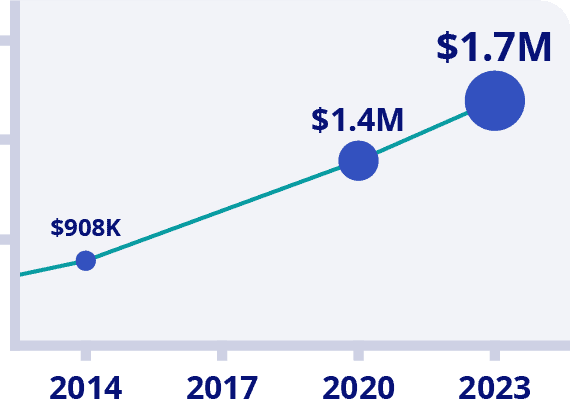
Canadians Believe They Need a $1.7 Million Nest Egg to Retire
Is Your Retirement On Track?
Become your own financial planner with the first ever online retirement course created exclusively for Canadians.
Get $50 Discount With Promo Code MDJ50
*100% Money Back Guarantee
*Data Source: BMO Retirement Survey
How Income Splitting Works
Because the phrase “income splitting” has become fairly well-known in Canada, it has come to encompass a lot of different financial moves. Some of which aren’t really the splitting of income, but are sort of ways for families to pay less tax in some manner. We’re going to go over all of them below.
Generally speaking, income splitting in Canada can be looked at when it comes to RRSP contributions, RRSP/RRIF withdrawals, pensions, loans, trusts, and various types of corporate maneuvering where multiple family members own shares of the same corporation.
We’ve listed all of the income splitting strategies below. Some of these techniques will be more useful if you’re in the accumulation stage of life, while others will be more useful in the decumulation stage once you’re retired. (We go into depth on several of the retirement-specific considerations in the online course on Canadian retirement – which you can check out by clicking here.)
The 13 Best Canadian Income Splitting Strategies
Defined Benefit Pension Income Splitting: Allows retirees to allocate up to 50% of eligible pension income to a spouse, reducing overall tax liability.
CPP Pension Income Splitting: Complete a CPP pension income splitting form and your combined CPP income will be taxed based on contributions made during the years that you lived together.
Defined Contribution Pension Splitting: You can convert your defined contribution pension account into an annuity, and the distributions would be eligible for income splitting. Alternatively, you can convert your defined contribution pension into a LRIF and it would be available for splitting once the account holder turns 65.
RRSP and/or RRIF Withdrawal Splitting: RRSP and RRIF withdrawals qualify for income splitting once the account holder turns 65.
“Simple” Lower-Income Spouse Pays First Strategy – This is the basic idea of getting one spouse to buy household necessities and make the bill payments, freeing up the higher-earning spouse to max out their RRSP deduction. This will allow a bigger RRSP tax refund, and when those investments are withdrawn in retirement, the pension income splitting rules above can be used.
Spousal RRSP Contributions: Contribute to a spouse’s RRSP to balance retirement income levels and minimize combined tax.
Age Amount Tax Credit Transfer: A non-refundable tax credit for Canadians aged 65 and over, which can be transferred to a spouse to reduce the overall tax burden.
Spousal Loans at the Prescribed Rate: Lend money to a spouse at the CRA’s prescribed rate for investment, with the investment income taxed in the lower-income spouse’s hands. See my section below for more details.
Capital Gains Splitting: Sharing the sale profits of assets between spouses to reduce taxes on capital gains. If you purchase assets together (land, shares of a Canadian-controlled private corporation, or pretty much any other asset).
Family Trust: Income can be split among family members by distributing dividends or capital gains through a trust. Setting up a trust can be pricey and comes with understanding a lot of subtlety.
Gifts to a Minor (Child): Parents can gift money to their minor-aged children for investing purposes. If this money is then invested in a tax-efficient ETF (see our list of best ETFs in Canada and look for the Horizons products) that only produces capital gains, it’s unlikely the child will ever pay tax on investment gains as children can realize about $20,000 in capital gains before there would be any tax owning.
Corporate Tax Splitting Strategies for Canadian Business Owners
Pay a Family Member a Salary: Business owners can use the revenue they earn from the business and pay a family member for the work they do for the business. Be careful, as the government has issued strict guidelines on how this has to be done.
This one was popular with a lot of farming and fishing family businesses growing up. It avoids corporate tax altogether and places income in the hands of a child, making it essentially tax-free in most cases.
Dividend Sprinkling and TOSI: Dividend sprinkling is a term that mostly popularized before 2018, and is much more nuanced now. It used to be the case that if someone incorporated their business and made their spouse a shareholder, they could effectively split their income easily each year by simply issuing dividends to the spouse through their own share class or the same share class.
In 2018 the tax on split income (TOSI) rules came into being and the government made this more difficult. A family member needs to own shares of the corporation and work at least 20 hours per week on average before dividends could be paid out. If you’re going to go this route, make sure you and your accountant are on the same page in regards to the TOSI rules.
Spousal Investment Loans
I wanted to take a second to give a little more background on spousal investment loans since I’ve written about this a few times (because I’ve personally been using this strategy for over a decade now).
A spousal investment loan strategy is where a higher-income spouse loans money to the lower-income spouse for the purposes of investing and staying onside with CRA. You would think that one spouse could simply give money to another spouse to invest in a taxable (non-registered) investing account. However, CRA does not allow this with its defined attribution rules.
Essentially, any gains and taxation from those investments would be attributed back to the higher income spouse if the funds are simply gifted from the higher income spouse to the other.
A spousal investment loan is essentially the same as a regular investment loan, except it is one spouse lending money to the other, instead of the bank doing the lending. Providing the loan is put towards a taxable investment account, the interest is tax-deductible by the lower-income spouse, and the investments will face lower taxation.
The higher income spouse would need to report the interest income when filing taxes.
How much is the interest on a spousal loan? The CRA publishes, on a quarterly basis, a prescribed interest rate which is the lowest that can be charged for a spousal loan. As of 2024, the prescribed rate of interest on spousal loans is 6%.
The beauty of the loan is that once it’s issued, the interest rate stays fixed for the term of the loan.
If you have a handle on the other income splitting strategies listed above and still have excess cash to invest in a non-registered account, then a spousal investment loan can make a difference.
Let’s take a look at an example.
- A family with one spouse making $120,000/year in Ontario and the other a stay-at-home spouse earning $0/year. Say the higher income spouse has been saving her/his bonuses over the years and has accumulated $100,000 to loan to the lower-income spouse to start a taxable portfolio.
- If the higher income spouse invests the money in a taxable account, dividends are taxed at 25.38% and capital gains at 21.70%.
- On the other hand, if the lower-income spouse invests the money, the dividends are taxed at -6.86% (yes negative!) and capital gains at 10.03%.
- Building a dividend growth portfolio yielding 4% (and assuming no selling) would result in $4,000 in dividends for the year. The lower-income spouse would pay $0 in tax, while the higher income spouse would have needed to pay $1,015.20 in tax if invested in his/her own investment account. Since the money saved on taxes would be invested in some of Canada’s best dividend stocks, the growing dividends will result in the savings growing by 14% to 20% per year (assuming dividend growth of 5% – 10% per year).
- The savings shown above do not include capital gains tax savings which would result from selling off the portfolio in the future to possibly fund retirement.
- The savings really escalate as the income difference rises and the higher income spouse starts making more than $250,000 per year (putting them in the top marginal tax bracket).
Income Splitting in Canada – FAQ
Conclusion
My family has saved thousands of dollars every year by utilizing tax splitting strategies to lower our Canadian tax bill (both the federal tax bill and provincial tax bill actually).
My wife and I used to be a little more aggressive with the business dividend strategy, but we’ve since scaled that back. We still make use of the RRSP contribution strategies, and the spousal loan strategy. Now that the proscribed rate is significantly higher than before I doubt we’ll do as much in this space, but the good news is that our old proscribed spousal loan rate is locked in.
With our pension income, RRSP, TFSA, and RRSP holdings – as well as with our probable CPP and OAS payments – we’ll basically be able to split our income exactly equally when we retire. This is one of the other arguments for family-unit taxation actually – that retirees already basically have family-unit taxation! Of course, single retirees are often quite upset at the idea that they somehow deserve to pay more tax than fortunate folks who have a partner to income split with.
As with all tax-saving strategies, make sure that you understand the full details before making any aggressive income splitting when you file your annual taxes.
Are You Saving Enough for Retirement?
Canadians Believe They Need a $1.7 Million Nest Egg to Retire
Is Your Retirement On Track?
Become your own financial planner with the first ever online retirement course created exclusively for Canadians.
Get $50 Discount With Promo Code MDJ50
*100% Money Back Guarantee
*Data Source: BMO Retirement Survey










Gains from your primary residence are not taxable. I’m betting this is the best news you’ve heard all day? :)
I have a question related to selling your primary residence? Living in Vancouver housing prices are out of control and we are thinking of cashing in. Our house is in both my wife and my name, although I am the only income earner in the family and have paid for the mortgage over the years. Does this mean that the profits of the house sale are attributed to me or can it be split between my spouse and I.
At what income level for the higher earner or what total family income does it really make sense to have an account or tax specialist look at your situation if you are both employees?
It would seem they would need to find a significant way to reduce your taxes to make it worth it. I make 3x my wife but we have always done our own taxes, etc.
J, I would say keep using online software until your tax situation becomes too complicated to do it yourself.
At what income level for the higher earner or what total family income does it really make sense to have an account or tax specialist look at your situation if you are both employees?
It would seem they would need to find a significant way to reduce your taxes to make it worth it. I make 3x my wife but we have always done our own taxes, etc.
Here is my strategy:
1. Both me and my wife are employed by my corporation, so split the income by simply paying us equaly salaries. Moreover, I keep those salaries low, so that they don’t hit higher tax bracket.
2. The remaining income stays in corporation and is taxed at 16%. I then borrow those funds and I avoid personal income tax in 40% bracket. Eventually I will have to pay them back, but till then I can save on taxes and have more money for investing.
3. When we max out our TFSAs, we can start RRSP and claim tax credit without having paid those taxes in that year, due to huge accumulated contribution room.
4. I also may choose to return the debt and pay those funds as salary in a year of lower income.
Aram, what interest rate do you have to pay to borrow from your corporation? How long can you borrow the funds for?
I can borrow for as long as my corporation allows me to borrow (i.e. indefinitely :) ).
As of interest rate, my accountant has suggested 1% rate. I haven’t paid the interest before, since this is first year I am borrowing from my corp. (going to pay it at the end of fiscal year in July). My understanding is that the rate cannot be less than Central Bank’s overnight rate (currently 0.5%) or the “Bank Rate” (currently 0.75%).
An update:
As my fiscal year ended recently, I had to take care about taxes related to borrowing funds from corporation. Here is what I have learnt from my accountant.
CRA defines a set of “prescribed rates” (see http://www.cra-arc.gc.ca/interestrates/). The one that was of my interest is described in Income Tax paragraph as follows:
“The interest rate used to calculate taxable benefits for employees and shareholders from interest free and low-interest loans will be 1%.”
What does it mean? When I borrow from corporation for lower that this prescribed rate (including interest-free loan), the saved interest becomes taxable benefit and should be reported in my individual tax return. E.g. if $100K is borrowed for 0.7%, then remaining 0.3% ($300) become my taxable benefit and are taxed at whatever tax bracket they fall into. 0.7% interest paid to corporation becomes corporate income and is taxed as such.
If the money are borrowed at 1% or higher, then no taxable benefit is produced for me. Since corporate tax rate is lower than my individual rate, it makes more sense to go with 1+% and pay taxes at corporate rate.
“Keep separate chequing accounts” – What about 2 joint checking accounts with different banks? Each spouse gets paid in one of the 2 accounts (keeping them joint for practicality) so it is fairly easy to track everything.
Will that work with two joint accounts at the same institution (1 checking and 1 savings)
Appreciate your opinion
I make over $100,000 and my husband does not work at all. What can I do regrding income splitting, if we are not retirement age?
Can you provide me with a thorough explanation and recommendation please.
What options are avaialble to me? Ontario/Canada
Hi Everyone,
My spouse and I are 30 years old, I make $160k a year and my spouse is a full time student with no income. We are planning to have children shortly and will continue to be in the same situation for at least the next 3 years where I bring in the income for the family.
I would like to understand what other options are available to split the income for the purpose of reducing the taxes we pay every year?
Can you share feedback on if you think it would be beneficial for me to approproach my employer to pay me as holding company (which I could split with my spouse)? Is this a worthwhile exercise based on the income I make?
What are some of the considerations I would need to consider by not being a full time employee? Would I need to be insured/WSIP/Medical benefits/Disability?
I will paying over $50k in taxes again this year and want to see what other options we have available.
The separate accounts really helps. I’m the saver in the relationship and my significant spends everything. If I didn’t save for us – we definitely wouldn’t have any money at all.
Jordan,
You are correct. An additional set of books and tax filing is required for the trust as well as for the holding company. The income company has to be large enough to generate enough tax savings and defferal options to warrant the additional expense and time that it takes to administer it. I maintain most of the accounting myself and our accountant just does the final tax filing for us, but it still costs around $1,500/year.
There are a couple of reasons I do not retain excess income in the main corporation. The first and most important is capital/liability protection. If something does occur (nothing that I am anticipating, but stuff happens) and the main corporation has to file for bankruptcy or gets hit with a massive lawsuit above our liability insurance limits, the additional retained earnings are protected in the holding company and are still available for personal income purposes. With the exra cash that sits in the holding company, I can then invest it in to an array of income-generating options, including other companies, stocks, bonds, whatever.
When the main corporation has a good year and issues a large dividend, we only have to take (and pay tax on) what we need personally and leave the rest in the holding company to with as it wishes. Then if we have a poor year, we can draw a little extra from the holding company to even out the bumps and reduce our overall tax burden (the tax rate on high income is brutal). Having two years pulling $50k/year each instead of $100k in the first year and $0k in the next will produce a better overall tax rate.
The holding company is also where I am building up funds for my children and when they turn 18, they can receive a “management fee” from the holding company which can go towards tuition, living expenses, etc. As they will be earning little to no other income, most of this money will flow to them tax free. The idea is that I will not give them a single penny personally: Whatever they need (as long as I approve the expense, of course!) will come as a dividend from the holding company, through the trust and in to their hands as low (or no) tax dollars.
Another advantage: Because the trust owns the shares of the income generating corporation, when the day arises that I decide to sell the company and record the capital gain on the shares, because the trust owns it, the trust receives the capital gain. I can then split this capital gain between myself and my children and *each* person can claim up to the $750,000 small business capital gains exemption. That means our family could potentially make a $3,000,000 capital gain on the sale of the company and not have to pay a single penny in tax. Compare that to if I held the shares myself and had to pay capital gains tax on $2,250,000!
Hi Sarlock,
I’m intrigued! This is an interesting way to structure things and I’ve just recently been reading up on trusts in Canada.
I’m assuming your trust makes no money in any given year and thus pays no tax, because any dividends would flow through to the beneficiaries (you and your wife) and taxed in your hands or transferred to the holding company for investment.
I’m wondering if you have any comments for your situation on the 21-year rule, which says the trust needs to dispose of all it’s assets after 21 years. Is your plan to sell your company and payout all the assets before then?
I’m also wondering if this is a good way to go for rental properties. Basically setup a company to own and run the rentals and then either move income to holding company or distribute to beneficiaries.
Last question, For the holding company and income earned (interest, dividends, or capital gains) it would need to pay tax correct? Is that at the business tax rate of 16%?
Thanks for the great comments,
-Todd